Showing posts with label Computer. Show all posts

Monday, July 14, 2025

Still Appreciated by Termites, Though

Your humble blogger went to school before mobile phones, before the Internet, even before there were personal computers (I received my MBA in 1975, one year before Apple was incorporated).

Mine was a generation that did all its research in libraries, and index cards were the pathway to getting information. Today most index card drawers are empty--if they haven't been tossed out--but at Yale they have been repurposed:
If you open one of the hundreds of card catalog drawers that line the south side of the Sterling Memorial Library nave, you won’t find any cards; online catalogs have rendered them obsolete.

But you might find a surprise. Over the past few years, students and other visitors to the library have created a tradition of leaving notes in the drawers to be found by others. Some are inspirational (“keep chasing your dreams, but don’t be afraid if the path to your dream changes”) and some are aspirational (“2016. In eight years, I’ll return as a Yale student”), and they are written in many languages. It’s a delightful adaptive reuse: hardware that was once used to organize the search for knowledge now holds the promise of serendipity.
Now if I can just find a use for my slide rule....

Thursday, April 03, 2025

Just Nibbling

My entry points for four stocks
Since the stock market began dropping in February I've been nibbling at stocks that I formerly believed were too expensive relative to their growth prospects. Of course, I had not anticipated the stock market rout from the Trump tariffs announced yesterday, in which case I have bought too soon. (Analysts expect more declines as other countries, especially China, respond with "retaliatory" tariffs.)

I've invested less than 2% of my retirement monies so far and will close my eyes and buy more if declines continue. I am still confident that stock prices will be higher in a year, and though they were not bought at the bottom I will be glad I nibbled.

Monday, October 14, 2024

Procrastination Hits the Immovable Deadline

Your humble blogger spent most of Sunday night and Monday morning working on his 2023 income taxes. While there are some justifiable reasons for his procrastination, it's hard to utter with a straight face that he couldn't have spared some time in the six months since April 15th to finish the task. October 15th is the drop-dead due date for filing.

But that's water under the bridge. I completed the input forms and submitted them to the processor. The preliminary run came back this afternoon, and there was a $10,000 error that should be easily fixable. Tomorrow I'll phone in the correction, get back the final run in the afternoon and drop it off at the Post Office by 5 p.m. Easy as pie.

Friday, July 19, 2024

More Dependence Means More Vulnerability

The blue screen of death (SFGate)
The Microsoft Windows "blue screen of death" appeared on many thousands of computers worldwide and disrupted operations of a broad swath of major industries, including airlines, banks, and hospitals. The culprit wasn't a hacker but a software update issued by the cybersecurity firm CrowdStrike.
The outage, one of the most momentous in recent memory, crippled computers worldwide and drove home the brittleness of the interlaced global software systems that we rely on.

Triggered by an errant software update from the cybersecurity company CrowdStrike , the disruption spread as most people on the U.S. East Coast were asleep and those in Asia were starting their days.

Over the course of less than 80 minutes before CrowdStrike stopped it, the update sailed into Microsoft Windows-based computers worldwide, turning corporate laptops into unusable bricks and paralyzing operations at restaurants, media companies and other businesses. U.S. 911 call centers were disrupted, Amazon.com employees’ corporate email system went on the fritz, and tens of thousands of global flights were delayed or canceled.

“In my 30-year technical career, this is by far the biggest impact I’ve ever seen,” said B.J. Moore, chief information officer for the Renton, Wash.-based healthcare system Providence, whose hospitals struggled to access patient records, perform surgeries and conduct CT scans.

Fixing the problem involved technical steps that confounded many users who aren’t tech-savvy. Some corporate IT departments were still working to unfreeze computer systems late on Friday. CrowdStrike said the outage isn’t a cyberattack.
Unfortunately, restarting computers and removing the offending software had to be done manually---skills well within the capability of Windows users 30 years ago but unfortunately lacking in the majority of users today. (An analogy is being able to understand the basic workings of an automobile and effecting some minor repairs versus being totally helpless if anything should go wrong with one's car.)
IT teams often can fix problems on employees’ computers using remote-access software—tools that became especially common during the work-from-home boom of the pandemic. But for laptops and other PCs that approach doesn’t work if the machines can’t restart. For those systems, CrowdStrike’s fix had to be done in person—either by a tech-support person on site, or by a regular employee trying to apply the instructions.
Another aspect of resilience is being able to perform one's basic job functions if the computers--which after all were once regarded as just a tool--go down.

Speaking as one who used to close the books, make the payroll, invoice the customers, and pay the bills with an adding machine, a pen, and a typewriter, I am appalled by accountants who lack basic knowledge of the functioning of accounting systems.

Maybe this CrowdStrike incident will be a wake-up call to companies who don't want to risk their existence on the computers always working.

Tuesday, July 02, 2024

Jiggling Too Much Can Get You Fired

I took early retirement in the oughts when people worked in the office full time.

Workers took computer breaks by web surfing, online shopping, and playing Solitaire. As long as we didn't engage in these activities too long or too often--there weren't specific numerical criteria--our employer didn't mind. The protocols didn't have to be spelled out, and for the most part it just took a passing manager's raised eyebrow to show where the line was.

The phenomenon of working from home has resulted in the formalization of employee monitoring. Also, technological advances have accelerated the "arms race" between employees who devise new ways to goof off and employers who measure productivity. [bold added]
It’s getting harder to outsmart the digital minders at work.

The rise of remote work and, in turn, employee-monitoring software sparked a boom in mouse and keyboard jigglers and other hacks to help staffers fake computer activity—often so they can step away to do laundry or a school pickup.

Now some companies are cracking down on the subterfuge, deploying tools that can better spot the phony busywork.

The latest salvo in this productivity-tracking arms race came in a recent regulatory filing from Wells Fargo. In the disclosure, first reported on by Bloomberg News, the bank said it had fired more than a dozen employees in its wealth and investment management unit for allegedly simulating keyboard activity to create the “impression of active work.”
Here's an ad for a mouse jiggler, a device that didn't exist back in my day.

Sunday, June 09, 2024

Spreading the Gospel of Net Present Value

Your humble blogger studied accounting and finance before the personal computer was invented.

The only electronic devices that we brought to class were calculators that performed basic arithmetic. And so it was that we labored over present value/future value problems, pencilling out intermediate solutions so we at least could get partial credit from the proctor.

After learning how the basic formulas were derived, we were taught how to use books of tables to bypass much of the repetitive drudgery in financial calculations. The future-value table below is from McGraw-Hill.


Until financial calculators and PC's came on the scene, such tables were used in finance for 3½ centuries(!) These tables seem extraordinarily crude today, but when they were first published in the 1600's, it sparked the widespread acceptance of "discounting" as an alternative payment. It wasn't businessmen or bankers who spread the word, but the Anglican church. [bold added]
In the early 1600s, the officials running Durham Cathedral, in England, had serious financial problems. Soaring prices had raised expenses. Most cathedral income came from renting land to tenant farmers, who had long leases so officials could not easily raise the rent. Instead, church leaders started charging periodic fees, but these often made tenants furious. And the 1600s, a time of religious schism, was not the moment to alienate church members.

Interest-calculation book from 1700.
But in 1626, Durham officials found a formula for fees that tenants would accept. If tenant farmers paid a fee equal to one year’s net value of the land, it earned them a seven-year lease. A fee equal to 7.75 years of net value earned a 21-year lease.

This was a form of discounting, the now-common technique for evaluating the present and future value of money by assuming a certain rate of return on that money. The Durham officials likely got their numbers from new books of discounting tables. Volumes like this had never existed before, but suddenly local church officials were applying the technique up and down England.
Spreading the "Gospel of Net Present Value" was one of the most important developments in capitalism. With apologies to the bard,
Neither a borrower or a lender be
But if you are either
Be mindful of the NPV.

Wednesday, March 20, 2024

Generative AI: Some Fruit are Poisoned

(WSJ image)
Data integrity, aka garbage-in, garbage-out, has been a problem with computing since its inception. With the rise of artificial intelligence and our projected future dependence on AI, the phenomenon has been given a frightening name: data poisoning. [bold added]
This is when malicious actors insert incorrect or misleading information into the data used to train an AI model with the aim of spreading misinformation, undermining the chatbot’s functionality or getting it to do something bad, such as share sensitive information.

While data poisoning is a concern with all types of machine-learning algorithms, some researchers say generative AI models could be particularly vulnerable because they must ingest vast amounts of text, imagery and other data from the public internet to gain the knowledge they need to create something on their own.

Researchers say this reliance on a vast number of data sources from the open web—rather than curated, locked-down data sets, which are harder for hackers to penetrate—could make it difficult to spot and eliminate poisoned data, only a small amount of which is needed to affect AI’s outputs.
In 2023 lawyers were caught citing fake cases in legal briefs produced by artificial intelligence (ChatGPT).

In recent months Google's Gemini image generator, which clearly had racial diversity as a bedrock principle, produced images that were the object of ridicule:


This latter example is not so much "data poisoning" as it is a matter of algorithmic over-ride of good data.

Artificial intelligence is still in its early stages, but already it has given users reasons to distrust its output. The lazy or the indifferent won't bother with performing checks, so I'd bet that we never get rid of the poison in the system.

Friday, March 01, 2024

New Name for an Old Problem

Legacy systems guy (BairesDev photo)
"Technical Debt":
an accumulation of quick fixes and outdated systems never intended for their current use, all of which are badly in need of updating.

Technical debt manifests in myriad ways, from system failures and slower innovation, to security breaches...

This technical debt would require $1.52 trillion to fix, and costs the U.S. $2.41 trillion a year in cybersecurity and operational failures, failed development projects, and maintenance of outdated systems, according to a 2022 report by a software industry-funded nonprofit.
Let's face it: management is highly incentivized to come out with new products and features, not to spend resources on making old software more secure or efficient. If management is lucky, potential weaknesses will never become actual weaknesses and see the light of day.

There's never been a better time to start a business when the old competitors are burdened by legacy software and customers are stuck doing things the old way,

Tuesday, May 24, 2022

E-Mails: a Curse and a Blessing

(Universal scribbler)
I entered the work force in an era when it was considered mandatory to respond to every phone call and letter request. The reasons were intuitively obvious: a response could lead to a sale, you're representing your company which has the highest standard of etiquette, treat others how you wish to be treated, etc.

Then telemarketing and email happened.

Re phone calls, I initially spent too much time on the phone listening to sales pitches. Worse, I fell for a few of them and was usually disappointed by paying too much for products that fell shy of promises. Now every call from a number that I don't recognize goes to voicemail, and even within that group I ignore nine out of ten messages, which are, no surprise, from telemarketers.

I receive over a hundred emails a day. The majority go to the aol account that was originated in the days of floppy disks and dial-up modems. The yahoo and google mailboxes were created for specific purposes and capture the remaining traffic. The only vestige of traditional etiquette is that I always open and answer emails from individuals whom I know and apologize to if their message goes unanswered because it got buried or was sent to the junk folder.

The sea of communications from people trying to reach others to serve their own purposes has become a modern burden:
So many of us spend our days ruled by email: constantly refreshing, wading through detritus, paralyzed by the pressure of crafting a reply to the one note that actually matters. The moment we reach inbox zero, and few of us ever do, the ding sounds again.
Consultant Greg McKeown's suggestion:
Start your day by writing a list of priorities on a piece of paper. Block two half-hour slots on your calendar to really deal with your email—rather than scrolling through constantly—and ignore it the rest of the time, he says.
Regardless of the tech tools at one's disposal, one must spend 30-60 minutes a day on email in order not to lose control of the inboxes. E-mail supposedly has improved our lives immensely, but it sure has us stressing while sucking up our time.

Monday, February 28, 2022

Bank of America: Not Optimal

Asterisks hide passwords from users, too
It's possible to have too much security on an internet bank account.

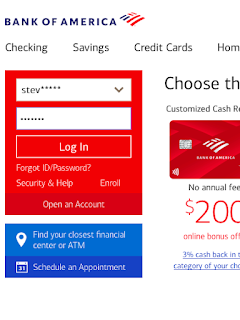
As many websites do, Bank of America's replaces password characters with asterisks (*) shortly after the characters are typed in. Because passwords now have numbers, special characters, and both lower-case and capital letters, the probability of a mistake has increased as passwords have become lengthier. But one can't see what has been typed.

Unlike all my other financial and shopping accounts, Bank of America does not have a "show" or "eye"(👁) button that allows the user to turn off the asterisks.

After 3 password failures, Bank of America locks the account. And yes, that has happened to me, and I had to call the bank and spend an hour satisfying the person at the other end that I was not a scammer. The bank had me at its mercy, because the fee structure almost forces retail customers to cancel paper statements in favor of electronic access, which makes it impossible to check or reconcile with a locked account.

I've also gotten to the third and final login attempt several times, when my aging arthritic hands shook with trepidation (okay, some poetic license here).

Bank of America does allow FaceID to login on the iPhone, but the user can do it on only one account--I was locked out of one of the other two which required a typed password.

All the above is a protracted preface to a simulation that showed
that five was actually the optimal number—the sweet spot we were hoping to identify. When allowing five attempts, the number of lockouts were minimized, with no adverse effect on security.
Bank of America would make me a happier customer if: 1) the Password field had a "show" option; 2) the account would lock after the fifth attempt, not the third; 3) iPhone FaceID would work on every account, not just one. I would like all of those changes, but I am not expecting any.

Come to think of it, why am I staying with them?

Monday, January 31, 2022

IRS: It Can't Even Get the Basics Right

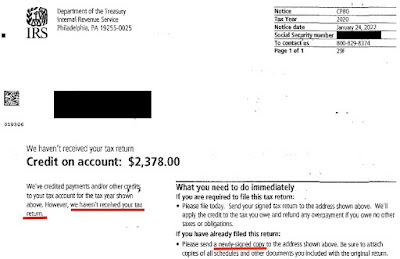
Any notice received from the IRS is upsetting, and this one was no exception. Form CP80, received last week, said that our account had a $2,378 credit and that our 2020 income tax return had not been filed.

We had mailed the return timely on April 14, 2021, along with a check for $2,378 and Form 1040-V, the payment voucher.

Everything was in the same envelope. Obviously they cashed the check and knew it was ours. How could the return have been "lost"?

The above question is sarcastic, dear reader. My mother's 2019 and 2020 tax refunds still have not been received, and getting through to talk to a live person who knows what he or she is doing is impossible.

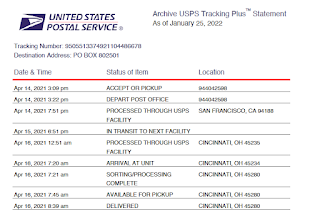
Tracking info to Cincinnati
And I was certainly not going to accede to the CP80 request to send them another copy with a 2022 signature date. It would go to Philadelphia while the original had gone to Cincinnati. They might think the copy was an Amended Return and accuse me of not filling out a 1040-X.

So I did what we used to do in the old days: compose a politely worded business letter, free of tone, especially sarcasm.

The letter explained that the return was mailed at the Foster City Post Office and, according to the enclosed USPS tracking record, was received in Cincinnati on April 16th. Your move, IRS.

Note: the Washington Post reports that we are in the same boat with an unspecified number of taxpayers. [bold added]
As of Dec. 31, the IRS had 6 million unprocessed individual returns, including returns for the 2020 tax year...

Many taxpayers have been receiving what’s called a “CP80 Notice.” Taxpayers who had already filed a return are told to send a newly signed copy to the address listed in the notice.

Obviously, this direction has alarmed those taxpayers who conclude their original returns are probably in a pile in some IRS office waiting to be processed. Wouldn’t mailing another return just cause more confusion?

Saturday, November 13, 2021

Zillow: Too Early, But They'll be Back

(Photo from Star Tribune)/td>
We've been regular users of Zillow since 2016. It has a trove of real estate information, useful for checking on the value of one's own home, the cost of homes in areas that we might want to move to, or market rents in every zip code.

However, one would be crazy to make a purchasing decision based solely on Zillow's algorithms. One can't know the "feel" of a house or a neighborhood, or whether the roof might leak or the pipes need replacing, without a viewing by a real human being and/or inspector.

Zillow thought that its valuation algorithm could be relied on to buy houses en masse to build a house-flipping enterprise. Now it's getting out of the business.
Zillow Group Inc. reached a deal to sell about 2,000 homes from its ill-fated house-flipping program, the company’s biggest bulk sale as it starts unloading thousands of homes and terminates the business...

Zillow’s home-flipping practice involved buying homes, lightly renovating them and then selling them quickly, making money on transaction fees and home-price appreciation. The company and other iBuyers used an algorithm to make home-price estimates and determine what to pay home sellers.

Zillow said last week that it was shutting down the business because it couldn’t accurately predict future home prices and was losing too much money. The company expects to record losses of more than $500 million from home-flipping by the end of this year and is laying off a quarter of its staff.
I confess to feeling a bit of schadenfreude that a successful (up to now) tech company got a little too big for its britches, but I think they were on the right track.

The algorithm needed to incorporate additional data--the kind of data that's hard to obtain--and Zillow needed to test the program on a much smaller scale before it bet the farm. They had the courage to pull the plug before it took down the company, and it's likely they'll be back some day, probably with a "money" partner that will provide the risk capital while Zillow provided the smarts.

Note: here we know all about being too early. Foster City was the headquarters of Webvan, the highly-touted grocery delivery business that failed nearly 20 years ago.

Monday, June 07, 2021

Before You Can Simulate the Universe, You Have to Map It

Perlmutter is named after Berkeley Lab’s Nobel
Prize-winning astrophysicist Saul Perlmutter.(WSJ)
A powerful supercomputer will use artificial intelligence to map the universe in 3-D:
The real power of Perlmutter, Dr. Bailey said, will come into play as the data starts to build up and researchers begin creating maps to judge their progress. Processing a year’s worth of the data, for example, would take weeks with an existing supercomputer, Dr. Bailey said.

However, Perlmutter—which will be shared with other research teams working on other scientific projects—should be able to accomplish the task in a matter of days...

HPE says the NERSC computer has a peak AI performance, or speed, of almost four “AI exaflops,” which the company said would make the machine the fastest AI supercomputer to date. An AI exaflop is roughly mathematically equivalent to performing 250 petaflops per second, it said. A petaflop is 1,000 trillion, or one quadrillion, operations per second.
Today's smartphone is more powerful than all of NASA's computers used for the moon landing. Perlmutter will seem as primitive to data scientists 50 years from now as NASA's computers appear to us today.

Given the speed that computing power is progressing, we may soon have the power to populate this 3-D map of the universe with beings who think they are "conscious." Of course, that doesn't have to mean anything about our world.

Monday, April 05, 2021

A Little More Humility

Philipp Strack
Yale Professor of Computer Science and Economics Philipp Strack on his research into prejudice: [bold added]
Recently I’ve been researching how to explain prejudice in society. In a working paper with Paul Heidhues and Botond Köszegi, we explore the idea that overestimating yourself can generate prejudice. Suppose I think I’m great, even though I’m not; when I look at my outcomes in life, I am unhappy and think I deserve more. To explain why I’m not receiving what I think I deserve, I may believe there is discrimination against me. This leads me to overestimate discrimination against the groups I’m a member of, while underestimating discrimination against groups with which I compete.

This can create prejudice and specific patterns in people’s beliefs. For example, if you ask Black and white people which group is discriminated against, there are huge gaps between the perception of different groups. The same is true for men and women. But standard theories of discrimination — that people discriminate because they don’t like certain groups, or believe them to be less qualified — don’t predict these large differences in beliefs about discrimination across groups.
While there have been voluminous studies on discrimination and prejudice, this is the first time I have read about research into how an individual's mis-apprehension--specifically he thinks he is better than he is--of his own abilities exacerbates prejudice against other groups.

A little more humility is in order, not only from an ethical and philosophical standpoint, but because it will lessen intergroup conflict.

Monday, March 08, 2021

IRS Failure: Disappointing But Easily Foreseeable

Mom's 2019 status on 3/6/21.
Some government entities, such as Foster City where I live, seem to be functioning well, but the Internal Revenue Service, long the bane of nearly everyone, seems to be cracking up.

The IRS can't even perform its basic function of processing returns. One year after I mailed in Mom's 2019 tax return, the IRS2GO app (right) continues to report that the return is still being processed. From February 18, 2021: [bold added]
A group of Republicans on the House Ways and Means Oversight Subcommittee sent a letter Wednesday to IRS Commissioner Charles Rettig complaining about the backlog of approximately 11 million unprocessed tax returns from the 2019 tax year. The backlog of unprocessed mail from the pandemic has created a ripple effect that’s continuing into this year’s tax-filing season, which opened last Friday.

The problem isn’t only with the mail, which piled up last year in trailers outside IRS facilities until IRS employees could return to their offices and open it. While most of the millions of pieces of mail have reportedly been opened, much of it remains unprocessed. That’s causing headaches for taxpayers and tax professionals alike, who are coping with past due notices sent automatically by IRS computer systems, even when payments were sent months ago, according to the investigative news site ProPublica. Taxpayers have had trouble with receiving their Economic Impact Payments from last year and are also having trouble reaching the IRS by phone this year, with the agency continuing to be understaffed due to the pandemic and budget cuts in past years.
Some have tried to blame Republican Congressional representatives for underfunding the Service, and indeed that is one reason the IRS is failing.

But in my humble opinion the primary problem is that Congress has assigned new responsibilities to the IRS that it was never designed to do, such as administer penalties and credits for the Affordable Care Act, aka Obamacare, and then to dole out stimulus payments ("refundable tax credits") resulting from pandemic legislation.

When an organization is being strained, one does not pile on additional tasks without a great deal of planning. Any experienced manager knows that you can't just throw money at the situation, you have to lay out the new requirements, figure out how they can fit in with the current systems, design and test the add-ons before widespread adoption, and then train the staff.

Of course, the COVID-19 response shut down the offices for months, just when a 24/7 work schedule was necessary to give the IRS even a chance to fulfill its new duties. Large tech companies, who have people who are accustomed to working around the clock to develop new products and services, would have had a prayer. But the IRS, or any other government agency? Not a chance.

Friday, February 19, 2021

Surreal ID

For your mild amusement:

DMV Mistakenly Issues Driver’s License With Photo Of Woman Wearing Face Mask
Lesley Pilgrim received the ID in the mail with a greeting reading, “Congratulations, enclosed is your newly designed California driver license.”

“I knew the picture was not going to be good because license pictures are never good, but I did not expect the picture to be with my mask on,” Pilgrim said...

Lesley Pilgrim in real life
When it was her turn, the DMV employee took two photos, the first still wearing her mask, the second without it.

“I sign it and I then I go home, and unfortunately he had used my picture with my mask on, and that’s what showed up on my Real ID,” Pilgrim said.
Since the DMV took with- and without photos, one would think that they could just reissue her a correct Real ID, but they're making Ms. Pilgrim come in again.

Note 1: we drove to Roseville two years ago to get the Real ID because we anticipated doing a lot of traveling in late 2020 and beyond. Hah!

Note 2 - the DMV has more serious problems than using the wrong photo: Security breach at DMV contractor may have exposed personal information of millions of California drivers

Tuesday, December 01, 2020

Beware the (Home) Office Turtle

Office turtle with ironing board (WSJ image)
Working from home didn't require special accommodations initially, but we're entering month 10 of shelter-in-place. If this is indeed the new normal, employees and employers are trying to figure out how to adapt to WFH for the long haul.
Those at home are often plunking down in broken chairs, using desks that are too shallow or even experiencing foot pain from walking around barefoot. Or worse, they’re just not getting up at all.

“We need to get people moving,” says Brian McEnaney, an ergonomist at Sunnyvale, Calif.-based NetApp, whose 10,000 employees are set to work remotely until at least July. Before the pandemic, Mr. McEnaney’s team received requests for help from about 10 workers a week. That’s ballooned to more than 100. The technology company has rolled out online classes on recovery breaks—short midwork stretching sessions that focus on gentle motions and deep breathing—as well as “ergonomic open office hours,” where employees can drop in with questions and concerns.

Mr. McEnaney says you don’t need to get fancy to correct many problems. Simple hacks, like sitting on a pillow to raise your body, can help. He also implores workers to avoid rounding their spines and pushing their necks out, an injury-prone position he calls the Office Turtle. Back at the actual office, he used to employ a 6-foot cutout of a turtle to get his message across.
Your humble semi-retired blogger spends an average of four hours a day on the laptop: personal finance, charity work, writing, continuing professional education, and purposeless web-surfing--not necessarily in that order--comprise the vast bulk of the activity.

I do have desks and tables, but moving from the couch would be an admission that life has turned serious again. And it's really not that serious, not until the orthopedist tells me that I look like a turtle.

Wednesday, November 11, 2020

MacBook Air Life Extension

Last month the touchpad on the 6 year-old MacBook Air became catatonic. The cursor would alternately freeze or skitter across the screen in random directions. Worse, it would open multiple applications and documents, and I had to press the power button to shut down the computer manually.

As the smart people recommend, I zapped the PRAM and reset the SMC but the dysfunction recurred after a few minutes.

Was it time to buy one of the new Macs that were announced today?

Maybe, but just one more thing.....to try.

I wiped out the disk--something that I used to do every six months on Windows machines--then reinstalled everything (of course, this was after performing a back-up to a hard disk). Restoring the Mac to factory settings has the benefit of eliminating all the stray fragments of deleted files that build up over time.

The half a day that it took to clean and reinstall the programs and data was worth the effort.

The touchpad functions like new, and an additional 10GB space was freed up on the solid state drive as a bonus.

The just-announced Macs have switched from Intel-based microprocessors (the speed of the MacBook Air's i7 is perfectly adequate for your humble blogger) to Apple's self-designed M1 microschip (3.5x faster!).

Buying a new MacBook Air was tempting, but thanks to this life-extension project, I'll wait for the M2.

Wednesday, September 16, 2020

The Last Mile is the Hardest

Alan Turing (biography.com)
Alan Turing, one of the founders of computer science, proposed in 1950 a way of distinguishing human from artificial intelligence in what has become known as the Turing Test. Though the Test is highly structured (typewritten communication in a laboratory with a human being and a computer), it has been popularly simplified to the question of whether one can tell if one is talking to a computer or a live person.

Alan Turing predicted that by the year 2000 a computer would have a 30% chance of fooling its interlocutor. We're a few years behind schedule, but his prediction has been fulfilled:
GPT-3 can work out analogy questions from the old SAT with better results than the average college applicant. It can generate news articles that readers may have trouble distinguishing from human-written ones.

And it can do tasks its creators never thought about. Beta testers in recent weeks have found that it can complete a half-written investment memo, produce stories and letters written in the style of famous people, generate business ideas and even write certain kinds of software code based on a plain-English description of the desired software. OpenAI has announced that after the test period, GPT-3 will be released as a commercial product.
GPT-3 (Generative Pre-trained Transformer, third generation) seems to "understand" fairly complex texts. Example:
(WSJ image)
I copied and pasted the first paragraph of George Washington’s 1796 Farewell Address: “The period for a new election of a citizen to administer the executive government of the United States being not far distant, and the time actually arrived when your thoughts must be employed in designating the person who is to be clothed with that important trust, it appears to me proper, especially as it may conduce to a more distinct expression of the public voice, that I should now apprise you of the resolution I have formed, to decline being considered among the number of those out of whom a choice is to be made.”

GPT-3 gave me its translation: “I am not going to run for president.” Take a bow, HAL 9000.
Nowhere in the Washington quote does the word "president" appear. Scary.

But the GPT-3 isn't perfect.
Yet when I gave it the famous first line of Jane Austen’s “Pride and Prejudice”—“It is a truth universally acknowledged, that a single man in possession of a good fortune, must be in want of a wife”—the AI was puzzling to watch. In the course of my first four tries, a few of its answers were sort of in the ballpark without being quite right. (For instance, “A man with a lot of money must be looking for a wife.”) Then on my fifth try, it seemed to crack up: “It is a truth universally acknowledged, that a single man with a good fortune must be in want of a wife, because men are very vain and they want to be seen as wealthy, and women are very greedy and they want to be seen as beautiful.”
I took satisfaction from knowing that the artificial super-intelligence had as much trouble with Jane Austen as I did. It is a truth universally acknowledged that female communications are still too complicated for the presumptively male programmers to figure out. Eventually, the AI suffered the fate of male brains: "it seemed to crack up."

Thursday, February 27, 2020

Preventive Purchase

2009: Lenovo IdeaPad
I bought a "Netbook" computer 11 years ago. The operating system was Windows, it had no hard disk and hence no file storage (at the time few consumers used the cloud). I used it primarily for web-surfing at public WiFi locations.

The Lenovo IdeaPad S10 Netbook cost $350. It was a pleasure to use--netbooks were much lighter compared to laptops with hard drives--but not durable. It broke after two years.

2020: Acer Chromebook
After an 11-year hiatus I bought my second websurfing-only computer, an Acer Chromebook 14. It's superior to the old IdeaPad--for example as the name implies, it has a 14" HD display--,but the functionality is basically the same. The operating system is Google's Chrome, not Microsoft's Windows. The price was right--$175 before tax--demonstrating the workings of Moore's Law.

I have other devices that can be used to websurf, but the main reason for the purchase was indeed different from 2009: there's been a rash of thefts of laptops while people are using them. I can't afford to lose one with (backed-up) sensitive information, but if thieves need a Chromebook that badly they can have it with no resistance.

In most ways the world is better, but in a few it's become worse.