Showing posts with label Retail. Show all posts

Tuesday, January 21, 2025

Good Things in Small Packages

Your humble boomer-blogger is embarrassed that his first three guesses about the subject of this article were wrong:

Small joints have become big business in California

Is the piece about 1) restaurants/bars; 2) the place where bones of the body meet; 3) prison? Nope, it's marijuana. [bold added]
Big men don't need big joints (SFGate)
Small joints have become big business in California. The state’s biggest pot brands have followed suit, recognizing the reality that many customers don’t actually want that much weed in one session. Micro joints “have exploded” in popularity in the last few years according to Eli Melrod, the CEO and co-founder of the dispensary chain Solful. He said his company is now working on releasing its own version of the bite-sized blunts under the house brand.

Micro joint fans say their benefits are plentiful. The smaller portion allows them to easily be finished in one sitting, as opposed to a larger joint that might require you to put it out and carry around a smelly half-smoked joint in your pocket. Modern pot is extremely potent, so many cannabis users simply don’t want to smoke a full gram joint...

[Chad] Heschong said the only small joint he had previously seen was a half gram, but he took the concept even further by releasing a joint that’s just 0.25 gram. Selfies sells the joints in two-packs, 12-packs and even 28-packs, which he said have become very popular for weddings and other parties where people want to share cannabis with a big group.
At our wedding in the last century we just served alcohol and food. Then, as now. I lacked imagination.

Sunday, June 16, 2024

Happy Father's Day

Paia, Maui boy makes good.
On this Father's Day I thought of my father-in-law, who passed away 23 years ago, and his fondness for a good deal.

When Fred visited us in Fremont in 1976, he chanced upon a small supermarket that called itself "Canned Foods." They sold canned, packaged, and frozen goods that were produced by recognized manufacturers but were priced at a huge discount from comparable products; this was because the items were discontinued, overstocked by retailers, or new-product introductions that failed.

Over the next 25 years his and our station in life improved, but he would always stop at Canned Foods (renamed Grocery Outlet in 1987) to see what bargains he could find. We enjoyed having my in-laws visit because they always cooked, cleaned, gardened, and baby-sat for us; the only downside was that we had to drink a lot of $2 wine and eat a lot of 59¢ canned chile from Grocery Outlet.

Scenes from the Oakland Grocery Outlet (SFGate)
In 2024 Grocery Outlet is a lifeline for inflation-embattled consumers. Its business is booming.
While Grocery Outlet provides an unorthodox shopping experience, those willing to take a chance on it have the opportunity to not only save hundreds of dollars but also bring home anything from pantry staples to high-end organic oddities. And as prices continue to rise and pandemic-era assistance programs grind to a halt, discount retailers are becoming more important than ever for millions of Americans who are struggling to put dinner on the table.

Originally a military surplus, Grocery Outlet was founded in San Francisco in 1946 by Jim Read. Though it was once a modest outpost, by 1973, the company signed its first independent operator agreement and began slowly introducing refrigerated goods, meat and produce over the next three decades. Once Grocery Outlet reached $1 billion in sales in 2011, it expanded its presence to the East Coast and Southern California shortly after...

Now, it has over 500 locations that serve millions of customers each week, easily making it one of the largest “extreme discount” stores of its kind in the state. Hundreds of them are concentrated in Northern and Southern California. In its 2023 fiscal year, Grocery Outlet unveiled 28 new locations, and though it has a presence in Oregon and Washington, more outposts are slated to open as far east as Ohio, Maryland and Philadelphia...

The way it works: When a company is suddenly left with 20,000 extra cases of frozen entrees, for instance, it’ll summon Grocery Outlet’s buying team, which purchases them at a reduced price and resells them to customers at a steep discount. Often, this will happen when a product’s packaging changes or a company can’t get rid of enough inventory by the expiration date. Once these items sell out, [CEO R.J.] Sheedy explained, chances are, they won’t return.
My last trip to the Grocery Outlet in Redwood City, 8 miles away, was to fill a box for a local food charity pre-COVID. Now that charities are welcoming gifts-in-kind again, not just monetary donations, I am going to pay another visit.

Wednesday, June 12, 2024

Mindful Chewing

I'm an infrequent gum chewer. I buy a pack before boarding a plane, when needing a breath freshener, or am feeling some stress and need something to chew on.

"Mindfulness" ad is not meant for boomers.
Mars Wrigley has come to the realization that we boomers aren't the demographic that will lead a chewing-gum revival and have designed a new marketing campaign [bold added]
that jettisons typical category promises such as fresh breath or great taste.

Mars is instead promoting its Orbit and Extra gum brands through the lens of mindfulness, purporting that mastication can silence anxious thoughts, improve focus or boost confidence. “Quiet your mind mouth with Extra Gum,” one ad concludes...

commercials in other countries lean more obviously into the idea of mental wellness with surrealist images of mouths in the middle of people’s foreheads.
Surrealist images of mouths evoke a negative reaction in this consumer--is that psychologically revealing?--but these ads have no influence on my gum-purchasing decision anyway.

Having no clue to what the TikTok generation will respond to, I wish Mars Wrigley--two venerable brand names--success.

Tuesday, February 27, 2024

Macy's on Union Square

After Macy's bought the I Magnin store (white building center left)
in 1994 it had the entire south side of Union Square (Chron photo)
Nearly a year ago the belief that San Francisco was in an inescapable doom loop became widespread. In seeming confirmation a month later Nordstrom, the anchor store of the San Francisco Centre, announced that it would close.

But subsequent events bred hope. In the fall the City banished homeless encampments near several major conventions and heavily patrolled the areas so that conventioneers wouldn't be victimized. Last week there were reports that tech employers were hiring again, and that some investors were buying at what they saw as the bottom of this real estate cycle.

However, trend lines never move smoothly in one direction. Today San Francisco received retail news that was worse than Nordstrom's departure.
Macy’s will close its massive flagship store in Union Square, San Francisco officials said Tuesday, a major setback to the city’s premier shopping district and its larger downtown recovery efforts during an election year.

The store will remain open until the company finds a buyer for the property, Mayor London Breed said in a statement Tuesday morning. The Chronicle has learned that the store will remain open until at least 2025...

Macy’s massive, 400,000-square-foot Union Square store — which spans nearly an entire block fronting Geary Street between Powell and Stockton streets — is the company’s last outpost in San Francisco. Macy’s presence in the city dates to 1947 and its store is a landmark on the south side of Union Square. Its loss marks one of the biggest retail closures the city has ever seen, on top of the loss of a nearby Nordstrom that had been open since 1988 and dozens of smaller retailers since the pandemic.
Union Square dates back to San Francisco's founding and is the unofficial heart of the City. Macy's is the dominant retailer of Union Square. If its building goes dark, it will deal a severe blow to Union Square and the revitalization of San Francisco.

Wednesday, September 27, 2023

Target Throws in the Towel

Target announced the closure of three (3) Bay Area stores:
Target announced Tuesday that it planned to close three of its Bay Area stores next month, citing “theft and organized retail crime” that was “threatening the safety of our team and guests, and contributing to unsustainable business performance,” the company said in a statement.

On Oct. 21, the company said it would close its San Francisco store on Folsom and 13th streets. In Oakland, Target will close its store on Broadway and 27th Street, its only location in the city, according to its website. The Target in Pittsburg on Century Boulevard is also closing.

Thirty-two Target stores will remain open in the Bay Area, the company said.
Before Target conceded defeat, it "invested in various security measures, including hiring guards, locking up merchandise and training employees in self-protection and de-escalation." However, the frequency and severity of crime in San Francisco, Oakland, and Pittsburg (pop. 77,000) forced Target to throw in the towel.

Nothing is locked down in the San Mateo Target
We go to the Target Store in San Mateo 2-3 times a month. It's less than two miles from our house, and we are regular users of its pharmacy and optical department.

Nothing is locked down, not even the alcohol, and shopping is a pleasant, safe experience.

It's puzzling why anyone who can afford to move out of the city hasn't done so already.

Thursday, August 24, 2023

The Limit of Advance Planning

Costco members buck the trend toward last-minute purchasing. Easter and Halloween products go on sale 1-2 months in advance, and the customers snap them up.

However, a full Christmas display (except for trees) four months ahead? That's pushing the limit of advance planning, and no, I didn't buy anything.

Wednesday, May 03, 2023

Slow to Build, Quick to Destroy

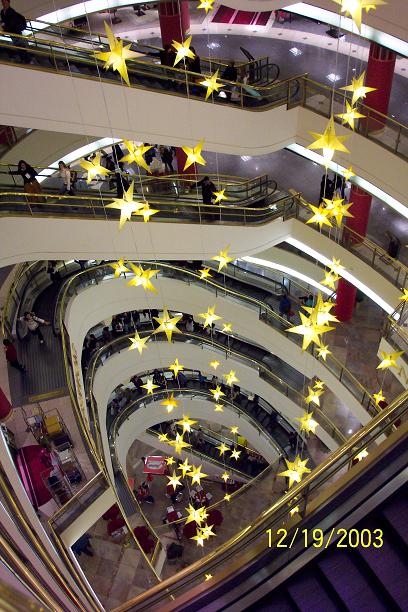
2003: Nordstrom's levels during the holiday season
20 years ago another building boom, fueled by tech, was about to start in San Francisco. (For historical perspective Google, 40 miles to the south, would have its IPO the following year and Apple's first iPhone would be released four years later.)

The San Francisco Centre, founded in 1988, reached its apex of development with the opening of high-end restaurants and stores, including Bloomingdale's. It looked like Market Street was on the verge of a long-awaited turnaround.

But the rot started later that decade with the refusal of the City to seriously address homelessness, drug use, and property crime. (Your humble blogger doesn't consider spending many millions of dollars while making no headway as being serious.)

This week Nordstrom's threw in the towel and is closing its flagship San Francisco store:
Nordstrom said downtown “changed dramatically over the past several years, impacting customer foot traffic to our stores and our ability to operate successfully,” without specifically citing public safety concerns in a staff memo.

Unibail-Rodamco-Westfield, which owns the Westfield mall where Nordstrom is closing, was more blunt, with a spokesperson blaming the city for “unsafe conditions” and a “lack of enforcement against rampant criminal activity.”
I had been a cockeyed optimist but am coming to believe San Francisco's doom loop is irreversible.

Thursday, July 14, 2022

Radio Shack v 2.0

After nearly 40 years the Foster City
Radio Shack closed in 2016.
We lamented the apparent demise of Radio Shack in 2015 but reports of its death may be premature: [bold added]
Retail Ecommerce Ventures in 2020 bought the rights to the brand in the U.S., Canada, India, Australia, Europe and China, along with related websites, for an undisclosed price. RadioShack at that time was operating as an online retailer but still had a network of stores with independent owners. [Brand marketing executive Abel] Czupor said the brand has licensing agreements with RadioShack locations.

The retailer in recent months has launched a cryptocurrency exchange platform. It plans to vastly increase the inventory on its site, including merchandise related to crypto. And it wants to revive its stores with new products such as videogames and “other trendy items,” Mr. Czupor said, to attract a wider base of consumers.

RadioShack is also examining further blockchain initiatives, according to Mr. Czupor.

The company isn’t ruling out again stocking goods that would appeal to engineers, once a staple. “We always hold true to our roots, and if that involves bringing back transistors in the stores, then so be it,” Mr. Czupor said.
Radio Shack stores are a shorthand way for movie makers to place a scene in the late 20th century. In 2019's Captain Marvel the heroine crash-lands into a shopping mall containing a Blockbuster Video Store and a Radio Shack. (These retailer outlets no longer exist, but they were ubiquitous in 1995.) Radio Shack and its Realistic electronics are prominently featured in the Netflix hit Stranger Things, which is set in the years following 1983. In science fiction shows of that era, techie characters are always running down to the local Radio Shack to build devices that will save the day.

In 2022 the new Radio Shack group has been producing edgy not-safe-for-work tweets in an effort to drum up visibility. The new business is focused on crypto, which seemed like a brilliant idea one year ago. However, the recent crash in cryptocurrencies and the bankruptcy of crypto companies bodes poorly for this strategy.

For nostalgia's sake I hope that Radio Shack comes back, but it's much more likely that I'll only see the brand in the movies.

Tuesday, January 11, 2022

The Dollar-and-a-Quarter Store

After paying for the take-out lunch, I wandered into the Dollar Tree next door to while away the next 15 minutes. I hadn't been there for several years and was surprised to see that they finally breached the one-dollar price point. Dollar Tree had raised the price of everything to $1.25:
Dollar Tree Inc. is raising prices for good, the company announced on Tuesday, moving its price point higher by a quarter from the eponymous dollar...

The company said the higher price point is a permanent move, and not the result of “short-term or transitory market conditions.” Moreover, the $1.25 price point allows the company to offer a wider range of merchandise, including items that had been discontinued at the $1 level.
I picked up two packages of five 9x12 mailing envelopes. The total was $2.50 for 10, a bargain.

The shelves aren't chained or locked.
The checkout lines, with everyone masked and distanced, were busy. The customers chatted with the cashiers; they seemed like regulars.

I didn't notice any of the chained and locked shelves that are ubiquitous in San Francisco stores. The paucity of security measures probably was due to the Redwood City crime rate being lower and the low per-item value of goods for sale. It wouldn't be worth the time to steal a shelf of anything, then list it on eBay.

Though you are probably not in its demographic, dear reader, Dollar Tree's business model meets the needs of millions, and Dollar Tree is not saddled with the high marketing and security costs that plague upscale establishments. May it thrive another 35 years.

Tuesday, July 06, 2021

Quixotic Endeavor

From 1964 to the turn of the century the store at 801 Kaheka St. was called Holiday Mart.

It hawked a variety of items in keeping with its description as a "full-line, one-stop discount department store," but the retail economics that would lead to Costco, Walmart, and Amazon gradually strangled Holiday Mart. A date with the wrecker's ball seemed inevitable; Holiday Mart had a single-story structure in a highly desirable location with commercial and residential multi-story buildings all around.

Daiei, the Japanese supermarket chain, showed that retail could still survive in the location by appealing to the tastes of Hawaii's Asian population.

Don Quijote, another Japanese company, acquired the property in 2006 and doubled down on Daiei's approach. Don Quijote seems to be succeeding by embracing the over-the-top colorful displays popular in Japan and Korea.

It's a pleasure walking down the aisles, and it keeps one from noticing that the prices are well above competitors'. Don't get me wrong---I'd rather have Don Quijote there than another condo highrise. Long may it tilt at windmills.

Thursday, February 25, 2021

This Retailer Was Something Special

Palo Alto Fry's, 2003: when you couldn't find parking
My first visit to Fry's Supermarkets was in Fremont in 1976, when we bought our first home in the then-sleepy East Bay town at the BART terminus. Fry's had an aisle devoted to electronics parts, an unusual feature in an era when grocery stores only offered food and household items.

Over the next few years Fry's found its niche in the tech-happy Bay Area and switched out of the cutthroat supermarket business.

Fry's Electronics became a fixture in Silicon Valley. There are hundreds of stories about engineers running down to the local store to pick up a crucial part for research that couldn't wait.
Fry’s Electronics was a mainstay for electronics experimenters from the 1980s through at least 2018 and one of the “must see” locations during visits to the Bay Area of California. They supplied many of the electronic parts, computers, tools, test equipment and accessories needed by Silicon Valley startups and other geeks living in the area.
Even your humble blogger, no tech whiz, kept his old equipment alive by going to Fry's for an old part; sometimes I would find something on a nearby shelf that might work better. I kept my 2009 MacBook alive by swapping out the hard drive in 2012 and again in 2014.

But Fry's, like many retailers, couldn't survive the trend towards online sales. Today the company announced the closure of all its stores.
After nearly 36 years in business as the one-stop-shop and online resource for high-tech professionals across nine states and 31 stores, Fry’s Electronics, Inc. (“Fry’s” or “Company”), has made the difficult decision to shut down its operations and close its business permanently as a result of changes in the retail industry and the challenges posed by the Covid-19 pandemic. The Company will implement the shut down through an orderly wind down process that it believes will be in the best interests of the Company, its creditors, and other stakeholders.

The Company ceased regular operations and began the wind-down process on February 24, 2021.
Fry's fell victim not only to Amazon but also to the shrinking of its customer base. There are fewer people who have the knowledge, motivation, and courage to work on hardware---either as fixers or inventors--with only speciailzed tools, a soldering iron, and an oscilloscope. A bygone store for a bygone era.

Thursday, February 11, 2021

Dump the Book Bins

The local supermarket has a couple of discount-book bins in the corner of the store. They are filled mostly with children's titles---nothing that I would consider reading, even if they were free. One mystery: the supermarket doesn't sell books, just magazines, so where do the books come from?

Physical publication sales have been falling, and the virus has only accelerated the decline. Few want to touch materials that others have handled.

Some small retailers thrive on selling discontinued items and new products that the big food companies test-marketed but decided not to go forward with. The local market would do well to get rid of the book bins and emulate its smaller competitors.

Wednesday, February 03, 2021

Support Your Local Merchant

Though continuing to shop at Amazon and Costco, I have diverted more spending dollars toward supermarkets, drug stores, and other physical retail outlets. Sure, the latter is more expensive, but while saving money is the most important thing, it's not the only thing.

The stores provide local employment, immediate availability of goods, and a larger selection than Costco. I want to keep them in business; the negative externality of a half-empty mall detracts from our happiness and well-being.

And so it was that I found myself picking up a package of Hello Kitty toilet paper at the local 99 Ranch. Neither the brand nor the store has a national presence.

30 rolls for $20 wasn't an outrageous price. In fact the same quantity of Charmin costs $20 at the local Costco ($27.99 at Costco online).

I still give the nod to Charmin for the combination of strength, softness, and absorbency, but Hello Kitty TP was perfectly adequate.

And that's the bottom line.

Thursday, January 28, 2021

The Big Market Story Yesterday

November: we bought 2 iPhones,
.000002% of Apple's 4Q revenue
Apple, at $2.4 trillion the most valuable company in America, reported record quarterly sales and earnings that handily beat Wall Street estimates.
Apple Inc. finished 2020 with its most profitable quarter ever, fueled by an uptick in higher-end iPhone sales and a pandemic-induced surge in demand for its laptops and tablets.

All together, the Cupertino, Calif., company generated $111.4 billion in quarterly sales, an all-time high and the first time it has topped $100 billion in quarterly revenue...

Profit rose 29% to $28.76 billion in the three months ended in December, its fiscal first quarter.
But Apple's announcement was overshadowed by Gamestop, a company valued at $24 billion (one percent the market cap of Apple), whose stock price increased 16-fold in one month.
Gamestop (GME) is a bricks-and-mortar videogames retailer whose prognosis was dismal. One month ago its shares were trading around $20. Yesterday GME closed at $347.51 after it rose $199.53 in one day. Not even in corporate takeovers, grossly underpriced IPO's, or cancer-cure discoveries have such "parabolic" increases occurred, especially in companies worth over $1 billion (such shenanigans do occur in the "penny stock" market).

Gamestop's action reflects something new: the power of social media to marshal the financial resources of hundreds of thousands of small investors.
The past year has seen a boom in individuals buying stocks through retail online platforms such as Robinhood. More and more, they seem to be coordinating their moves on sites such as Reddit’s WallStreetBets, placing wagers on firms that are under attack by professional speculators like hedge funds. At Tuesday’s close, GameStop, once a popular target for short sellers, was up almost 3,700% over six months.

There are two main causes of big market moves. The healthier one is when new information comes to light about a company, an industry or the economy at large, and financial assets are repriced to reflect it. The other is when market participants buy or sell in a rush, often because they suddenly need to protect their finances—in which case asset prices don’t convey much useful information.

The latter is at play now. Hedge funds’ short bets have been unsettled, forcing them to buy back the stocks to limit their losses. Also, punters have been using options contracts to prop up their targets. Such instruments can amplify even small market moves, because they force banks to take the other side and then hedge the risk by buying the actual underlying stocks. It can create a feedback loop: Those stocks then go up, and the value of the options tied to them increases even more, forcing banks to hedge further, and so on.
Your humble blogger is absolutely convinced that Gamestock will fall below $100 sometime this year. Unfortunately, buying put options or selling short the stock is extremely expensive, and knowing when the fever will break is a hazardous game; the bid-ask is $100 higher this morning before the market opens, and it's easy for a Gamestock bear to lose everything before the stock collapses.

“Markets can remain irrational longer than you can remain solvent.”--John Maynard Keynes

Monday, May 04, 2020

SF Empty Storefront Tax: Oops

Last year we noted different views on San Francisco's empty storefront problem.

(Chronicle diagram)
Businesses asserted that one main factor was the lengthy permitting process that required small business owners to survive at least 12 months before opening. (Click to enlarge diagram, right.) Other reasons were
high construction costs, as well as the need for seismic retrofits, which account for a quarter of the neighborhood’s current vacancies. San Francisco’s high rents and labor costs have also hurt.
Progressives had a different take:
Supervisor Aaron Peskin, who represents North Beach, blame[d] landlords who have “unrealistic expectations of value” and “greedy brokers” who inflate those expectations.
The progressive view prevailed, and an empty-storefront-tax initiative passed in March. It will charge vacant properties $250 per foot of linear frontage.

The timing couldn't have been worse, because in two weeks the coronavirus shuttered even more San Francisco storefronts. (Some closings appear permanent, according to friends who walk by them every day). Even Aaron Peskin can't ignore the new reality:
The tax was slated to go into effect Jan. 1, 2021. On Tuesday, Peskin introduced legislation that would postpone the start date by nearly a year.
But the supervisor is undaunted:
Peskin said he still expects “the best behavior of property owners relative to helping stabilize small businesses.”
We expect you to behave....or else, comrade.

Thursday, April 16, 2020

Cramer: Giving it to us Straight

CNBC analysts often present negative opinions, but I especially like Jim Cramer, who doesn't hesitate to give us his personal take as an investor and as a consumer.

Jim Cramer (middle): "No! I call Amazon."
This morning, Cramer on Walgreens (negative):
I don’t want to go to Walgreens because I don’t like Walgreens. Why do I have to go to Walgreens? Everything comes to my house now.

I go to Walgreens, I look at all the things that I don’t want. I’m in there for the Edge shaving cream. I gotta unlock something in order to get the blades and call the person over. No! I call Amazon.

Have you ever been to a drugstore? You know that everything’s under plastic now. You gotta say, “Hey!” There’s nobody there. “Help me, help me, I want to buy blades for $48 with plastic that’s going to end up in the Pacific.” No, thank you.
Cramer on Costco (positive):
So Costco increased its dividend last night 7% . Really big increase. You go to Costco, they now have physical separation. They have a line, there’s a race track you have to go. Costco’s got the lowest prices. But I feel great about that. I feel great because in the absence of the blood testing at least I know that Costco has got everything under control for me. It’s not fearful.

When I go into a little store I worry that there's too many people close to me. Now I'm sure there's people out west who say, “Cramer why don’t you wear a rubber suit?”

Monday, September 30, 2019

In the Cards

Goldman Sachs is one of the premier investment banks on Wall Street. It's been trying to leverage its prestige by entering the consumer space:
I caved to the marketing hype
Goldman’s new consumer bank, which operates under the brand Marcus, has lost $1.3 billion since launching in 2016. It spent heavily to buy startups and cloud-storage space, hire hundreds of techies, and build call centers in Utah and Texas. Loans have gone bad at a higher rate than that of rivals.

and got an Apple Card
Marcus launched without a collections team to chase down delinquent borrowers, resulting in early loan losses, people familiar with the matter said. A credit card developed with Apple Inc. was a coup, but a costly one: Thousands of engineers across Goldman were diverted to finish it in time for an August debut, delaying other projects.

Apple ads for the card carried the phrase: “Designed by Apple, not a bank”—a line that didn’t appear in a giant banner ad in Goldman’s lobby this fall.
It's easier for an upscale line to go down-market than the reverse. The risk is watering down the brand, and a failure in execution could tarnish Goldman's name. Even if the Apple Card succeeds, the cultural changes wrought from managing millions of retail accounts might prove too much for the venerable investment bank, and it wouldn't be surprising if a spin-off or even a divestiture is in the cards.

Monday, September 23, 2019

San Francisco: the High and the Low

Unfortunately the "high" is nothing to be proud of. Per the San Francisco Chronicle (bold added):
Van window bye-bye (Chronicle)
San Francisco has by far the highest property crime rate in California, with more than twice the number of reported thefts per capita than Los Angeles or Santa Clara counties, according to a new report by the Public Policy Institute of California.

And when it comes to arrests, San Francisco is 50th out of the state’s 58 counties.

Burlingame Apple Store (KTVU)
"Apple workers and security guards
are instructed not to engage"
One likely reason is the passage of Proposition 47, "a voter-approved measure that dropped property crimes of less than $950 in value to a misdemeanor that carries little if any jail time." California released many of its so-called "non-violent" criminals, and the consequences were what any pragmatic person might expect; criminal rings have organized to smash-and-grab cars and retail outlets (Apple Stores, which have desirable products under $1,000, are particularly vulnerable.)

And what do the enlightened progressives who run San Francisco suggest? Here's what the two candidates for San Francisco District 5 Supervisor have to say: [bold added]
[Dean] Preston would take a softer approach: enlisting a “non-police property crimes unit” to patrol the streets, unarmed. And how, we asked, would that stop car break-ins? The patrols would ask the thieves to stop.

[Vallie] Brown noted that many of the break-ins are being conducted by criminal rings. “I wouldn’t have someone say anything to them,” she said.
From one year ago: We keep voting them in, so I guess we're getting the government we deserve.

Thursday, June 13, 2019

San Francisco: The Retail Blight Spreads

The empty storefront blight not only affects areas where pedestrians hesitate to go, it's spread to popular sections of San Francisco like North Beach. [bold added]
Grant Ave., North Beach (Chron photo)
The number of vacant retail properties in North Beach has jumped, alarming residents, business owners and City Hall.... Something deeper seems at play in North Beach, where the vacancy rate grew from 13% in 2017 to 21% in 2018, the sharpest increase in any San Francisco retail district.

North Beach now ranks fourth among the city’s 24 recognized neighborhood commercial districts by vacancy rate; the citywide average is 12%.

Among the reasons: Long permitting times and high construction costs, as well as the need for seismic retrofits, which account for a quarter of the neighborhood’s current vacancies. San Francisco’s high rents and labor costs have also hurt. There’s been bad luck, too: Two fires have gutted historic buildings that housed a half-dozen businesses.
As noted previously, politicians say the reason is greed:
Supervisor Aaron Peskin, who represents North Beach, blames landlords who have “unrealistic expectations of value” and “greedy brokers” who inflate those expectations.
Speaking as someone who spent over 20 years in leasing in a variety of industries, your humble blogger will state unequivocally that, greedy or not, a property owner should never hold out for higher rents if the property (unless it's taken off the market for improvements) will be vacant another month or longer.
There are no financial advantages for a landlord to intentionally leave a storefront vacant, said Said Kordestani, a partner and tax expert at law firm Farella Braun+ Martel. Property owners can declare a loss on a property if their operational expenses exceed their revenue, but there’s no loss that can be declared for rent that isn’t being collected, he said.

“Leaving a property vacant is mind-boggling to me,” he said. “There’s no tax benefit.”
Progressives like Supervisor Peskin say that more regulation and tax penalties will solve the problem.

Sure, that's the answer.

Meanwhile, sales tax receipts keep falling....

Friday, February 23, 2018

At the Neighborhood Supermarket

On the far left side, next to the restrooms, of the neighborhood Lucky Store is the resting place for items that are destined for the scavenger companies. The sole reason to buy something from the markdown shelves is price--maybe the kids would still like some Valentine candy, or 50 cents for a 2018 calendar, still good for 10 months, ain't bad.

Bottles from the Francis Ford Coppola winery were parked next to the power-steering fluid and engine oil. The movie-themed labels would be good conversation starters.

I passed. Bargains like these are the reason that clearing the clutter is a perpetual New Year's resolution.