Showing posts with label Fire. Show all posts

Tuesday, May 20, 2025

Its Hair Was on Fire

The SF apartment fire in March, 2024 (Mercury News)
Removing ticks from a dog set a five-story apartment building on fire.
Giancarlo was just trying to help. But he set the dog on fire, the dog set the couch on fire, the couch set the curtains on fire, and before long, residents of a five-story, 114-unit apartment building in San Francisco were fleeing for their lives down a fire escape amid a blaze that sent two people to the hospital.

That’s according to a fire department report filed as an exhibit in a wrongful-eviction lawsuit against the building’s owners.

“He tried to remove the ticks using a lighter, which accidentally lit the puppy on fire,” the report said.

The lawsuit was filed May 14 in San Francisco Superior Court by a couple who claim the building’s owners delayed work to repair their apartment after the fire, forcing them to live in a home-made trailer on streets around the Bay Area. It seeks unspecified damages.

A second-floor tenant told fire investigators she had adopted a puppy in Modesto, and after she brought it home, noticed it had a tick. The woman, whose name is redacted from the fire department’s report, said her friend Giancarlo decided to use a lighter to remove the blood-sucking parasite. It was just before midnight on March 12 last year.

Giancarlo — who is not identified by a last name in the report — told investigators he found many ticks on the dog’s stomach, and that he had experience using heat to get rid of ticks.

The dog, which Giancarlo said combusted as if something flammable had been applied to it, ran over to the couch, where the tenant tried to grab it, the report said. Her clothing and the sofa both caught fire, and the sofa set the curtains ablaze, the report said.
If you are a San Francisco landlord, not only can your tenants set the building on fire but you can be sued for "wrongful eviction" if you don't make repairs fast enough. Another reason to get out of San Francisco with all deliberate speed.

Thursday, February 27, 2025

Welcome to the Real World

People cite evidence to support an argument, but sometimes the evidence doesn't mean what they think it means.

Headline: Calif. weather expert issues dire warning on Trump's reported mass firings [bold added]
In a post on X Friday, Daniel Swain, a former UCLA climate scientist who now works at the University of California Agriculture and Natural Resources, said the firings are alarming.

“If there were to be large staffing reductions at NOAA and NWS—[as] appears is now indeed underway, with credible reports of much larger further cuts on the horizon—there will be people who die in extreme weather events and weather-related disasters who would not have otherwise,” he said in the statement...

For example, the National Weather Service issued a “life-threatening, destructive” wind event warning for most of the Los Angeles region days before the destructive and deadly Palisades Fire began on Jan. 7, urging residents to “Stay alert to the forecast and follow instruction from emergency officials.”
Perhaps there were a few people in Palisades who paid attention--but certainly no one in authority to make any difference; Pacific Palisades was destroyed. If no one heeds the warnings, then the personnel that issue them serve little or no purpose.

Indeed, the people who lose their jobs may have integrity and be competent, but hundreds of such good people lose their jobs every day in private industry (Headline today: Two Bay Area tech giants announce huge layoffs at almost exact same moment).

Welcome to the real world, government employees.

Friday, January 17, 2025

The Scales Fell From Her Eyes

Ignoring decades of contrary experience, your humble blogger speculated last week that the LA fires "may well be the proverbial straw that breaks the back of Progressive dominance in government." Notable commentators across the political spectrum are coming around to that view.

(WSJ graphic)
Inside-the-beltway Republican and Trump-hater Peggy Noonan ("I don’t like the SOB, I think him a bad man") remembers when her family lost everything in a New Jersey fire in 1969:
you never get over a fire. It’s serious, it’s sobering. Losing what you have changes you, the precariousness and impermanence of things enters you in a new way.

And it will change California.

If your first thoughts during a catastrophe are political then maybe something in you has gotten too tight and reflexive, but if your thoughts don’t come to include the political then maybe something in you has gotten too unreflective and rote. All disasters have political reverberations. I suspect for California this will in a general way involve a new shift, a reorientation toward reality.

Government, on whatever level, exists first to keep citizens and their property safe. That’s the bottom line: keeping people and what they have in one piece. Safe from fire and from crime, safe within a criminal-justice system that works and protects people. People need an electrical grid that works, a clean water system, sufficient police. It is hard to do these primary and essential things, hard to see to them every day and improve them wherever possible. It takes concentration and focus.

In California as elsewhere ideology has allowed—and encouraged—unrealism about the essential responsibilities of government. It encourages a dispersal of forces and attention. But even though ideology and philosophy are a part of the California story, I want to focus on the practical. California’s political and governing classes have for decades been preoccupied not enough by the primary responsibilities of government and too much by unquantifiable secondary and tertiary issues—world climate change, notions of equity.
If even Peggy Noonan says that its governing classes have been suffused with "unrealism," then you know California is ripe for change.

Monday, January 13, 2025

After the Fall

House rich, cash poor: the 3 cities with the longest
tenured home ownership have astronomic house prices.
We are in that fortunate group of Bay Area homeowners who bought their homes in the late 20th century. We stretched to make the purchase in the hundreds of thousands of dollars, and in 2025 our houses could well have a market value of $2 million or more. As I've heard many middle-class homeowners marvel, "I couldn't afford to buy my house today."

Some Pacific Palisades homeowners had similar good fortune but have seen it all disappear this past week:
The fires also wiped out the homes of Californians in the middle class who bought into affluent neighborhoods decades ago, when the properties were still within reach for teachers, plumbers, and nurses. After years of rising home values, many of them have the bulk of their wealth tied up in homes that are now ash...

Now, those middle-class homeowners face a crushing housing crunch. Los Angeles was already experiencing an acute shortage of homes. Its real-estate prices are more than double the national level. In the wake of the fire, thousands of people desperate for temporary housing are flooding a cutthroat rental market, where bidding wars are breaking out for leases. Some are considering leaving for good.

Then there is perhaps the most daunting prospect of all for those who have lost their homes: battling with their insurance companies to rebuild...

For those who lost their homes, much of the value of their properties is in the land they still own, but rebuilding on it will be a long and expensive process. It’s unclear how many homeowners in these areas lack insurance or are underinsured. A number of leading insurers have stopped selling new home-insurance policies in the state. State Farm said last year it would not renew 69% of its property policies in the Pacific Palisades.
From an objective standpoint these fire victims are not worse off than the poorest members of our society. However, their precipitous fall is frightening to those of us who identify with them. There but for the grace of God go I.

Saturday, January 11, 2025

Up in Smoke

LA Mayor Bass and Gov. Newsom tour the ruins of the
Palisades business district (Photo by Thayer/TNS/Chron)
Chronicle "reporter" Kurtis Alexander says we should go easy on criticisms of politicians for their responsibility for the LA fires:
If you were to scan social media for what was behind this week’s deadly Southern California wildfires, you might think leaders in Los Angeles and Sacramento went out of their way to push policies to invite disaster.

The mayor of Los Angeles cut the city’s fire department budget, one pervasive criticism goes. The fire department hired the wrong people, others say. The city didn’t fill the reservoirs that feed the fire hydrants, another asserts. The state didn’t send enough water from Northern California for the firefight, yet another criticism goes.

While the series of wind-driven fires that has blasted Los Angeles County certainly exposed government shortcomings, media experts are quick to note that many of the accusations circulating online are less about real problems and more about pushing an agenda. And some are flat-out wrong.
Should you care to read the rest of the editorialist's (not "reporter"'s) defense against accusations of poor water management (both LA and statewide), emphasizing Diversity, Equity, and Inclusion over merit, misplacing budget priorities, and why we shouldn't dismiss climate change so quickly, click on the link above.

Your humble blogger understands that people have been overly quick to seize onto these criticisms but also understands that the Progressive ideologues who have run California for a quarter-century are responsible for that portion of the disaster that cannot be laid at the feet of Mother Nature.

And that portion will be significant, no matter how hard the people in charge will try to deflect the blame.

[Note: the Mayor and Governor's tight-lipped expressions aren't typical of sadness or concern. Could it be because they both realize their political futures have gone up in smoke?]

Thursday, January 09, 2025

The Fire This Time

Palisades neighborhood (Swope/AP/WSJ)
Measured on the basis of lives lost (85) and acreage burned (153,000) the 2018 Camp Fire that devastated Paradise, CA is still the most destructive wildfire in California history. However, the ruination of Pacific Palisades, home to the rich and famous, is far more likely to change the future of California.
Pacific Palisades is known for its scenery, with views of the ocean and the Santa Monica Mountains. It is a quiet, secluded atmosphere. The neighborhood sits between state parks and the ocean, offering residents easy access to hiking and the beach.

While it is populated with high-end homes and gated communities, there is also a small, walkable downtown with boutiques and cafes. Celebrities who have bought homes in the area include Reese Witherspoon, Ben Affleck and Jennifer Garnerand Steven Spielberg...

The typical home value in Pacific Palisades is $3.4 million. Sixteen homes on the market are priced at $10 million or more in Pacific Palisades, according to Zillow. In neighboring Brentwood, 18 properties meet that threshold.
When the rich and famous encounter the California government's multi-year delays in granting rebuilding permits, that may well be the proverbial straw that breaks the back of Progressive dominance in government. Add to that the difficulties in finding homeowners' insurance and the incompetence in water management and wildfire prevention, the conflagration that engulfed Pacific Palisades may well start a metaphorical fire in the halls of Sacramento.

Sunday, December 08, 2024

The Restoration of Notre Dame

The 2019 fire at Notre Dame (WSJ/AFP/Getty images)
Like many who watched in horror five years ago, we thought that Notre Dame Cathedral had been lost forever to fire. Yesterday it re-opened, radiant and gleaming.
The limestone facade of Notre Dame Cathedral is radiant. Its ornate gargoyles and angels show no signs of the smoke and flames that once billowed from the church. The cavernous interior is immaculate, the soot having been meticulously scrubbed from its arches.

By almost any metric the restoration of Notre Dame has been a success, coming five years after a fire swept across the masterpiece of Gothic architecture, nearly destroying it. On Saturday, a host of global figures, including President-elect Donald Trump, gathered inside the cathedral for a solemn ceremony to mark its reopening.

Notre Dame’s revival is nothing short of a miracle to many, a sign that cooperation across France and beyond to achieve a singular goal is still possible.
We marvel that the skills necessary for the restoration had not been lost, that there was little dithering over what the "new" church should look like, that funds were raised quickly, and most of all, that beauty came back into the world.

Saturday, June 01, 2024

The Unofficial Start to Summer

(Twitter/X link here)
Memorial Day weekend has been called the unofficial start to summer, but this year it just may be June 1st. Next week the first heat wave of the year will hit California.

And today the year's first major wildfire has so far burned 9,000 acres in Tracy (pop. 97,000).
Officials are asking residents in a neighborhood south of Tracy to evacuate as a wildfire in the area grew to over 9,000 acres, closing parts of Interstate 580 on Saturday evening...

High winds are leading to the quick growth of the fire. In a little over an hour, it grew from 4,900 acres on Saturday as of 7:40 p.m. to 8,800 acres as of 8:50 p.m., according to CalFire.

The Corral Fire broke out Saturday around 2:40 p.m. near the Lawrence Livermore National Laboratory Site 300, southwest of Tracy.

The fire, reported earlier this afternoon as 40% contained, had been downgraded to just 10% contained as of 8:50 p.m. on Saturday evening, CalFire reported.
Tracy is the classic bedroom community that appeals to Bay Area workers who are willing to trade high housing prices for a longer commute. We frequently take I-580 east through Tracy to get to I-5 north to Sacramento or I-5 south to L.A. We never stopped there until Costco opened its gas station, a sure sign that Tracy has made the big time.

One worrisome sign is that Tracy is mostly flat. The Corral Fire is a grassfire that's been spread by wind. The conventional wisdom that only houses near woodlands are the ones in danger of out-of-control wildfire may need to be expanded.

Finally, did you notice that the fire started near Lawrence Livermore Labs site 300? From its own website
Site 300, located 15 miles east of Lawrence Livermore's main site, is home to world-class facilities to support development of explosive materials as well as hydrodynamic testing and diagnostics. Here, our researchers can safely formulate, fabricate, and test high-explosive assemblies to assess the performance of nonnuclear weapon prototypes and components.
Let the conspiracy theories begin!

Saturday, March 23, 2024

FAIR to No One

Riverside County fire in October, 2023 (CNBC)
It's old news that California's property insurers are withdrawing from the state; this week State Farm announced that it would not be renewing 72,000 policies (it had already stopped writing new ones last year).

Thousands of homeowners in risky wildfire areas can only be covered by California's insurer of last resort, the Fair Access to Insurance Requirements (FAIR) plan. However, the FAIR plan's financial condition has become precarious: [bold added]
The number of homes and commercial properties in high-risk wildfire areas covered by the California FAIR Plan has more than doubled, from 154,000 in 2019 to 375,000, and liability exposure has ballooned from $50 billion in 2018 to $336 billion in February, its president told lawmakers at an insurance committee hearing last week...

The state created the California FAIR Plan in the 1960s in response to insurers refusing to cover inner-city businesses following riots in Los Angeles’ Watts neighborhood. It’s a nonprofit association of all the state’s authorized property insurance providers, chartered to provide temporary basic insurance for properties deemed so high risk that companies refused coverage.

The FAIR plan isn’t tax supported, and its bare-bones coverage — just fire and smoke damage — is paid from policy premiums that can be much more expensive than regular insurance because the risk pool is much higher.

The plan also isn’t subject to the insurance regulation under Proposition 103, the check on rates voters approved in 1988. But it is regulated by the state legislature and its rates approved by the elected insurance commissioner, though not under the review of consumer groups, which can intervene on regular policies.

[FAIR Plan President Victoria] Roach said that the FAIR Plan has encountered the same problems as regular insurance providers in getting policy rate increases approved to provide enough revenue to cover its risk exposure. Approvals take too long and don’t allow the plan to include the cost of reinsurance — which helps insurers absorb losses — or to factor in catastrophe risk models.

“Our rates are never actuarially sound because not all of our expenses are included in that ratemaking,” Roach told lawmakers. The plan must file for rate adjustments every two years, and she said its last increase requested in 2021 should have been “around 70%” but the plan asked for 48.8%. The insurance department approved only a 15.7% increase, she testified.

At the same time, the huge increase in properties needing last-resort coverage has greatly inflated the plan’s risk liability...

Roach said the FAIR Plan has cash on hand “somewhere in the neighborhood of $700 million.”
Your humble blogger does agree that insurance needs regulation--insurers could collect premiums and flee without having to make good on claims--but as usual California, in the name of protecting the consumer, has made it impossible to supply the product, even by the non-profit entity it created.

Sunday, February 25, 2024

Notre Dame:: Continuing the Tradition

1966 windows by Jacques le Chevallier
Four years ago Notre Dame Cathedral miraculously survived a devastating fire. Not unexpectedly there has been disagreement surrounding the reconstruction of the over-800-year-old national monument.

The latest controversy is over the replacement of the Chevallier stained-glass windows that were not damaged by the fire. These windows are grisaille (“shades of gray” accented with color). In addition they do not depict scenes from the Bible or saints ("non-figural"), and didn't have defenders when their replacement was authorized by both the Catholic Church and the government.

Now there are petitions to leave the windows intact. Your humble blogger has no dog in this hunt, but I do think that, based on history, if the windows are replaced they will be beautiful.

Monday, November 13, 2023

Picking Up Their Marbles

2018 rubble of the city once known as Paradise.The old
advice to stand under a doorway during an earthquake
seems to have some basis in fact. (Chron photo)
Insurance companies are walking away from California's home and auto business, and the Chronicle editorial board--stop the presses!--sympathizes with the companies: [bold added]
Seven of the state’s top 12 insurers have paused or restricted new business since 2022, and consumer options seem to shrink every day. The latest examples: Farmers Direct Property and Casualty Insurance Co. recently announced plans to end coverage in California and shift most policyholders to its parent company, Farmers — which has itself already limited coverage in the state. Last month, four small insurers said they would stop renewing California policies in 2024...

California is among the states with the nation’s highest cost of living but comparatively low insurance rates. This is partly due to Proposition 103, which established a robust regulatory process that, among other things, requires the insurance commissioner to review and approve any rate changes.

Prop. 103 had the admirable intent of protecting consumers and increasing transparency. But in practice, it has discouraged insurers from raising rates above a 7% threshold that triggers a more extensive and often costly review process. In 2022, it took the California Insurance Department an average of 349 days to approve rate filings, according to an S&P Global Market Intelligence analysis.

This has hindered California’s insurance market from nimbly adjusting rates to match conditions on the ground...

It’s one thing to be wary of “unchecked corporate interests,” as the congressional delegation put it. It’s another to deny that a business needs to make money in order to stay afloat. Over the past 10 years, insurance companies’ direct profit on insurance transactions in California was -6.1%, compared to 4.2% nationwide.
Economics teaches that, if prices are held below the level at which demand meets supply, shortages of the product or service will result. And so it is that California has a shortage of policies and the companies that write them.

(Note that I am not advocating a total elimination of government oversight. Without regulation a business could collect premiums and flee without having to make good on claims.)

Tuesday, November 07, 2023

Slow News Day at the Chronicle

No point in doing an excerpt, here's the entire text, complete with what must be a stock photo (right):
San Francisco Fire Department officials said firefighters responded Tuesday to an electrical lighting outlet at the Westfield Mall on Market Street that was malfunctioning, throwing off sparks and smoke.

Firefighters arrived to the mall shortly before 8 a.m., Fire Department officials said.

The sparking outlet "was quickly mitigated thanks in part to the quick response of the San Francisco Fire Department and the collaboration with Westfield building staff," Fire Department officials said.

The mall was scheduled to open at its regularly scheduled time, and no one was injured.
The Westfield Centre is the poster child for San Francisco's "doom loop." Once it was on the list of top SF destinations. Then the mall's tenants, notably Nordstrom's, preferred to incur substantial financial penalties by cancelling leases and writing off their capital improvements rather than soldiering through. The landlord / owner stopped making its loan payments and turned the keys over to the lenders.

I suppose that it's a sign of improvement that this Westfield story was a smoking electric fire where no one was injured and little damage occurred (inferred from the mall's regular opening).

Saturday, September 23, 2023

For the Rest of our Lives

Our Peninsula neighborhood three years ago
One summer in Los Angeles was enough. The cleaner air indicated that the SF Bay Area was a more hospitable place to live.

I've never regretted that decision, made over 40 years ago ("when you come to a fork in the road, take it"-Yogi Berra)

The recent spate of hazy days is reminiscent of that LA smog. Air quality has flattened, or even gotten worse, all over the country:
increasing pollution from wildfire smoke has reversed or stalled air-quality improvements in 41 of 48 states, according to a new study published Wednesday in the journal Nature.
Health professionals have improved their understanding of the dangers of wildfire smoke.[bold added]
Particles from these emissions pass through the body’s defenses and bury themselves deep in the lungs, where they can cause a variety of acute and chronic health problems, especially for vulnerable populations such as children, the elderly and those with pre-existing conditions.

To separate wildfires from other sources of particulate pollution, the researchers from Stanford and Harvard universities devised a method of identifying wildfire particles using satellite imagery to trace the path of the smoke. They combined this information with data from nearly 2,500 ground-based air-pollution sensors collected by the EPA from 2000 to 2022...

Smoke from California wildfires coincided with an 18% to 22% spike in cases of invasive fungal infections in 22 hospitals across the state, according to a May study published in the journal Lancet Planetary Health. Researchers found that fungal spores in the soils of California are lofted into the air by wildfires. When inhaled, the spores can lead to Valley fever, an infection that can cause respiratory symptoms including cough, fever, chest pain and tiredness.
On smoky days we wear masks outdoors, not because of the coronavirus but to protect lungs. Tests at the allergist have revealed that our respiration has weakened considerably over the past 20 years.

Both wildfires and protective masking, sadly, will be with us for the rest of our lives.

Saturday, August 19, 2023

When You Want Everything, You End Up with Nothing

(Images of class action lawsuits against HE)
After its 2019 bankruptcy resulting from wildfire liabilities, PG&E enacted procedures to cut off electricity preemptively when fire danger is high.

Now similar class-action lawsuits have been filed against Hawaiian Electric for not shutting down Maui's power lines.

Utilities may not be as legally responsible in Hawaii as they are in California. [bold added]
The company noted that there is no precedent in Hawaii, as there is in California, for property owners to receive compensation for damages caused by a private party such as an investor-owned utility, or from a government entity.
Hawaiian Electric also cited the dangers of shutting down electricity in the midst of a fire:
“Preemptive, short-notice power shut-offs have to be coordinated with first responders, and in Lahaina, electricity powers some of the pumps that provide the water needed for firefighting,” the company wrote. “A power shut-off can jeopardize the health and safety of the elderly, the disabled and those most in need.”
Hawaiian Electric management no doubt bears some responsibility, but IMHO government is at least equally culpable. Government regulates utilities because utility monopolies are free to set prices without being restrained by competition. The WSJ says that Hawaiian Electric and PG&E are simply following their State governments' orders:
If Hawaiian Electric’s lines did ignite the fires, it would echo the problems of PG&E, the California utility that filed for Chapter 11 bankruptcy in 2019 after getting sued for tens of billions of dollars for damages from fires caused by its equipment. The 2018 Camp Fire killed 84 people and razed the town of Paradise.

What both utilities have in common is that they prioritized growing renewable power to meet government mandates over hardening their systems and reducing fire risk. In 2015 Hawaii lawmakers required that 100% of the state’s electricity come from renewable sources by 2045. California and some other states followed with similar mandates.
Hawaii and California share another characteristic: the Democratic Party has held all state-wide offices and controlled the state legislature for over a decade. This means that the priorities of regulated businesses are the priorities of the Party: eliminating fossil fuels, promoting DEI (diversification, equity, and inclusion) and corporate ESG (environment, social, and governance) all supersede such mundane activities as hardening infrastructure and operating profitably.

The voters of Hawaii and California are getting what they wanted, and the victims of Paradise, CA, and Lahaina, HI paid the tragic price.

Wednesday, August 16, 2023

Winning by Losing

After the acquisition fell apart in 2016, NEE and HE's stock prices diverged, even before the Lahaina fires.
(This post is related to yesterday's about the collapse of Hawaiian Electric Industries' stock price.)

Seven years ago Florida-based NextEra Energy (NEE) failed in its attempted acquisition of Hawaiian Electric for $2.63 billion. The deal was rejected by Hawaiian regulators.

The ostensible reason was that NextEra did not provide enough details about whether its green-energy plans were sufficiently compliant with Hawaii's own goals. In truth there was a local element that would have resisted any takeover of HE, a Hawaiian institution that was more than 120 years old.

NEE, with a current market cap of about $137 billion, must be thanking its lucky stars that the deal fell apart. With a wealthy Mainland parent company who would be convenient to blame, the Maui victims and lawyers would try to extract $billions in damages from HE's parent.

In NextEra's case the failure to make a deal was the best deal.

Tuesday, August 15, 2023

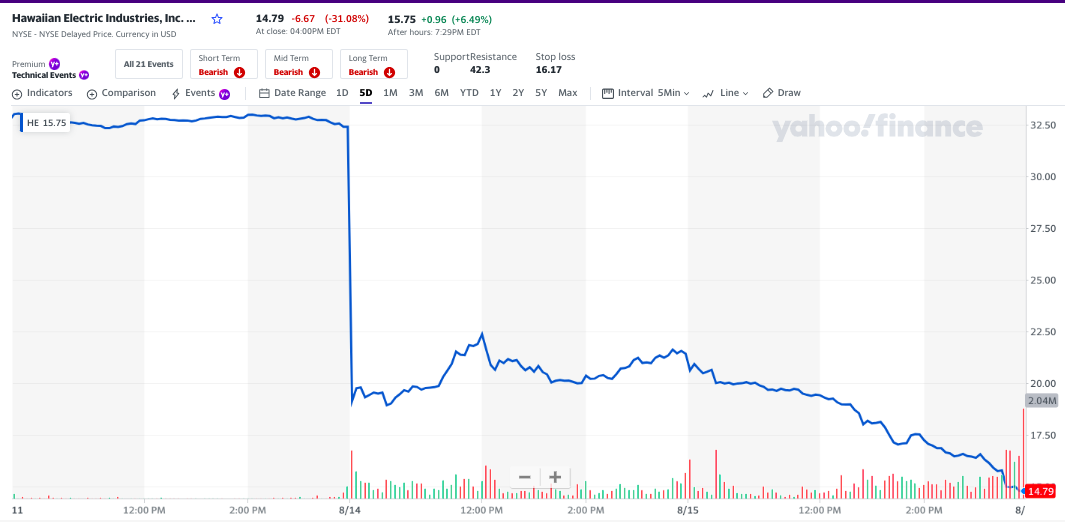
Hawaiian Electric on the Brink

The Lahaina fires began on Tuesday, Aug. 8.; HE stock took over a 50% hit this Monday and Tuesday.
Whether justified or not, Hawaiian Electric Industries is now accused of bearing major responsibility for the Lahaina fire:
The selloff continues in shares of troubled utility Hawaiian Electric Industries.

The stock fell another 24% on Tuesday after Monday’s plunge, on fears the utility could be held liable for the wildfires that have devastated Maui.

The stock recently traded around $16.

Wells Fargo analysts cut their price target to $25 per share on Monday. “While it remains unclear if any of HE’s equipment directly caused any of the wildfires, we believe it prudent to account for the risk,” they wrote.

All told, the stock has dropped about 50% so far this week, according to FactSet; that’s the stock's worst two-day selloff on record dating back to 1983, according to Dow Jones Market Data.
Honolulu: as power needs grow, the tangles get worse.
In 2017, as California wildfire liabilities drove PG&E into bankruptcy, I wrote:
Telephone poles and overhead power lines have been a ubiquitous part of the Honolulu landscape ever since I can remember. They're still in every neighborhood a half-century later despite the danger and poor esthetics. The cost of burying infrastructure (electricity, trains) is enormously expensive, so little has been done.

In Napa and Sonoma counties Pacific Gas and Electric faces similar costs to Hawaiian Electric and did not bury most of its power lines.
At today's close, HE had a $1.6 billion market cap, and there's not much flesh to scavenge from its bones. Any substantial recompense will have to come from Hawaii ratepayers.

Thursday, August 10, 2023

Lahaina No Ka Oi, Hopefully Again


As of this writing (4 p.m. HST) there are 53 confirmed dead in the Maui wildfires that started on Tuesday. 1,000 people are unaccounted for, historic Lahaina town is completely destroyed, and basic communications and infrastructure are heavily damaged. Flames are 80% contained.

The videos are similar to those that Californians saw during the 2018 Camp Fire that leveled the City of Paradise. In Maui too we watch residents given only seconds to flee, trees burning on both sides of the road, and winds spreading flames faster than people can run. In California people jumped into rivers and lakes, in Maui they leaped into Lahaina Harbor.

Before the Camp Fire Paradise was a city of 14,000 homes and 27,000 residents. 4½ years later Paradise is less than half what it once was: "more than 1,400 homes have been rebuilt and now nearly 10,000 people call Paradise home again."

Because of the importance of Lahaina to the State of Hawaii, your humble blogger hopes that Lahaina's restoration will be faster and more complete than California's rebuilding of Paradise. And, selfishly, it will raise the probability that I can visit Lahaina one more time before age and infirmity prevent me from doing so.

Tuesday, July 18, 2023

Collateral Benefits

At least they got rid of the termites.
When fire ravages a house, there sometimes is collateral damage to other properties. In the case of my sister-in-law, who lives across the street from a burnt-out home in Kailua, there are collateral benefits.

An episode of Magnum P.I. had a scene with a burning house, and the neighbor's misfortune had a silver lining. The husk was needed by the TV show--flames to be added later through special effects--and Magnum will help defray some of her out-of-pocket costs for the rebuild.

A lot of work for a hole in the ground.
The collateral benefits? A plot point had a character burying something nearby, so my sister-in-law was paid $2,000 to shoot the scene on her property.

The production dug the hole, filled it later, and re-sodded the surface in addition to clearing some weeds. My brother-in-law says the area looks better than before.

Although Magnum has been cancelled by NBC, their house is now frozen in time as long as Magnum P.I. reruns are shown.

Related: another relative's house was used regularly in Hawaii Five-0. 

Friday, December 16, 2022

Bottoming Temperature ==> Bottoming Fortunes?

A cold snap is upon us:
a ridge of high pressure digs in further and gives way to a cold weather outbreak. The region can expect some of the coldest air of the winter season tonight and over the next couple of nights, with temperatures dropping into the 30s across large swaths of Bay Area.
Though much chillier than this Hawaiian-born immigrant is accustomed to, the freezing temperatures have coincided with heavy snowfall in the Sierras, signalling a possible end to the drought.
This frigid air mass comes to the Bay Area from the Arctic Circle and has quickly made itself at home as it spins over Nevada’s Great Basin. The Sierra’s northern, central and southern snowpacks are all currently running over 195% of normal levels.
The past several years have been pretty rough for the region. The dismal economy, wildfires, the coronavirus, inflation, the population exodus, not to mention crime and homelessness, have afflicted the once-paradisiacal Bay Area.

Maybe the cold, accompanied by heavy snow, is a sign that we've bottomed out.

Saturday, June 18, 2022

California on the Precipice

Lake Tahoe is shrinking (Chron photo)
We take a break from looking at our incredibly shrinking stock portfolio to worrying about the apocalyptic summer in store for Californians: [bold added]
This year’s extraordinarily dry, warm weather, which is expected to continue in the coming months, is stoking fears of a multitude of problems: increasing water restrictions, extreme heat, blackouts, wildfire and smoke — potentially all of the above in one vicious swoop...

Already in California, climate volatility, as palpable as it’s been, has joined the list of reasons people cite for wanting to move away, after soaring home prices, high taxes and traffic. The state’s population, which had grown for decades, dropped in each of the past two years.

“We have people say they’re concerned about drought, they’re concerned about wildfire,” said Scott Fuller, founder of LeavingTheBayArea.com, a 7-year-old real estate company that helps people relocate. “We’ve had clients say this is literally the final straw.”
And we haven't even mentioned the danger that most concerned us during the last century: a major earthquake.

Should the latter happen, that really will be the last straw for millions of soon-to-be ex-Californians. Will the last one out the door please close the lights, if they're not out already?