Showing posts with label Commute. Show all posts

Tuesday, February 25, 2025

Smishing

We ordered a FasTrak "toll tag" (a plastic transponder that charges us for bridge tolls and express-lane fees when passing under a scanner) eight years ago.

As largely housebound retirees who live on the Peninsula, we rarely need the device, as we avoid highway traffic jams during rush hours and go over toll bridges once every 2-3 months,

On our drive to and from Yosemite last weekend we did use the toll tag and I received the text message (shown right) on the same day we left.

It was the first time I had received a text message that asked me to make a FasTrak payment. It had caught me off guard because it coincided with the first FasTrak use of 2025. My travel companion said that the message was a scam that had been going around.
Road toll scams that besieged the Bay Area and and other parts of the country last year have ramped up again, with insistent text messages that demand payment — and sometimes threaten penalties.

A Chronicle reporter received three such missives since December, purportedly for not paying fees to use toll lanes. Other Bay Area drivers have shared screenshots of similar messages on social media, asking about their validity. Some say they are getting hammered multiple times a month, and note the language in these texts has evolved: fewer spelling errors, increasingly detailed instructions, and a more intimidating tone.

“In order to avoid excessive late fees and potential legal action on statements, please pay the fee in time,” one message sent on Jan. 12 said. It provided a website to resolve violations, imitating the real web address for Southern California’s toll authority but stringing a sequence of numbers and letters at the end...

Law enforcement officials have a name for the tactic: “smishing.” The term is a portmanteau of phishing perpetrated through SMS text messages, and describes an aggressive and sophisticated form of social engineering. Bridge and road toll scammers use smishing to cast a wide net, tricking people to pay bogus fines for crossings they didn’t make.
Smishing---a crime that could only exist in a world with SMS text messages and toll tags, which in turn exist because the State government eliminated human toll takers. It's progress, I suppose, but we have to be on our guard more than ever.

Friday, February 07, 2025

Saving California from Itself

In 2012 I expressed skepticism about the just-approved high-speed rail (HSR) project:
But they're going to start in the middle, i.e., the Central Valley, where the labor and land are cheaper and environmental obstacles less restrictive. After the expenditure of an estimated $6 billion, HSR will be operational between Fresno (pop. 350,000) and Bakersfield (pop. 500,000) in 2017...

Just to make clear, your humble observer is not in favor of the HSR project. It's expense ($65 billion in today's dollars and $90+ billion, including inflation ) is only defensible under the wildest pie-in-the-sky scenarios. When one looks at the sad history of California construction overruns in projects like the Bay Bridge extension, San Francisco airport, and BART, it is even more improbable that the final cost will be justified, and it won't matter much whether it was built top-down, bottom-up, or middle-out.
Support pillars in Hanford (Merc photo)
13 years later HSR has played out as foreseen: $billions over budget, decade-long delays, and no guaranteed funding to finish it. Even many of its former supporters agree that HSR is a white elephant, but very few have publicly advocated abandoning it.

This time around (he failed to do so in his first term) President Trump will likely be able to kill the project given the weakened state of his opposition:
“The train that’s being built between Los Angeles and San Francisco is the worst-managed project I think I’ve ever seen, and I’ve seen some of the worst,” Trump told reporters, asserting that the project is “billions and billions” of dollars over budget.

“We’re going to start a big investigation of that, because I’ve never seen anything like it,” he added. “Nobody’s ever seen anything like it. The worst overruns that there have ever been in the history of our country.”

...The current estimate for linking San Francisco with Southern California is $107 billion. Officials don’t even know how to fully finance Merced-Bakersfield, much less raise the other $72.4 billion they would need.
By pulling the plug President Trump will be saving California from itself, but I doubt anyone in Sacramento will thank him.

Monday, June 03, 2024

One Implication of Hybrid Work

Long commutes are more tolerable if workers don't have to go into the office frequently--that statement is obvious, but it seems that everyone hasn't fully grasped the implications.

(Image from Forbes)
Headline: America’s Commute to Work Is Getting Longer and Longer
Big shifts in the way people live and work are making commutes of over an hour into the office more common—and even more palatable. Rising housing costs have prompted many to move farther away from city centers, while the staying power of hybrid work means they don’t have to drive into work every day.

The share of super commutes—those 75 miles or longer—have grown the most and are up by nearly a third since 2020, according to new research from Stanford University.
Cities can invest in mass transit, police, and other services, but their downtowns will never come back completely because of the adoption of hybrid work. A few, like San Francisco and Las Vegas, may make up for the losses in foot traffic by boosting their tourist and convention business, but not everyone is a destination city.

Meanwhile, investing in developable land even farther from urban centers has a greater chance of paying off.

Allocate your real estate dollars accordingly.

Wednesday, May 11, 2022

Hump Day is Humming

(Image from Reader's Digest)
The explosion in working from home during part of the week, aka "hybrid work", has resulted in Wednesday being cities' busiest day.
Commuter rail lines in cities like Boston and San Francisco found Wednesday typically the busiest weekday in April. The same is true of hotel occupancy in many big cities, a sign salespeople know that is the day they’re likeliest to find contacts in the office, said Jan Freitag, director of hospitality analytics at CoStar Group Inc.

An average of 46% of U.S. office workers went to work on Wednesdays in March, said Kastle Systems, a security firm that monitors access-card swipes. That trounced Monday’s meager 35%...

The critical mass of workers on Wednesday can be self-reinforcing, some managers suggest. Employees say they like office socialization, so it makes sense to go in on the day you think the most other people will.
As a retired boomer, I've generally refrained from telling the young 'uns how tough I had it commuting for two hours, wearing a coat and tie every day, and counting myself lucky if I didn't have to go in on Saturday.

But c'mon man, Wednesday's are tough because you can't get a lunch reservation? I wasn't concerned about climate change or the national debt, but now I'm worried about America's future.

Wednesday, July 22, 2020

CalTrain Power Play

2004 Christmas week: in the COVID-19 era it looks this deserted all the time
Caltrain, the commuter rail that provides transportation from San Francisco to San Jose, is on the brink: [bold added]
Having lost 95% of the ridership it relies on for the bulk of its revenue, the vital transportation and economic link between San Francisco and Silicon Valley needs voters to throw it a lifeline by raising sales taxes an eighth of a percentage point. All local governing bodies have to do is let the people decide.

The proper course was therefore obvious to San Francisco’s supervisors: Take advantage of the dire emergency to promote class warfare and do bureaucratic battle while threatening to paralyze an irreplaceable public asset.

Supervisors Aaron Peskin and Shamann Walton have joined officials in Santa Clara County in holding up the modest tax increase while reviving demands for more control over the commuter line, which is managed by the San Mateo County Transit District, known as SamTrans.
California government officials file lawsuits against the Federal Government when the latter withholds funds to force compliance with Trump Administration policies.

But when CalTrain, which is run by San Mateo County, wants a sales tax measure, San Francisco and Santa Clara hold up the ballot to get control over CalTrain's finances.

Whatever principles they espoused in their arguments against the Federal Government go out the window when the progressives hold the pursestrings. It was all about the power.

Saturday, June 27, 2020

Beyond the Outer Limits

Yesterday, we commented on the threat to American cities from the spiral of urban flight, declining services, higher taxes, more urban flight, etc. Reihan Salam of the Manhattan Institute elaborates:
As cities grow poorer and less populous, and as public employees come to represent an even larger share of those with meaningful political influence, urban populists may promise to redistribute whatever wealth is left—which in turn will contribute to further outmigration...urban residents aren’t a captive audience. Cities are facing a much more competitive landscape than they were even six months ago. Those that succeed will do so by offering the highest quality of life at a price that won’t cause sticker shock. That is the surest route to maintaining urban communities that are more integrated, prosperous and just—a goal worthy of this moment.
Before the coronavirus San Francisco and Silicon Valley high-paying jobs, coupled with the unavailability of affordable homes, caused developers to test the limits of "super-" commuting by building homes that require a commute of up to two hours one-way.

A Chronicle ad for Chico, which few San Franciscans have even driven through since it's not on Hwy 5.
The COVID-19 recession and civil unrest have prompted home-building beyond the outer limits of a practical commute from San Francisco. An ad section for homes in Chico, nearly three hours away, appeared in the Chronicle last week.

Developers are betting that their cheaper-but-not-cheap-looking product will appeal to first-home buyers who can telecommute from San Francisco.

I'm betting they're right.

Friday, July 19, 2019

Proceed with Caution

One of the reasons that a picture is worth a thousand words is because a verbal description often is confusing. Here are the words--with a picture--describing a new traffic design. (Try to read it first, and then look at the picture to see if you got close).
It’s called a diverging diamond. To enter the freeway, the cutting-edge interchange requires drivers to veer at a 45-degree angle across the center divide, switching sides with opposing traffic and briefly motoring across as if they are in England.

By being on the left side, they can then glide left onto the highway without a dangerous 90-degree turn across oncoming cars.

Some traffic planners are smitten with the concept and how, in the name of efficiency and safety, it forces opposing traffic to negotiate an X-shaped, signalized crossover before a bridge or underpass. As freeway-bound drivers drift to the left to an on-ramp, those heading through the interchange to the other side of the freeway follow the road back to the right at another crossover.
The example of the modern roundabout is instructive. While the roundabout is easy to picture, its high efficiency in moving more cars along through an intersection is difficult to apprehend unless one has experienced it a few times.

Without the "divergent diamond" schematic, your humble blogger couldn't envision even how it would work, much less whether it would an improvement. Now I'm guardedly optimistic. Traffic engineers have a good, albeit not perfect, record and have earned our trust.

As for those who are "smitten with the concept", let's pump the brakes. Don't go big until we've seen how it works on a small scale. (I'm looking at you, high-speed rail enthusiasts.)

Monday, April 15, 2019

And I Don't Even Know What's SUP

I haven't even tried Standup Paddle boarding (SUP)--the placid Foster City lagoon is perfect for beginners--and the next thing, electrically assisted water bikes, is already here.
(Chronicle photo)
The bikes, which [Jessica] Schiller invented in 2013, resemble mini-catamarans: a standard bicycle frame suspended over two inflatable pontoons, with a drop-down propeller powered by pedals and a 750-watt motor. The pontoon design provides stability so users can ride the bikes without having to worry about tipping or getting wet.
There's a practical application for this invention. Residents of Alameda Island typically drive across bridges or through the Webster and Posey underwater tubes to get to jobs in Oakland and the rest of the Bay Area. The bikes are a way for solo commuters to traverse the Oakland-Alameda estuary.
Oakland (top) and Alameda (bottom)
are 200 yards apart (Google Maps)
Oakland and Alameda officials have given the Mill Valley entrepreneur the go-ahead to install a fleet of 25 electrically assisted water bikes that will allow commuters to ride between the Jack London Square area in Oakland and either Mariner Square or the Grand Street dock in Alameda.

As with the land-based scooters and e-bikes that fill the roads, commuters will use a mobile app to claim a bike on either side of the estuary, ride across the 200-yard expanse of water and surrender it on the opposite side, paying by the minute.
There's no practical commuting application here in Foster City, but I can see my neighbors getting these for their backyard docks, and yes, for some of them money is not a problem.

Thursday, April 12, 2018

Pardon My Scooter

Two Bird scooters parked on Market (Chronicle photo)
Another headline that distinguishes San Francisco from other American cities:

As complaints roll in, San Francisco considers action over wave of motorized scooters
hundreds of motorized stand-up scooters meant to be shared for short rides....appeared suddenly, and since their arrival, they’ve drawn praise from early users and a flood of complaints from people who don’t like one of the slender two-wheelers’ biggest features: They can be parked anywhere.
Three scooter-sharing startups are testing their product on the streets of San Francisco:
Three companies — LimeBike, based in San Mateo; Bird Rides, headquartered in Venice (Los Angeles County); and Spin, located in San Francisco — own the scooters and lease them to people who unlock them with a mobile phone app. For now, all three charge the same rates: a flat $1 fee to unlock the scooter plus 15 cents per minute of use.

The companies scatter the fully charged scooters around the city at locations where they believe they’ll be used. The scooters are popular with people trying to get from BART to work, heading to a meeting a few blocks away, or visiting the city and observing the sights.
Comments:
1) Positive: San Francisco is a good place to test the idea. Thousands of workers take BART, Cal-train, or a bus into the City but must transfer to Muni for the last leg. Compared to Muni's $2.50 adult fare, the scooter rental is a bargain.
2) Positive: Bay Area workers are accustomed to trying new technology and new business models.
3) Negative: Unable to do anything about the homeless, residents and workers are likely redirecting some of their frustration to the scooters parked all over the sidewalks.
4) Negative: This business seems to have limited upside. A new scooter costs around $300, and a regular user would probably buy a foldable version that he can take up to the office. People traveling in groups are unlikely to be frequent customers; neither are people over 50.

Wednesday, July 05, 2017

Nearly Every Day

From 13 years ago:
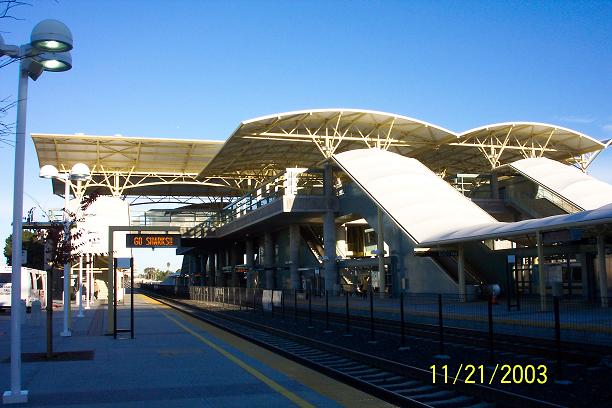
The Millbrae BART/Caltrain connection is a maze of concrete, escalators, ducts, stairs, turnstiles, and ticket machines. The designers did their best with the translucent roofing, but there are too many dark, cold areas. Yes, the station is functional, but the parking lots are mostly empty and traffic is far below expectations.
The booming Bay Area economy and the addition of a BART line to San Francisco Airport should have improved Millbrae Station's utilization. However, [bold added]
By now, BART’s Millbrae Station — with its connections to Caltrain, buses and shuttles — was supposed to see 16,500 passengers pass through its fare gates every weekday, making it the fifth-busiest station in the system.

But 13 years after it opened, it’s pretty much just another BART station, nowhere near the bustling Peninsula transit hub that planners envisioned. With just under 7,000 riders entering and exiting daily, the station ranks 27th in activity among the transit system’s 46 stations.
One of the problems is that there's little coordination between BART and Caltrain. A passenger trying to get from Oakland to Mountain View would take BART to Millbrae, then often wait more than 30 minutes for the next southbound Caltrain---and that's when both BART and Caltrain are running on time.
BART riders coming from the north and bound for Caltrain arrive on the east side of the station. To catch Caltrain, they have to ascend escalators or stairs, exit through the BART fare gates and walk a few yards across the concourse before descending to the Caltrain station’s west side.
When it's not rush hour, the drive would take one hour, and mass transit two. When Millbrae Station opened, a round-trip BART fare from Millbrae to San Francisco was less than $5. Parking was free, an obvious inducement to try the new station.

Now the round trip costs $9.30, and parking is $3. It's no wonder that BART doesn't attract more commuters; it's too expensive for low-wage earners (even if the minimum wage rises to $15 an hour), and it's too inconvenient for those with high incomes, who choose to park in downtown buildings at $25 per day ($5,000 per year).

Don't get me wrong--I'm glad the station was built. It's very useful to have an alternate means into the City since the highways are backed up nearly every day.

Friday, September 04, 2015

It's Always the Same Solution

Californians pay the highest gas taxes in the nation. Because these taxes are not enough--they're never enough--to fix our roads and bridges, Governor Brown has proposed new taxes and a new per-car fee [bold added]:
The administration’s plan would create a highway user fee of $65 per vehicle, which would generate $2 billion and could be assessed during vehicle registration. Another $1 billion would be generated by raising the gas tax by 6 cents per gallon and the diesel tax by 11 cents per gallon. Those taxes would continue to rise based on the Consumer Price Index*.
*Because having to go back and ask permission all the time is so tiresome.

Governor Brown will have to twist some arms to get the $3 billion proposal passed.

Meanwhile, the $68 billion high-speed rail project is well on its way to connecting San Francisco and LA by 2029.

Tuesday, May 05, 2015

$6.5 Billion Doesn't Buy What it Used To

From the initial 1997 $1 billion estimate to its "final" $6.5 billion cost when it opened in 2013, the new Eastern span of the Bay Bridge was a typical government construction project that experienced drastic modifications, multi-year delays, and gigantic cost overruns. But at least it finally got done.....Or did it?

The eastern tower (SFGate photo)
From today's Chronicle:
Caltrans tests indicate that salt water from the bay may be seeping into the foundation of the new Bay Bridge eastern span’s tower, an ominous prospect that raises questions about the long-term viability of hundreds of massive steel rods that anchor the landmark structure.
Where will the State get the billions of dollars to fix a problem that could cost lives? Well, down south there's an expensive transportation project of dubious benefit that has absolutely nothing to do with public safety.....

[Update - 5/7: Bay Bridge news gets worse: "One of the steel rods anchoring the tower of the new Bay Bridge eastern span has failed a key integrity test, suggesting it became corroded and broke during years when it was soaking in water."]

Wednesday, February 04, 2015

Their Presence Isn't Welcome

Google commuter bus in San Francisco (TechCrunch photo)
In the latest instance of blue-on-blue disputes, Salon.com founder David Talbot says the influx of Silicon Valley tech workers into San Francisco is ruining the City. This time evil Republicans aren't to blame but Stanford University and Silicon Valley, both of which have overwhelmingly supported the liberal agenda:
Not long ago, Bernal Heights was a funky mix of blue-collar workers, lesbian starter-families, counterculture artists, community organizers and Latina grandmothers. But Bernal Heights had the misfortune of being blessed with affordable housing, verdant backyards and parks – and being conveniently located next to the hipster-infused Mission, and even worse, to Highway 101 – the Google bus route to Silicon Valley.

Suddenly, this unusually mixed San Francisco neighborhood was transformed into what one real estate web site recently crowned the hottest zip code in the country. Now, if you stand at the corner of Precita and Alabama – the main checkpoint for the neighborhood — instead of seeing battered Subaru Outbacks and Hondas, you see a steady stream of new-model Teslas, BMWs and Uber limousines. A rapid, seamless flow of gleaming, luxurious metal that never slows down – not even for the children and dogs who come spilling into the street from the nearby park. These Silicon Valley movers and shakers can’t afford to slow down – time is money.
Stanford is the target of his anger because it is the birthplace of Silicon Valley [bold added]:
For many years, Stanford was the country-club university where millionaires of the West sent their children – the bright and the not-so-bright offspring of privilege. But in the 1930s and ‘40s. things began to change around here. Stanford grads William Hewlett and David Packard began tinkering in their legendary garage. And, after World War II, William Shockley moved west to work on his transistors. Pumped full of Pentagon money, this sun-dappled campus and the green fields and orchards surrounding it suddenly blossomed into Silicon Valley. Engineers and entrepreneurs were the new gods – not farm owners and railroad barons.

Much of the wealth in this new boom was blood money. The shiny new instruments of technology that bloomed here sprang from the Defense Department’s need to identify the enemy, track the enemy and destroy as many of them as possible. Even vaporize entire civilian populations if necessary.
I've never heard "Stanford" spoken of so pejoratively, not even by Cal loyalists (Mr. Talbot went to UC-Santa Cruz):
The ones who proudly wear their Ivy League hoodies as they jog and hydrate around Precita Park or line up for artisanal chocolate tastings on Valencia Street, forking over enough cash to feed an entire family in the Mission for two or three days. “Stanford dicks.” That’s what my sons call them. Or Stanford douchebags, or Stanford tools. The term “Stanford assholes” has even made it into “Looking,” the HBO show set in gay San Francisco – and it’s not meant to be flattering.
It's easy to make fun of David Talbot's rant--he tries hard to inflame the reader by using terms of military violence and listing the frivolous indulgences of the nouveau riche--but his anger stems from a common phenomenon, the transformation of the places we once loved into something cold and unfamiliar.

I once knew every street in Honolulu, but now I get lost in, and don't care for, many parts of new Oahu. During the 1980's many Americans resented the Japanese development of U.S. real estate, including the purchase of trophy properties like Rockefeller Center and Pebble Beach. And for half a century people in the other Western states have deplored how the out-migration of Los Angelenos was "Californicating" their bucolic communities.

Sorry, David, you sound like a grumpy conservative who is standing athwart history yelling 'Stop! Just make sure you get out of the way of those driverless cars.

(NY Times graphic)

Saturday, November 16, 2013

More Skype, Less Frustration

Earlier this week I was traveling east on the Hayward-San Mateo bridge (the road is usually uncrowded against the westbound morning commute) when traffic came to a dead stop. There was a three-car accident on the bridge, and all lanes were blocked.

After texting everyone that I was going to be late indefinitely--yes, I know that texting while driving is illegal but does the rule still apply to texting while stopped?--and second-guessing whether I should have taken the Dumbarton Bridge, I "third"-guessed that I should have teleconferenced and/or worked from home.

Eventually arriving at the office, I had some worthwhile face-to-face meetings, informative interactions with a few people that I had not planned to see, and a tasty lunch to boot. Nevertheless, the benefits were not quite equal to the cost of the day's commute. Next time: more Skype, less frustration. © 2013 Stephen Yuen

Monday, October 21, 2013

Anxious Weekend

After an anxious weekend the BART strike, chapter 2 (chapter 1 was in July), was apparently settled. The trains will roll again tomorrow after disrupting the daily schedules of hundreds of thousands of commuters who rely on BART. However, we're not out of the tunnel entirely because the agreement must still be approved by union membership next week.

The region's vulnerability to transit strikes has given rise to calls to outlaw them by some California Democrats. (Transit strikes have been banned even in such labor-friendly bastions as Chicago, Washington, D.C., and New York.) The San Francisco Chronicle says that it's time:
This strike may represent the most egregious and most counterproductive overreach by the unions. They and their consultants should have recognized in July that public sentiment was not with them.

Their obliviousness has brought the issue to the fore: Why should workers in a service so essential to Bay Area life and safety even be allowed to strike?
BART is fairly quick, reliable, and cheap, and, excluding the intra-San Francisco Muni system, far more people in the Bay Area rely on it every day than all other forms of public transportation. BART is also a good example of the danger of entrusting too much power to a single supplier, public or private, for-profit or non-profit.

We who live on the Peninsula are fortunate to have several commuting options to San Francisco: SamTrans express buses, CalTrain, BART, and, of course, one's own car. Diversification is good, because it means that you have a back-up plan. © 2013 Stephen Yuen

Tuesday, September 03, 2013

Still Second Choice

Having lived in the Bay Area for nearly 40 years, I avoid the San Francisco-Oakland Bay Bridge whenever possible. Whether heading east or west, the traffic always seems to stop when going through San Francisco and Berkeley, so I take the longer San Mateo Bridge/580/680 route when traveling north to Sacramento or Reno/Tahoe. Adding to the congestion are the poor esthetics: the lower (eastbound) deck of the Bay Bridge is ugly and poorly lit and has been declared seismically unsafe, to boot.

After eleven years and an expenditure of over $6.5 billion, the first major Bay Bridge reconstruction in nearly 80 years was completed over the Labor Day weekend. Opening to great fanfare, the new Eastern span is definitely prettier and safer, but it remains to be seen whether traffic will run more smoothly. The San Mateo Bridge will still be the first choice on this person's trip planner.

The new eastern span

The Bay Bridge western span hasn't changed...for now

Tuesday, July 02, 2013

Too Much Power

San Bruno station is shuttered during the strike
Diversification isn't just a desirable attribute of investment portfolios, it's a fundament of capitalism. If purchasers of goods or services are too reliant on one supplier, purchasers are vulnerable to supply disruptions, price hikes, unfavorable contract renegotiations, and other characteristics of monopolies.

"Natural" monopolies, such as public utilities that have no competition because of their economies of scale, are regulated by the government. When the government operates the monopoly, consumers are for the most part helpless.

For thousands of commuters Bay Area Rapid Transportation (BART) trains are the only transit method. Alternative transportation--including driving--from the East Bay to San Francisco is costly and can be much slower. That is why the BART strike, which began Monday, is so devastating. It's also dysfunctional (bold added):
BART's labor stoppage is polluting the air, wasting commuters' time and, at least by one estimate, costing the overall Bay Area economy $73 million per day.

The most public sticking points that led to the strike have been raises and pension contributions, a dispute that is separated by $17.53 million a year.
When the monopolist sneezes, everyone catches cold---a cautionary tale about granting any entity, public or private, too much power over everyone's lives.
© 2013 Stephen Yuen
[Update - 7/5/13: trains will resume service for 30 days as management and unions attempt to reach a deal.]

Wednesday, September 19, 2012

Trip-trapping Across Their Bridge

Golden Gate Bridge by stevebyuen
While crossing the Golden Gate Bridge several years ago, I was in the wrong lane. I couldn't get to the booths on the far right to pay the $6 cash toll, nor did my car have a FasTrak device that would pay the toll electronically.

I went through the FasTrak lane and circled back to the Bridge administrative office. They wouldn't take my money, and I had to write several letters to pay the toll and expunge the $30 fine.

It will soon get even more confusing for the infrequent bridge-crosser. In five months there will be no way to pay the toll with cash:
Come February, the only options for drivers will be signing up for FasTrak, opening a pay-as-you-go license plate account, or making a one-time payment before the transit district mails a bill. [snip]

All-electronic tolling was approved in 2011 as a way to help close a projected $89 million five-year shortfall, a number that [spokeswoman Mary] Currie said Tuesday had been reduced to $66 million after changes were made to workers' pension and health care plans.

Implementation of the program will cost $3.2 million and is expected to save the district $19 million over an eight-year-period by eliminating toll workers, Currie said.
I'm all for government operating more efficiently, even if that means some jobs will be lost. In this case, however, efficiency means a significantly degraded service, a service which everyone must use because there are no feasible alternatives. Drivers who don't wish to open an account, prepay a toll, or mail in a check have no choice. It's the bureaucrats' bridge, not ours. © 2012 Stephen Yuen

Saturday, September 15, 2012

Tragedy Averted

I occasionally board Caltrain in South San Francisco and fortunately was away in LA on August 24th.

A southbound train roared through the SSF station and nearly hit northbound passengers crossing the tracks.
Caltrain says the "very serious" near-accident was the first of its kind in the modern history of the popular commuter line and has led to major safety changes and left two engineers on leave. [snip]

The station is old and, unlike most Caltrain stops, does not have a gate or crossing arms that come down to prevent passengers from crossing active tracks. Usually engineers radio each other or use headlight signals to ensure the station is clear before an express train zooms through, but that apparently didn't happen this time.
At that hour Caltrain commuters disembark to shuttles that will take them to South City biotech firms. We were lucky tragedy was averted.

Union Pacific freight cars stored at SSF.

Friday, July 06, 2012

High Speed Rail: From the Middle Out

"Middle-out" is becoming a popular design approach, whether one is talking about philosophies of engineering or economics. Middle-out also appears to be an apt description of the just-approved California high-speed rail (HSR)project.

Central Valley (in green) will be operational first.
The long-time dream of California planners has been to connect the San Francisco and Los Angeles megalopolises with rail transportation that is quick, cheap, and good (here we go again with the Project Triangle). [HSR is not total fantasy: both the shinkansen(Japanese bullet train) and TGV(French high-speed rail) have shown that the technologies and business models are feasible.]

But they're going to start in the middle, i.e., the Central Valley, where the labor and land are cheaper and environmental obstacles less restrictive. After the expenditure of an estimated $6 billion, HSR will be operational between Fresno (pop. 350,000) and Bakersfield (pop. 500,000) in 2017.

This may be engineering-wise but politically foolish. IMHO, it would have been more astute to build out from population centers, say the SF Bay Area (pop. 7 million) to Gilroy or Greater Los Angeles (pop. 17 million) to Bakersfield first. Serving the long-range commuter would accumulate political capital for problematic future funding requests amounting to tens of billions of dollars.

Just to make clear, your humble observer is not in favor of the HSR project.  It's expense ($65 billion in today's dollars and $90+ billion, including inflation ) is only defensible under the wildest pie-in-the-sky scenarios. When one looks at the sad history of California construction overruns in projects like the Bay Bridge extension, San Francisco airport, and BART, it is even more improbable that the final cost will be justified, and it won't matter much whether it was built top-down, bottom-up, or middle-out.