Showing posts with label PG&E. Show all posts

Thursday, May 02, 2024

California's Self-Inflicted Energy Wounds

Headline: California electricity prices now second-highest in U.S.: ‘Everyone is getting squeezed’ [bold added]
Propelled in large part by PG&E, which hiked residential electricity rates by 20% for about 16 million Californians in January, the state’s high electricity prices are second only to Hawaii, which is always an expensive outlier because of the costs of shipping oil to the far-flung archipelago...

East Coast residents are paying higher prices during cold winter months with Californians paying higher electricity prices for a brief period nearly every summer since 2014, likely when people must cool their homes during heat waves.

It is unusual for Californians to pay higher prices than the East Coast in the depth of winter.
It's a safe bet that the "unusual"-ness of California paying more than East Coasters during winter will become the usual story. As is there wont, pro-regulation activists blame lax Public Utilities Commission oversight--there may be some truth to that--but as we stated in 2019, it's impossible to place all these conflicting demands on an energy provider:

  • Deliver electricity and natural gas reliably to 16 million Californians;
  • Charge customers as low a rate as possible;
  • Earn a profit for investors, including a regular dividend;
  • Clear trees and brush to reduce the risk of wildfires;
  • Provide generous salary, medical and pension benefits in accordance with union contracts;
  • Repair and replace its aging infrastructure with less efficient and more costly carbon-minimizing energy sources (principally windmills and solar, but not nuclear);
  • Decommission Diablo Canyon, its last nuclear power plant, for an estimated $4.8 billion beginning in 2024;
  • Meet Environmental, Social, and Governance (ESG) standards;
  • Pay $billions in damages for its culpability in the 2017-2019 wildfires.
  • Transfer hundreds of thousands of acres to tribes and public agencies per agreements dating back to 2001.

    After PG&E declared bankruptcy in 2019, Governor Newsom threatened to take over the troubled utility. It was in the end a hollow threat, because he knew that politicians would take the blame for the hard decisions that had to be made (for example, backing off from green energy goals to keep fossil-fuel plants operating). If PG&E had become "Government Gas & Electric", who knows how much larger California's projected $73-billion budget deficit might have become?
  • Saturday, August 19, 2023

    When You Want Everything, You End Up with Nothing

    (Images of class action lawsuits against HE)
    After its 2019 bankruptcy resulting from wildfire liabilities, PG&E enacted procedures to cut off electricity preemptively when fire danger is high.

    Now similar class-action lawsuits have been filed against Hawaiian Electric for not shutting down Maui's power lines.

    Utilities may not be as legally responsible in Hawaii as they are in California. [bold added]
    The company noted that there is no precedent in Hawaii, as there is in California, for property owners to receive compensation for damages caused by a private party such as an investor-owned utility, or from a government entity.
    Hawaiian Electric also cited the dangers of shutting down electricity in the midst of a fire:
    “Preemptive, short-notice power shut-offs have to be coordinated with first responders, and in Lahaina, electricity powers some of the pumps that provide the water needed for firefighting,” the company wrote. “A power shut-off can jeopardize the health and safety of the elderly, the disabled and those most in need.”
    Hawaiian Electric management no doubt bears some responsibility, but IMHO government is at least equally culpable. Government regulates utilities because utility monopolies are free to set prices without being restrained by competition. The WSJ says that Hawaiian Electric and PG&E are simply following their State governments' orders:
    If Hawaiian Electric’s lines did ignite the fires, it would echo the problems of PG&E, the California utility that filed for Chapter 11 bankruptcy in 2019 after getting sued for tens of billions of dollars for damages from fires caused by its equipment. The 2018 Camp Fire killed 84 people and razed the town of Paradise.

    What both utilities have in common is that they prioritized growing renewable power to meet government mandates over hardening their systems and reducing fire risk. In 2015 Hawaii lawmakers required that 100% of the state’s electricity come from renewable sources by 2045. California and some other states followed with similar mandates.
    Hawaii and California share another characteristic: the Democratic Party has held all state-wide offices and controlled the state legislature for over a decade. This means that the priorities of regulated businesses are the priorities of the Party: eliminating fossil fuels, promoting DEI (diversification, equity, and inclusion) and corporate ESG (environment, social, and governance) all supersede such mundane activities as hardening infrastructure and operating profitably.

    The voters of Hawaii and California are getting what they wanted, and the victims of Paradise, CA, and Lahaina, HI paid the tragic price.

    Tuesday, August 15, 2023

    Hawaiian Electric on the Brink

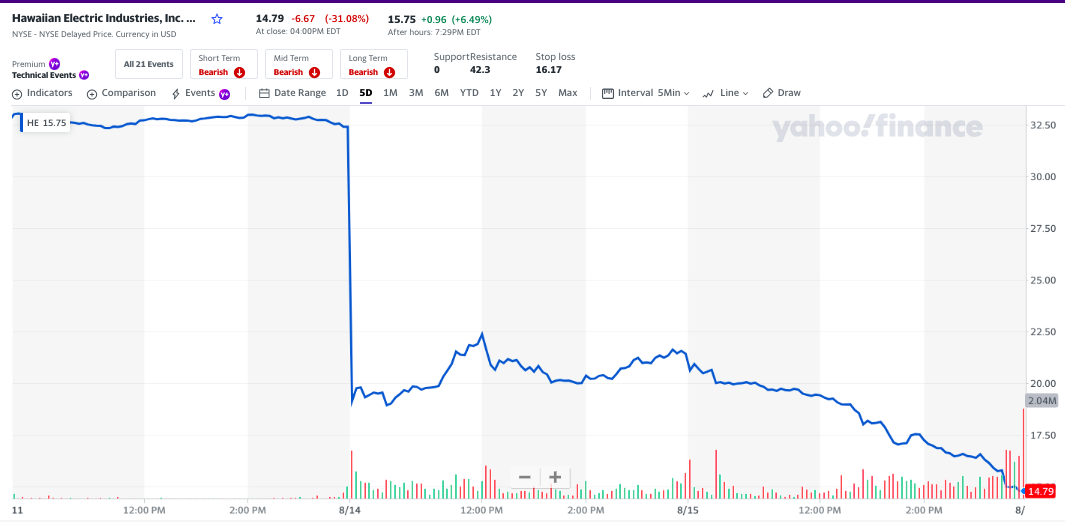
    The Lahaina fires began on Tuesday, Aug. 8.; HE stock took over a 50% hit this Monday and Tuesday.
    Whether justified or not, Hawaiian Electric Industries is now accused of bearing major responsibility for the Lahaina fire:
    The selloff continues in shares of troubled utility Hawaiian Electric Industries.

    The stock fell another 24% on Tuesday after Monday’s plunge, on fears the utility could be held liable for the wildfires that have devastated Maui.

    The stock recently traded around $16.

    Wells Fargo analysts cut their price target to $25 per share on Monday. “While it remains unclear if any of HE’s equipment directly caused any of the wildfires, we believe it prudent to account for the risk,” they wrote.

    All told, the stock has dropped about 50% so far this week, according to FactSet; that’s the stock's worst two-day selloff on record dating back to 1983, according to Dow Jones Market Data.
    Honolulu: as power needs grow, the tangles get worse.
    In 2017, as California wildfire liabilities drove PG&E into bankruptcy, I wrote:
    Telephone poles and overhead power lines have been a ubiquitous part of the Honolulu landscape ever since I can remember. They're still in every neighborhood a half-century later despite the danger and poor esthetics. The cost of burying infrastructure (electricity, trains) is enormously expensive, so little has been done.

    In Napa and Sonoma counties Pacific Gas and Electric faces similar costs to Hawaiian Electric and did not bury most of its power lines.
    At today's close, HE had a $1.6 billion market cap, and there's not much flesh to scavenge from its bones. Any substantial recompense will have to come from Hawaii ratepayers.

    Thursday, April 13, 2023

    Power Crazy

    Repairing downed power lines in March (Merc photo)
    Pacific Gas & Electric has been criticized, principally for power outages and high rates, throughout the 50 years I've lived in California.

    Since the year 2000 the utility has declared bankruptcy twice, because of rising fuel costs in 2001 and wildfire liabilities in 2019. However, the over-riding reason, IMHO, is that it's impossible to meet all the goals that the regulators have set for it; any unforeseen major problem was bound to put the company under.

    Exhausted from listening to their criticisms, your humble blogger advocated a takeover of PG&E in 2019 by the Progressives so that they could show how to accomplish their conflicting goals:
  • force the complete conversion to alternative energy from fossil-fuel sources
  • keep rates at current levels (or lower);
  • repair its aging infrastructure to prevent more San Bruno pipeline explosions
  • pay their unionized workers a fair wage;
  • bury more power lines both to prevent forest fires and to protect the public from downed lines.
  • The latest requirement is that PG&E has been tasked with a billing adjustment that affects millions of ratepayers in the name of "equity."
    The changes would affect only those customers who receive electricity services from PG&E and its sibling power companies.

    Here’s how the fixed charges would work in the PG&E service territory. The numbers are based on a four-person household:

  • Households earning less than $28,000 a year would pay a fixed charge of $15 a month on their electric bills.
  • Households with annual income from $28,000 to $69,000 would pay $30 a month.
  • Households earning from $69,000 to $180,000 would pay $51 a month.
  • Those with incomes above $180,000 would pay $92 a month.
  • Just how will PG&E determine its customers' income? Will it have access to and security for Franchise Tax Board data?

    It's hard enough for businesses to determine pricing strategies for their products; will they now have to price differentially according to customers' income?

    The Progressives who run the State government surely have the answers.

    Saturday, August 15, 2020

    Government Gas & Electric, Continued

    Our home's central air-conditioning has not worked for at least 20 years, and I've been too cheap frugal to replace it. Besides, I'm being environmentally virtuous by suffering through the heat--currently 97°F--and not drawing fossil-fuel-originated electricity from the grid. (Yes, I plan to flaunt my green virtue to neighbors by installing solar panels with battery backup when the technology improves a bit.)

    The planned rolling blackouts have begun: [bold added]
    Current PG&E outage map at 6:15 p.m. today. Color code
    for #customers affected: Green,1-49; Yellow, 50-499
    Orange, 500-4,999, Red 5,000+
    The rotating outages were ordered because of the increased electricity demand from customers running air conditioners and other devices. Demand outpaced available supply...

    Today, California faces very different circumstances after spending much of the past two decades greening its power supply with large-scale wind and solar farms. The state has almost eliminated coal-fired generation and has been reducing its reliance on natural gas in favor of renewables, particularly solar power.

    That poses a supply challenge when electricity demand jumps. Solar-energy production begins to decline in the early evening hours, when power usage peaks, reducing the capacity available during a supply crunch.

    The California grid operator has complex, comprehensive plans in place to address such challenges. When demand surges, California relies more heavily on power imported from neighboring states, and natural-gas-fired power plants capable of firing up quickly are kept on standby. But during Friday’s blackouts, some of that power didn’t materialize as expected.

    “The capacity that was supposed to be available just didn’t show up,” said Michael Wara, head of the climate and energy policy program at Stanford University’s Woods Institute. He said more information is necessary to determine exactly why the blackouts were necessary.
    Last year we marveled at the demands placed on PG&E.
  • Deliver electricity and natural gas reliably to 16 million Californians;
  • Charge customers as low a rate as possible;
  • Earn a profit for investors, including a regular dividend;
  • Clear trees and brush to reduce the risk of wildfires;
  • Provide generous salary, medical and pension benefits in accordance with union contracts;
  • Repair and replace its aging infrastructure with less efficient and more costly carbon-minimizing energy sources (principally windmills and solar, but not nuclear);
  • Decommission Diablo Canyon, its last nuclear power plant, for an estimated $4.8 billion beginning in 2024;
  • Meet Environmental, Social, and Governance (ESG) standards;
  • Pay $billions in damages for its culpability in the 2017-2019 wildfires.
  • Transfer hundreds of thousands of acres to tribes and public agencies per agreements dating back to 2001.
  • The cries for a government takeover of the utility have intensified. Your humble blogger approves.

    Rather than continue the everlasting arguments about socialism vs, capitalism, socialists can prove the superiority of their system by running PG&E cheaper (it won't have to pay dividends) and more reliably.

    With all the money saved I might even loosen the pursestrings for central air.

    Wednesday, December 04, 2019

    An Impossible Task

    A bankruptcy judge has ruled that PG&E must compensate the fire victims for damages caused by its equipment. The judge's ruling seems clear-cut to us non-lawyers, but an unfamiliar legal term slowed down this reader. [bold added]
    Judge Dennis Montali said Wednesday the principle of inverse condemnation applies to PG&E, rejecting an argument that the utility was attempting to invoke to limit the amount it owes for homes and businesses destroyed by the fires...

    The idea behind the doctrine of inverse condemnation is that operators of public utilities should have to pay for damage done to private property, whether the utilities are public or owned by investors, as PG&E is.

    PG&E argued that the doctrine is unfair because it won’t be able to raise electric rates to cover the cost of wildfire damages. Judge Montali said the utility is speculating and doesn’t know what state regulators would say if it asked for a rate increase and proved its operations were safe.
    What is "inverse condemnation? Wikipedia [bold added]
    Inverse condemnation is a term used in the law to describe a situation in which the government takes private property but fails to pay the compensation required by the 5th Amendment of the Constitution, so the property's owner has to sue to obtain the required just compensation. In some states the term also includes damaging of property as well as its taking. In inverse condemnation cases the owner is the plaintiff and that is why the action is called inverse – the order of parties is reversed, as compared to the usual procedure in direct condemnation where the government is the plaintiff who sues a defendant-owner to take his or her property.
    Bloomberg explains PG&E's legal argument:
    Inverse condemnation usually applies to government agencies that damage private property while providing a public service. But courts in the Golden State have ruled that the doctrine also can be used against utilities, since they’re authorized by the state to provide a vital public service.

    That’s why California utilities can be held liable for damages from fires sparked by their equipment, even if they followed all of the state’s stringent safety rules. They can try to pass on those costs to ratepayers, but there’s no guarantee such efforts will get approved by the state’s California Public Utilities Commission.
    The arcane becomes a little clearer. PG&E followed the safety rules dictated by the Public Utilities Commission, yet inverse condemnation makes it liable for damages as if it were a public agency. However, PG&E is not the government and so can't raise taxes to pay for its debts. It must apply for a rate increase to be approved by the PUC. Just try getting that through when everyone seems to want the utility's blood, if not its dismemberment.

    As we've said before, under the current constraints running PG&E is an impossible task.

    Related--given that PG&E is held liable for wildfires but not power shutdowns, its behavior is perfectly understandable: PG&E Refuses to Get Burned--Under the utility’s incentive structure, blackouts make sense.

    Friday, November 01, 2019

    Government Gas & Electric

    Like North Koreans, power-less Oaklanders could gaze
    at the lights of a city a few miles away (Chronicle photo)
    After the wildfires, evacuations, and PSPS ("Power Safety Power Shutoffs"), California politicians are, er, feeling the heat to do something about PG&E, the utility they had a hand in bankrupting. Governor Newsom threatens a government takeover:
    The utility must exit bankruptcy by the end of June to access a new state fund that would help PG&E pay for damage from future wildfires caused by its equipment.

    But if the company doesn’t reach a resolution quickly, Newsom said, a state takeover is on the table, a position the governor has previously been reluctant to embrace.
    Even the wisest Latina couldn't run PG&E.

    (From pge.com)
    She has to
  • Deliver electricity and natural gas reliably to 16 million Californians;
  • Charge customers as low a rate as possible;
  • Earn a profit for investors, including a regular dividend;
  • Clear trees and brush to reduce the risk of wildfires;
  • Provide generous salary, medical and pension benefits in accordance with union contracts;
  • Repair and replace its aging infrastructure with less efficient and more costly carbon-minimizing energy sources (principally windmills and solar, but not nuclear);
  • Decommission Diablo Canyon, its last nuclear power plant, for an estimated $4.8 billion beginning in 2024;
  • Meet Environmental, Social, and Governance (ESG) standards;
  • Pay $billions in damages for its culpability in the 2017-2019 wildfires.
  • Transfer hundreds of thousands of acres to tribes and public agencies per agreements dating back to 2001.

    Your humble blogger is strongly in favor of a government takeover of PG&E. Then the credit or blame for the outcome will be clearly assigned to one party, not diffused over a multitude of groups who have a say in PG&E's governance.

    If "Government Gas & Electric" succeeds, then it will be the first major piece of evidence that socialism works, i.e., government can operate a major non-defense sector of the economy. If it fails, then the reasons should become obvious after a few years. In either case, the lessons learned will reverberate far beyond the confines of Northern California.

    After-thought - WSJ:
    Mr. Newsom, a Democrat, said he will compel PG&E to make massive investments in its infrastructure to improve the safety of the system and reduce the need for pre-emptive power shut-offs.
    PG&E was "compelled" to make massive investments in wind and solar farms to meet California's climate-change goals. Now the Governor wants to compel safety and always-on power. Just take it over, already, so you can show us how it should be done.
  • Tuesday, October 29, 2019

    A Hell of Our Own Making

    Fire and Ice by Robert Frost

    (Wallpaper safari image)
    Some say the world will end in fire,
    Some say in ice.
    From what I've tasted of desire
    I hold with those who favor fire.
    But if it had to perish twice,
    I think I know enough of hate
    To know that for destruction ice
    Is also great
    And would suffice.
    We first pondered Robert Frost's short and superficially simple poem in grade school. By then we were familiar with scientists' predictions about the fate of our planetary home: the sun will become a red giant and envelop the earth, which, if it somehow remained intact, would spend eternity frozen in the orbit of a dead star. But our elementary minds couldn't fathom the poet's allusions to the emotions of desire and hate. Hey, we're talking science here! (Wikipedia: "John N. Serio claims that the poem is a compression of Dante's Inferno.")

    As we contemplate the disasters that are unfolding in California--wildfires, high winds, evacuations, and power shut-offs--we are catching a glimpse of what the poet is referring to. With thousands displaced, the damage only beginning to be assessed, and new fires popping up, some prominent politicians are laying blame, resulting of course in counter-accusations:
    The Soda Rock Winery, Healdsburg (Chronicle photo)
    Gov. Gavin Newsom is trying to deflect political blame. “It’s about dog-eat-dog capitalism meeting climate change. It’s about corporate greed meeting climate change. It’s about decades of mismanagement,” Mr. Newsom declared. But Democrats for years have treated PG&E as their de facto political subsidiary. The wildfires and blackouts are the direct result of their mismanagement...

    Yet PG&E received no safety fines related to its power-grid management over the last several years. The commission has instead focused on enforcing the Legislature’s climate mandates.

    State law mandates that utilities obtain 33% of electric generation from renewables such as wind and solar by 2020 and 60% by 2030. Utilities must spend hundreds of millions of dollars each year to reduce the cost of green energy for low-income households. PG&E has prioritized political obeisance over safety.

    In 2018 PG&E spent $509 million on electric discounts for low-income customers in addition to $125 million for no-cost weatherization and efficiency upgrades for disadvantaged communities. Utilities also receive allowances from the state’s cap-and-trade program—$7.5 billion since 2012—to pay for other “ratepayer benefits” that reduce emissions.
    In a discussion with a climate-change activist over the weekend, he named PG&E as the cause of the entire disaster. I said that PG&E is a regulated monopoly and is following the directives of the Public Utilities Commission. "So it's the government's fault?" my friend asked. No. It's all our fault--we elected the politicians who gave the marching orders to PG&E.

    Besides, if I blamed the government or the Democratic Party--which are synonymous in California--we'd get into a heated, purposeless argument.

    One thing that we and Robert Frost can all agree upon, albeit for different reasons: we are in a hell of our own making.

    Thursday, October 17, 2019

    Across the Lagoon

    The night was cold and clear. An hour before midnight I had the boardwalk to myself. Across the lagoon the lights on Whaler's Island shone brightly.

    It was late on Thursday, but after last week's power shut down maybe we're all appreciating the lights a little bit more.

    Update: 10/18/2019 - The houses do seem more cheery in the sunlight.

    Thursday, October 10, 2019

    Glimmer of Green

    Inoperative Tesla charging station in Napa (Chron photo)
    During yesterday's electricity shutdown, conservative websites chuckled about expensive, idle Teslas that weren't able to recharge.

    As we've noted before, if you're going with alternative energy, go all in. Vertically integrate an electric car with solar panels and a storage system.

    What many neglect to include is the latter. Rather than purchase electricity high from fickle PG&E during the night and sell it low to them during the day, for us it's essential to find a storage solution, typically a battery.

    2017: independence means buying two.
    With car, battery, and panels, one can be completely independent of PG&E. The economics of this solar triad weren't appealing when we first looked at Tesla's PowerWall in 2017. The costs may still be higher than we want to pay, but does the concept work?

    Headline: Tesla owners weather PG&E’s power outage as gas stations across CA shut down. The headline doesn't tell the complete story: [bold added]
    Amidst the chaos surrounding the state, Tesla owners who purchased a Powerwall 2 battery with rooftop solar systems have reported that they are barely feeling the effects of the ongoing outage. Mark Flocco, a homeowner who acquired two Powerwalls for his home, noted in a Twitter post that his battery units have been powering his house with no issues since the outages started.

    Considering that there seems to be enough sun in CA these days, Flocco noted in a follow-up post that his two Powerwalls haven’t dipped below 68% before the next day begins and they can start getting power from the sun again. Thus, for now, the Powerwall 2 owner’s home could remain powered indefinitely, or at least until the days start getting shorter...

    Tesla’s electric car and energy storage business is designed to promote an ecosystem that allows customers to achieve energy independence from the grid. By using the company’s electric cars together with its solar panels and home batteries, owners could essentially power their vehicles and houses with the sun. This, ultimately, is Tesla’s endgame, and if the performance of Powerwall 2 batteries and solar panels in PG&E’s current outage is any indication, a good number of homeowners might very well end up purchasing batteries and solar systems for their houses after this incident.
    At the time we roughed out the cost, installation of two PowerWall batteries and Tesla's panels (really energy-collecting shingles) would have totaled around $40,000. When one adds the car, we're talking six figures.

    With technology improving and costs coming down each year, the question for us is when, not if.

    We may not be "green" in the ideological sense, but we are finally seeing a glimmer of green in a switch to alternative energy.

    Wednesday, October 09, 2019

    Fiddling Around, But At Least We're Not Burning

    Pacific Gas & Electric shut off the power to an estimated 800,000 Californians today. [bold added]
    Scores of Northern California residents are preparing to lose power for an extended period because the company that provides their electricity chose to shut down its infrastructure so it doesn’t start yet another catastrophic wildfire during high winds and low humidity.
    (Chronicle graphic)


    PG&E helpfully provided county-by-county outage maps.

    In general, areas like Foster City were in no danger of wildfires and avoided the shutdown.

    Foster City, built on landfill, is miles away from the green tree-covered hills that are covered with brown tinder during drought years.

    Already anger is building toward PG&E, not so much for the decision itself--economic estimates for the shutdown are about $1 billion to avoid the $8 billion in damage from wildfires like those in the recent past--but for the mismanagement that put us in this situation.

    I think the critics are being too harsh. The utility has been focusing on California's stated priority of converting power sources to renewable energy (except for nuclear), where PG&E is ahead of schedule. They're just doing what we wanted them to do.

    Saturday, June 22, 2019

    The Fire Next Time

    California is inching its way toward a program for mitigating future damages by utility-caused wildfires. [bold added]
    Paradise, 2018 (Chron photo)
    [Gov. Gavin] Newsom has proposed extending a Department of Water Resources charge that was originally imposed because of the energy crisis in the early 2000s. The charge could be extended for more than a decade, netting as much as $10.5 billion.

    Under the first financing option, known as a “liquidity fund,” the state would be able to provide a line of credit for utilities to pay wildfire claims. But the utilities would have to reimburse the fund.

    The second option would work more like insurance, paying out claims directly. If all three utilities [Pacific Gas & Electric, Southern California Edison, and San Diego Gas & Electric] participated, they would match the $10.5 billion charge by providing $7.5 billion up front and annual payments of $300 million to finance the rest, all with investor — as opposed to ratepayer — money. The insurance fund, which would be managed by the state, could take other steps — including buying reinsurance — to bring its total capacity up to about $40 billion, according to the governor’s office.
    Ratepayers, taxpayers, existing bondholders, and stockholders will all have to contribute to the fund. In the 1980's PG&E stock was one of our first investments, using Peter Lynch's investment principles. We got out 15 years ago when the energy industry began to change, and it didn't look like PG&E had a handle on what was happening.

    By the way, in the stampede toward solar energy the fire danger may be increasing due to higher geographic dispersion and more exposure to the atmosphere than a traditional power plant. Articles:

    Fire Concerns with Roof-Mounted Solar Panels
    (Photo from blfirerisk)
    One of the many dangers to solar panels is how the panel and its mounting system impact the combustibility of the overall roof system. Some solar panels, for example, include a backing of highly combustible plastic.

    In laboratory-based fire tests of roof assemblies, the maximum allowable fire spread is between approximately 20 and 40 ft2 (1.9 and 3.7 m2), depending on whether an A, B or C rating is desired. In actual roof fires with roof-mounted solar panels, fire damage has involved areas of between 1,000 and 183,000 ft2 (93 and 17,000 m2). In the most extreme case the fire spread to the inside and destroyed the entire building.
    ‘Avian Incident’ Knocks Out 84% of Massive California Solar Farm
    An “avian incident” sparked a fire at one of California’s biggest solar farms, affecting 1,200 acres and knocking out 84% of the California Valley Solar Ranch’s [250 megawatt] generating capacity.
    A Huge Solar Plant Caught on Fire, and That's the Least of its Problems
    On Wednesday, May 25, [2016] Ivanpah's operator, NRG energy, confirmed the fire was indeed caused by mirrors that did not track the sun properly, which focused sunlight onto the wrong part of the tower [in San Bernardino County].

    Monday, March 18, 2019

    Energy Efficiency: Let the Market Work

    (LED's. NY Mag photo)
    Lately we've been buying LED's (light-emitting diodes) to replace our compact fluorescents (CFL's) and incandescents. We're installing LED's independent of any government incentives or penalties.

    The price-performance relationship of LED's for us beats the other products, and we've come to that conclusion on our own....which is why your humble blogger finds the following headline irritating:

    Trump administration could hamper shift to more efficient light bulbs

    Energy efficiency is good, goes the thinking, so the Trump Administration should force the adoption of LED's by increasing the cost of incandescents or even outlawing them. Haven't we learned the lesson from the last energy-mandate fiasco? [bold added]
    Congress established the first national light bulb efficiency standards in 2007, which were signed into law by President George W. Bush. Starting in 2012, the law required new light bulbs to use 28 percent less power than existing incandescent lights — essentially ending the sale of the older, inefficient bulbs.
    (Photo from snopes)
    Back in 2012 light-emitting diodes were costly, so most people installed CFL's. But the latter's mercury content made clean-up and disposal extremely expensive. Below are the EPA's recommendations for cleaning up a broken CFL bulb:
    Before Cleanup

  • Have people and pets leave the room.
  • Air out the room for 5-10 minutes by opening a window or door to the outdoor environment.
  • Shut off the central forced air heating/air-conditioning system, if you have one.
    --Collect materials needed to clean up broken bulb:
    --stiff paper or cardboard;
    --sticky tape;
    --damp paper towels or disposable wet wipes (for hard surfaces); and
    --a glass jar with a metal lid or a sealable plastic bag.
    During Cleanup
  • DO NOT VACUUM. Vacuuming is not recommended unless broken glass remains after all other cleanup steps have been taken. Vacuuming could spread mercury-containing powder or mercury vapor.
  • Be thorough in collecting broken glass and visible powder. Scoop up glass fragments and powder using stiff paper or cardboard. Use sticky tape, such as duct tape, to pick up any remaining small glass fragments and powder. Place the used tape in the glass jar or plastic bag. See the detailed cleanup instructions for more information, and for differences in cleaning up hard surfaces versus carpeting or rugs.
  • Place cleanup materials in a sealable container.

    After Cleanup
  • Promptly place all bulb debris and cleanup materials, including vacuum cleaner bags, outdoors in a trash container or protected area until materials can be disposed of. Avoid leaving any bulb fragments or cleanup materials indoors.
  • Next, check with your local government about disposal requirements in your area, because some localities require fluorescent bulbs (broken or unbroken) be taken to a local recycling center. If there is no such requirement in your area, you can dispose of the materials with your household trash.
  • If practical, continue to air out the room where the bulb was broken and leave the heating/air conditioning system shut off for several hours.
  • We've always followed grandma's admonition to turn out the lights when leaving the room, so maybe we've saved a hundred bucks in electricity over the last seven years for switching to CFL's but sacrificed 10-20 man-hours for CFL cleanup and disposal, not to mention spending more time worrying about mercury poisoning.

    So, Chronicle headline writer, leave alone the person who wants to replace an incandescent bulb with another incandescent; perhaps she will turn it on once a week in a storage locker, or maybe she likes its warm glow, or maybe she wants to heat up the lava lamp. Don't make her a criminal, and (sigh) stop making every story about the dastardliness of Donald Trump.

    Wednesday, February 13, 2019

    Steep Price for Corporate Virtue

    Virtue Signaling by individuals is questionable, but it only affects the person doing it. When a business virtue-signals, it can divert management's attention from key missions like serving customers and earning a profit for shareholders. Such is the case with Pacific, Gas, and Electric, now bankrupt, which curried favor with the green crowd. [bold added]
    (Chronicle photo)
    The California utility’s moves over the past 10 years to rely more on renewable energy sources such as wind and solar resulted in high scores on environmental, social and governance [ESG] metrics, which are considered by many investors to be a positive factor in choosing a stock and used by others to manage risk...

    Both firms evaluate companies on a broad range of issues. Under the heading of environmental, for example, MSCI and Sustainalytics assess corporations on issues such as carbon emissions, raw-material sourcing and climate-change vulnerability.
    ESG is a poor predictor of financial success:
    2015 VW share price after cheating 
    as of November 2018, Sustainalytics rated PG&E in the top 10% of its peers in the environmental category, and the firm had singled the California utility out in 2017 as one of 10 companies world-wide best positioned to take advantage of emerging ESG trends...

    PG&E isn’t the only high-rated company that has faced an ESG-related selloff in the past year. Facebook shares have fallen more than 20% since its peak over the summer, a decline that many analysts attribute to its handling of a data-privacy controversy...

    Similarly, Volkswagen was historically viewed as a strong ESG company before the 2015 disclosure that the German auto maker systematically cheated on emissions tests. In that case, MSCI raised governance concerns about the firm ahead of the scandal and later attributed “Dieselgate” to Volkswagen’s mismanagement....An investor who bought Volkswagen shares in April 2015 would show a loss of more than 35% on the investment.
    With its very existence at stake, PG&E seeks to shed itself of long-term renewable energy contracts that gave it a high ESG rating.
    PG&E has agreements to purchase power from about 350 energy suppliers representing $42 billion, according to Bankruptcy Court papers. The company says it entered into most of the agreements to satisfy California’s renewable energy requirements, and the contracts typically last for 15 to 20 years or more.

    Renewable energy prices have fallen significantly since the contracts were put in place, creating an opportunity for PG&E.
    When a company touts all the great things it's doing for the environment and "social justice", take a second look. If it's more than PR, do your portfolio a favor and walk away.

    Wednesday, January 30, 2019

    PG&E Bankruptcy as a Demo for Socialists

    We held PCG for 20 years and sold it in 2005 for $37.75. It's now at $13.
    We've long subscribed to the Peter Lynch principle "invest in what you know"; for example, if you know, like and use Apple products, buy AAPL because many people may think like you and you are Everyman/woman/other, right?

    Pacific, Gas, & Electric (PCG) is a hard company to "like", but as a utility its captive customers provide a steady stream of cash flow and dividends. In 2005, when PG&E's raw materials cost became more volatile and customers were beginning to look at alternative sources of energy, we sold our shares after holding them since the 1980's.

    We got out 13 years early. Now PCG is about $13, a precipitous fall due to the calamitous Camp Fire that began on November 8th, not coincidentally the 12-month high ($49.42) for the stock. The utility declared bankruptcy on Tuesday. One doesn't need an MBA, or even a calculator to figure out why: [bold added]
    The company, which says there will be no interruption in gas and electric service, listed assets of $71.4 billion and $51.7 billion in liabilities....

    “If the liability is anywhere close to the $30 billion estimate, they will lose market share tremendously because customers can in essence walk, especially the commercial and industrial customers,” said Terry Boston, the former chief executive of PJM, the power grid that serves parts of 13 states from Virginia to Illinois.
    The lawsuit damages, plus existing liabilities, exceed PG&E's assets. To preserve what's left, and to continue to provide service to its millions of customers, declaring bankruptcy was the prudent thing to do.

    IMHO, the PG&E bankruptcy is a tremendous opportunity for the Progressives who run California to show how much better Socialism is than Capitalism. The Government could buy the company for a pittance. Then, without having to deal with noisome shareholders and the Board of Directors, they can:
  • force the complete conversion to alternative energy from fossil-fuel sources
  • keep rates at current levels (or lower);
  • repair its aging infrastructure to prevent more San Bruno pipeline explosions
  • pay their unionized workers a fair wage;
  • bury more power lines both to prevent forest fires and to protect the public from downed lines. Sure, it'll cost a lot:
    A new underground distribution line across most of PG&E’s territory costs about $1.16 million per mile, according to data filed with state regulators during the utility’s most recent general rate case. That’s more than twice the price of a new overhead line, which costs about $448,800 per mile. Most of the difference comes from the expense of digging a trench for the cable.

    Prices rise within cities, where the work is more complex. A 2015 San Francisco report found that recent costs for moving power lines underground in Oakland had averaged $2.8 million per mile, while similar work in San Jose had cost $4.6 million per mile.
    Accomplishing all of the above shouldn't be too difficult since a government entity need not show a profit or pay dividends.

    Actually---and I'm being serious now---if Socialists can accomplish all of the above without losing money, they would have a much better chance of convincing the public that they could own and operate the health care system.