Showing posts with label Electricity. Show all posts

Saturday, June 15, 2024

(Much) Higher Cost to Repair EVs

Saving the planet is expensive (WSJ illustration)
When weighing the advantages and disadvantages of electric vehicles, one should include the much higher cost of their repair: [bold added]
For EVs, repairs following a collision can cost thousands of dollars more than their gas-powered counterparts, because the fixes tend to require more replacement parts, the vehicles are more complicated and fewer people do such repairs...

Last year, repairing an EV after a crash cost an average $6,587 compared with $4,215 for all vehicles, according to CCC Intelligent Solutions, a company that processes insurance claims for auto repairs in the U.S....

Higher repair costs are also helping to drive up insurance premiums for electric owners, who pay on average $357 a month for coverage compared with $248 for gas vehicle owners, according to insurance comparison website Insurify.
Here are more specifics about why EVs cost more to repair (and insure):
Part of that cost can be the greater work involved: over three mechanical labor hours on average for a repairable EV claim estimate, versus less than two for ICE vehicles, according to Mitchell data. Mechanics sometimes have to de-energize electric vehicles before removing their high-voltage batteries to avoid damaging them during repairs, Mitchell said...

One complication is the trend toward “gigacasting”—using smaller numbers of larger cast parts to make vehicles. Tesla has championed the technology, and others, including Toyota, are now following. But it could make cars even more expensive to repair. If lower production costs mean higher insurance costs, then drivers won’t actually save money.
Higher insurance and repair costs reinforce last year's decision not to be in a hurry to buy an electric vehicle.

We will first need to replace our 20-year-old roof and install a solar panel/battery storage system to defray the EV recharging cost, so at the earliest it's three years away.

Friday, September 08, 2023

An EV Will Have to Wait

Filling a tank is easy, charging a Tesla needs parking instructions.
Buying an electric car has been the medium-term plan, but lately I've been having second thoughts that have nothing to do with range anxiety.

Operating an electric car means learning a new way of performing basic functions, like opening the door, turning on the "engine," and braking. [bold added]
On the Ford Mustang, you press a circular button on the door and it pops open.

On the Kia EV6 and Hyundai Ioniq 5, the handle is flush with the car and pops out when the car is unlocked. With the Tesla Model Y, you need to push in the wide part of the handle then pull the longer skinnier part toward you. Thankfully, there’s a GIF for that...

Instead of a physical key fob, Tesla provides a hotel-style keycard. You can also use Tesla’s smartphone app as a key. As soon as you open the Model Y’s door, the touch screen powers on and you can operate all controls...Ford, Hyundai and Kia stick to start/stop push buttons. There are key fobs, but you can also set up the apps as keys...

OK, you know how traditional automatic-transmission cars creep forward when you take your foot off the brake? That generally isn’t the case with EVs. To move, you tap the accelerator. (Even in reverse, which can be a little unnerving.) As soon as you take your foot off the accelerator, the car slows and brakes on its own. You only hit the brake pedal itself if the car isn’t slowing quickly enough. Most EVs let you do “one-pedal driving”—that is, driving with only the accelerator.
In our three-car non-EV family it's already crucial to be aware of which car I'm driving. The oldest, a 2004 Camry, doesn't have infrared sensors that trigger beeps when the car gets too close to a stationary object or pulsing sounds when a vehicle or pedestrian approaches. I've caught myself counting on a warning light in the side view mirror, then remembering to turn my head to check the blind spot in the old car.

If I got used to driving an EV, I'd have to remember that our ICE (internal combustion engine) cars won't automatically brake when I take my foot off the gas pedal. The variation would be extensive if we got an EV, so for safety's sake, we'll wait until more user-friendly and standardized controls are developed.

[Side note: why don't we at least get rid of the pre-sensor pre-GPS 2004 Camry? We need an old car to drive into and park in San Francisco, where windows are smashed and catalytic converters are cut off with impunity.]

Tuesday, August 22, 2023

Scientific Grounds Are Not Yet Settled

LA pilot Luis Rios likes to be grounded
Mainlanders are finally catching up to what Hawaii residents have always known:

Stand Outside Barefoot for Better Health [bold added]
Grounding is what proponents call the process of connecting to the earth’s natural electric charge, often by physically touching it or connecting to the grounding system built into most U.S. homes.

The wellness practice is gaining, well, ground, among alternative-health fans, who claim it cures headaches, helps them sleep and reduces inflammation. Some go basic by simply standing barefoot in their yards. Others try more complicated, do-it-yourself approaches to maximize time spent grounding—even while indoors.

Luis Rios, a pilot based in Los Angeles, says grounding, also known as earthing, helps ease joint pain in his knees after long flights.
Skeptics point to perceived health benefits as rooted in the placebo effect, getting away from the screens, and being outdoors communing with nature. But what do these experts know?

Hawaii has the highest life expectancy of all 50 states. Coincidence? I think not!

Saturday, August 19, 2023

When You Want Everything, You End Up with Nothing

(Images of class action lawsuits against HE)
After its 2019 bankruptcy resulting from wildfire liabilities, PG&E enacted procedures to cut off electricity preemptively when fire danger is high.

Now similar class-action lawsuits have been filed against Hawaiian Electric for not shutting down Maui's power lines.

Utilities may not be as legally responsible in Hawaii as they are in California. [bold added]
The company noted that there is no precedent in Hawaii, as there is in California, for property owners to receive compensation for damages caused by a private party such as an investor-owned utility, or from a government entity.
Hawaiian Electric also cited the dangers of shutting down electricity in the midst of a fire:
“Preemptive, short-notice power shut-offs have to be coordinated with first responders, and in Lahaina, electricity powers some of the pumps that provide the water needed for firefighting,” the company wrote. “A power shut-off can jeopardize the health and safety of the elderly, the disabled and those most in need.”
Hawaiian Electric management no doubt bears some responsibility, but IMHO government is at least equally culpable. Government regulates utilities because utility monopolies are free to set prices without being restrained by competition. The WSJ says that Hawaiian Electric and PG&E are simply following their State governments' orders:
If Hawaiian Electric’s lines did ignite the fires, it would echo the problems of PG&E, the California utility that filed for Chapter 11 bankruptcy in 2019 after getting sued for tens of billions of dollars for damages from fires caused by its equipment. The 2018 Camp Fire killed 84 people and razed the town of Paradise.

What both utilities have in common is that they prioritized growing renewable power to meet government mandates over hardening their systems and reducing fire risk. In 2015 Hawaii lawmakers required that 100% of the state’s electricity come from renewable sources by 2045. California and some other states followed with similar mandates.
Hawaii and California share another characteristic: the Democratic Party has held all state-wide offices and controlled the state legislature for over a decade. This means that the priorities of regulated businesses are the priorities of the Party: eliminating fossil fuels, promoting DEI (diversification, equity, and inclusion) and corporate ESG (environment, social, and governance) all supersede such mundane activities as hardening infrastructure and operating profitably.

The voters of Hawaii and California are getting what they wanted, and the victims of Paradise, CA, and Lahaina, HI paid the tragic price.

Tuesday, August 15, 2023

Hawaiian Electric on the Brink

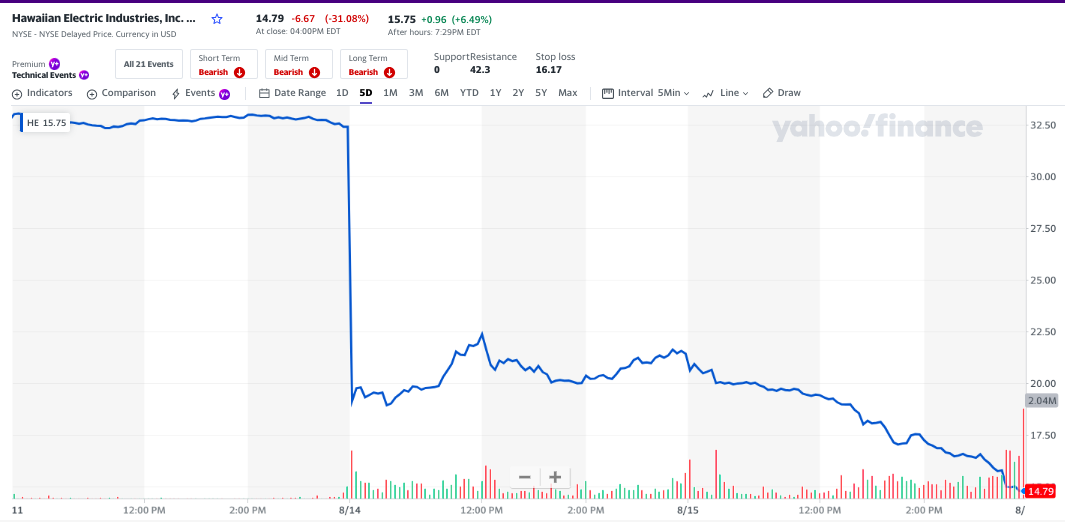
The Lahaina fires began on Tuesday, Aug. 8.; HE stock took over a 50% hit this Monday and Tuesday.
Whether justified or not, Hawaiian Electric Industries is now accused of bearing major responsibility for the Lahaina fire:
The selloff continues in shares of troubled utility Hawaiian Electric Industries.

The stock fell another 24% on Tuesday after Monday’s plunge, on fears the utility could be held liable for the wildfires that have devastated Maui.

The stock recently traded around $16.

Wells Fargo analysts cut their price target to $25 per share on Monday. “While it remains unclear if any of HE’s equipment directly caused any of the wildfires, we believe it prudent to account for the risk,” they wrote.

All told, the stock has dropped about 50% so far this week, according to FactSet; that’s the stock's worst two-day selloff on record dating back to 1983, according to Dow Jones Market Data.
Honolulu: as power needs grow, the tangles get worse.
In 2017, as California wildfire liabilities drove PG&E into bankruptcy, I wrote:
Telephone poles and overhead power lines have been a ubiquitous part of the Honolulu landscape ever since I can remember. They're still in every neighborhood a half-century later despite the danger and poor esthetics. The cost of burying infrastructure (electricity, trains) is enormously expensive, so little has been done.

In Napa and Sonoma counties Pacific Gas and Electric faces similar costs to Hawaiian Electric and did not bury most of its power lines.
At today's close, HE had a $1.6 billion market cap, and there's not much flesh to scavenge from its bones. Any substantial recompense will have to come from Hawaii ratepayers.

Friday, April 21, 2023

And So It Goes.....Maybe

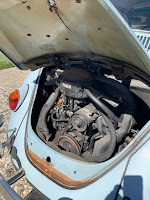
Having encountered a malfunctioning electrical system, I hadn't run the VW Bug since last fall. Big mistake. Some problems go away if you ignore them, but not if they have to do with cars.

The battery had fully discharged in the interim, and I tried to jump-start the engine to no avail. The gas had completely evaporated.

I poured three gallons into the tank and, using a plastic syringe, injected fuel into the line to the carburetor. The engine caught briefly, but the gas wasn't getting through.

The poor man's "fuel injection" failed, but I'll keep futzing with the lines, fuel pump, and carburetor to get it running.

Eventually I'll take the car to a repair shop, but pride won't let me have it towed. In the meantime, I replaced the battery, and we'll see how it goes.

Sunday, January 15, 2023

Thinking Like a Greek

We live in an age of specialization and compartmentalization. Science, religion, mathematics, politics, philosophy, and literature are separate fields of study. Each of these has dozens of sub-categories with their own terminologies and modes of thinking.

However, the ancient Greeks
didn't make a distinction between philosophy and science, nor did they recognize the range of disciplines such as physics, chemistry, mathematics, astronomy, etc. that we do today. There simply wasn't the depth of knowledge and range of information that later made separate disciplines practical. In the Greek era, one individual could be an expert in several fields.
The splintering of knowledge makes it difficult to recognize patterns that may cross knowledge silos. More importantly, some believe that there is a deeper underlying reality to the universe that is understood only piecemeal by experts in their respective specialties. No human being has yet fully grasped, much less been able to explain to his fellow creatures, such a reality.

In a book to be released this Tuesday, Professor of theoretical physics Heinrich Päs ponders the "One."
his book proposes, rather than a definitive answer, an exploration of both the mind-bending conclusions of modern physics and the long history of the beguiling notion of a unifying, universal fabric. His book proves a heady mix of history, philosophy and cutting-edge theory that is fascinating, provocative and at times infuriating.
I'm a sucker for these books that explain the nature of the universe, where it came from and where it's going. If the writer presumes to discuss the nature of man, then I must resist the temptation to tell him to stay in his lane, which in this case is theoretical physics. He's thinking like an ancient Greek.

Wednesday, January 04, 2023

One Day to Prepare

Water exited under the fence.
Sunday's rain flooded the backyard, and the storm water exited under the fence to the street.

Yesterday was spent smoothing over the channel, then digging a trench to direct the water elsewhere (we have poor drainage).

Outside the fence the dirt was covered with a garden cloth to reduce erosion.

These moves may not be enough to protect against the more intense winds and rain that will begin tonight, but admittedly our problems are minor compared to our fellow citizens.

Papering over the problem.
Wednesday night headline: strong winds and heavy rain batter Bay Area
With many more hours of rain and winds yet to come into Thursday morning, the tempest had already left its mark, with at least one fatality and widespread havoc across the larger Bay Area, including downed power lines, blocked roads, mudslides and more.

Images of a massive bomb cyclone showed a thick swirling band slamming into the Northern California coast, pushing wind gusts over 40 mph around the Bay and into the 80 mph range at higher elevations by early evening.

Reports poured in of downed power lines in Marin County, waves pitching over the Embarcadero in San Francisco, fallen trees blocking both lanes of Hwy. 1 in Mendocino County, mudslides near multimillion-dollar homes in San Jose, flooding and washed-out trails in San Mateo County and evacuations in Richmond below a fissure-covered hillside.
41,000 PG&E customers on the Peninsula are without power. So far, so good. I hope our luck holds up.

Saturday, June 25, 2022

Klamath Tear-Down: Trust the Cost-Benefit Analysis

(Chronicle map)
California has dire need for both water and electricity. Hydroelectric dams provide both, and do so without producing carbon emissions. One would be hard pressed to find a more beneficial example of human engineering.

At first blush it doesn't make sense that four hydroelectric dams on the Klamath River will be torn down.
the largest dam-removal project in U.S. history is expected to begin in California’s far north next year.

The first of four aging dams on the Klamath River, the 250-mile waterway that originates in southern Oregon’s towering Cascades and empties along the rugged Northern California coast, is on track to come down in fall 2023. Two others nearby and one across the state line will follow.
Environmentalists and fishermen are eagerly anticipating the restoration of the Klamath chinook salmon run, which once totalled in the hundreds of thousands but is now 10% of that number. But the principal reason for the tear-down is that the cost of maintaining aging dams exceeds the benefit of electricity generation, and "the dams are not used for irrigation, municipal water or flood control."
The plan to raze the dams is the product of at least 20 years of debate over what to do with the river’s old and increasingly problematic infrastructure.

Owned by power company PacifiCorp, a subsidiary of billionaire Warren Buffett’s Berkshire Hathaway, the dams have long needed major upgrades, including fish ladders, which are believed to cost more than the dams’ worth as hydroelectric assets...
Despite the cost-benefit analysis, some residents are reluctant "to surrender any power source and [have] less water available for fighting wildfires." We just have to trust that Warren Buffett's company knows what it's doing, a good bet based on Mr. Buffett's past record of determining value.

Related: in 2018 Stanford University brought together environmental groups and hydropower interests, who are known for their vehement disagreements, to discuss how to generate more electricity while improving the health of rivers. They already can point to some successes.

Saturday, June 18, 2022

California on the Precipice

Lake Tahoe is shrinking (Chron photo)
We take a break from looking at our incredibly shrinking stock portfolio to worrying about the apocalyptic summer in store for Californians: [bold added]
This year’s extraordinarily dry, warm weather, which is expected to continue in the coming months, is stoking fears of a multitude of problems: increasing water restrictions, extreme heat, blackouts, wildfire and smoke — potentially all of the above in one vicious swoop...

Already in California, climate volatility, as palpable as it’s been, has joined the list of reasons people cite for wanting to move away, after soaring home prices, high taxes and traffic. The state’s population, which had grown for decades, dropped in each of the past two years.

“We have people say they’re concerned about drought, they’re concerned about wildfire,” said Scott Fuller, founder of LeavingTheBayArea.com, a 7-year-old real estate company that helps people relocate. “We’ve had clients say this is literally the final straw.”
And we haven't even mentioned the danger that most concerned us during the last century: a major earthquake.

Should the latter happen, that really will be the last straw for millions of soon-to-be ex-Californians. Will the last one out the door please close the lights, if they're not out already?

Friday, April 22, 2022

Earth Day, 2022: Going Nuclear

Even Democrats are having second thoughts about
closing Diablo Canyon in 2025. (Chron photo)
On Earth Day, 2022 there are signs that the decades-long freeze against nuclear energy is over.

Biden launches $6 billion effort to save nuclear power plants
The Biden administration is launching a $6 billion effort to rescue nuclear power plants at risk of closing, citing the need to continue nuclear energy as a carbon-free source of power that helps to combat climate change...The program was funded through President Joe Biden's $1 trillion infrastructure deal, which he signed into law in November.
Question Asked: Can Coal Plants Turn Into Nuclear Reactors? [bold added]
the main issues are that you have these coal plants that are closing down that have an experienced workforce. So you could tap into the workforce, you could save some jobs, and help out local economies. And that you would reuse the site in a sense that you have these valuable grid connections that are there and that you could do something with that. And then that you would be replacing coal essentially with a cleaner energy, that nuclear is a no carbon way to make electricity. So the idea behind modular nuclear reactors is that they are smaller and faster to build.
Bill Gates’ TerraPower aims to build its first advanced nuclear reactor in a coal town in Wyoming
The Kemmerer plant will be the first to use an advanced nuclear design called Natrium, developed by TerraPower with GE-Hitachi.

Natrium plants use liquid sodium as a cooling agent instead of water. Sodium has a higher boiling point and can absorb more heat than water, which means high pressure does not build up inside the reactor, reducing the risk of an explosion...

Natrium plants can also store heat in tanks of molten salt, conserving the energy for later use like a battery and enabling the plant to bump its capacity up from 345 to 500 megawatts for five hours.

The plants are also smaller than conventional nuclear power plants, which should make them faster and cheaper to build than conventional power plants. TerraPower aims to get the cost of its plants down to $1 billion, a quarter of the budget for the first one in Kemmerer.
Nuclear power plants designed a half-century ago are being matched against today's solar and wind power technology. Comparing all non-fossil-fuel sources of energy for their current safety, cost, and reliability is a much more honest analysis.

Thursday, December 30, 2021

A Lot of Trouble to Replace

Bent out of shape: I did that without help.
The best $150 I ever spent was in 2008.

Our 20-year-old dryer was irredeemably broken, and the new dryers at the time were too wide and cost at least $500, not including tax, installation, and hauling the old one out. On Craigslist the ideal replacement miraculously appeared. It was narrow enough, and the door hinge was at the bottom which was a "try-for" specification from the household CEO.

The seller, a lady in Palo Alto, had bought a new laundry pair and thought she could find a use for her old dryer but had given up trying. Her Kenmore had been sitting on the back patio for a year, covered with a tarpaulin. Before taking it, I asked her to plug it in to prove that it worked. It did.

The dryer easily fit in the 11-year-old Dodge Grand Caravan. (I always use an old car--for different reasons, of course--when I have to negotiate a purchase, do charity work, or go to crime-ridden areas like San Francisco.) The used dryer worked like a champ, and the garbage haulers took the old dryer on one of the two annual bulk-disposal days.

[Note: I forgot that I had blogged about the purchase in 2009. Most of the details are still clear in my memory. I'm not that far gone....yet.]

This week the dryer that had served us for 13 years finally failed. The drum turns but doesn't heat; the problem was likely due to one of three parts, said the Internet, each of which costs less than $50. But first the bottom cover plate has to be opened. It had never been removed by myself, nor likely the original owner, too, so I'm using brute strength and WD-40 against the rusty metal. So I can't even get to step 2: testing the continuity on the three parts to see which of them is busted. So I'll be spending a bit more time, probably through New Year's weekend, working the problem before giving up.

Fortunately for me the household CEO did not act disappointed though I bent the bottom plate out of shape. She knows that the hired help doesn't respond well to criticism and will be a lot of trouble to replace.

Thursday, December 23, 2021

Diablo Canyon: the Ground is Shifting

Diablo Canyon (Chron photo)
In California environmentalists won the debate over nuclear power long ago. New construction was halted, and existing plants were decommissioned. The last nuclear power plant, Diablo Canyon, is scheduled to be closed in 2025.

Second thoughts have arisen about the shuttering of Diablo Canyon. The belief in the "existential threat" of global warming has become widespread, and eliminating 9.6% of California's energy production, especially since nuclear power is carbon-free, seems foolish.

The danger from earthquakes has not diminished, but the relative importance of carbon-free generation has increased, especially given California's ambitious targets for zero-carbon electricity production.

Stanford and MIT researchers have proposed two additional reasons why Diablo Canyon should remain open, reasons that did not seem important in 2018 when the plant was ordered to be closed. [bold added]
Intriguingly, the study suggests adding a desalination plant to the site to address water shortages in our drought-prone state. A desalination plant powered by Diablo Canyon could produce as much fresh water as the controversial project to build a tunnel under the Sacramento-San Joaquin River Delta, the study says.

Diablo’s nuclear power also could be used to produce more of the hydrogen-based, zero-carbon fuels the state will need to transition to carbon neutrality. Stanford and MIT found that hydrogen produced by Diablo could cost up to 50% less than hydrogen produced via solar and wind power, and would require much less land...

Such possibilities weren’t on the table when the 2025 closure was approved back in 2018. Other realities have changed as well. Drought conditions and water shortages have increased, blackouts have become more common, and California and the world have learned more about the value of reliable nuclear energy in stabilizing the electric grid during the shift to renewables.
Also significant is the fact that present and former members of Democratic Administrations do not support the shutdown.
Leading federal officials, including current Energy Secretary Jennifer Granholm and her predecessors (notably the Nobel Prize-winning Stanford physicist Steven Chu) are pushing to keep the plant open.
Progressives have dominated coastal politics, but their visible failures in crime, education, and homelessness and housing have tarnished their aura of invincibility. Now some Democrats are pushing back against unbending anti-nuclear policies. I can feel the ground shifting.

Monday, October 18, 2021

Annoyances Ahead

A 43-year-old house, 54-year-old car, and 7-year-old laptop computer have something in common: they all have parts that are breaking down.

Last week the faucet was dripping (I couldn't let it go with water rationing on the horizon), the VW Bug wouldn't run because of a fuel-line and electrical issue, and the MacBook battery was totally kaput (it would shut down immediately if the power cord were disconnected).

Fixing these annoyances doesn't require a SpaceX scientist, but it doesn't help matters that the repair guy himself has parts that are giving him problems.

It should be a challenging week.

Tuesday, August 10, 2021

No Savings for a Sunny Day

"Lake" Oroville on July 22, 2021 (Chronicle photo)
The Lake Oroville hydroelectric plant has been shut down due to the drought:
It was the first time the Hyatt Powerplant at Lake Oroville has been shut down because of low lake levels since it was constructed....Hyatt is the fourth-largest hydroelectric energy producer in California, authorities said.
It was only four years ago that there was so much rain and snow during the winter that the water pouring over the Oroville Dam threatened the collapse of the spillway.

Oroville in 2017
The failure to add water storage capacity to save for a sunny day--and to upgrade existing dams and reservoirs--is another consequence of a Progressive governance that wasted multi-$billions on a high-speed rail system and decommissioned reliable, carbon-free nuclear power plants.

The inability to provide adequate water, not to mention electrical power, is a feature of a developed society, and it's a reasonable question whether California fulfills even that basic definition.

Sunday, July 11, 2021

Pray for Rain

The Foster City lagoon, fed from rainwater, shows the effects of drought.
As if the coronavirus and wildfires aren't enough, California is experiencing a record drought.

California drought: Bay Area, state hit 126-year lows for rainfall this year
The Bay Area got only 9.88 inches of rain this season, 39% of its normal amount of 25.28 inches, Golden Gate Weather Services said. That’s the least ever, going back to 1895.

California got 11.46 inches, or 49% of its normal 23.61 inches. That’s also the least ever...

The years of low rainfall were similar to what California went through in the mid-1970s, [meteorologist Jan] Null said.

The dearth of water will have its greatest effect on agriculture, which accounts for 80% of water use in the state. Household use makes up only 10% of water usage, he said.
One of the wealthiest and most technologically advanced regions in the world cannot provide basic services like water and electricity to its residents.

The methodology already exists--building hydroelectric dams and desalination plants--to alleviate the shortages. The finances can be mustered, as demonstrated by the $billions that have been raised for homelessness and high-speed rail. Even the usual environmental show-stoppers can be over-ridden, as in the case of building high-rises in dense urban centers.

The necessity is there; all that's missing is the desire and the will.

Meanwhile, we do what people have done for thousands of years and pray for rain.

Wednesday, March 31, 2021

The Joke Backfired

Volkswagen made an April Fool's joke related to the intense interest in electric cars. Unfortunately the joke backfired:
Volkswagen AG’s U.S. subsidiary said Tuesday the company would rebrand itself as Voltswagen of America to promote its electric car strategy, but a spokesman for the parent company in Germany later said the move was a joke.

The name change, which immediately lit up social media and online news sites, was originally intended as an early April Fools’ Day stunt to get people talking about VW’s ambitious electric car strategy.
Too bad, the Volkswagen-with-a-K nameplate on my 1967 Beetle could have become a collector's item.

Saturday, November 21, 2020

Deferred Gratification: One Key to Happiness

My lifelong cheapness frugality, besides helping augment the retirement nest egg, has another benefit, as noted in 2013 when the 35-year-old furnace was replaced.
technology is advancing at such a rapid rate that the replacement unit, even one with just average features, is leaps and bounds ahead of the unit that it replaced. The new system is cleaner, quieter, and much more energy efficient. It has an electronic ignition, i.e., no pilot light.
We've encountered the replacement-is-so-much-better-than-the-original phenomenon when we junked our 18-year-old unfixable car in favor of a hybrid.

Even small items like electrical outlets (pictured) are much improved. The replacement to a 30-year part that had become loose had more secure grounding screws, an LED power-detection light, and USB-A and USB-C slots to charge cellphones and tablets.

Today's wisdom: there is happiness in being able to fix things oneself and, when replacement is finally necessary, happiness in marveling at how the new one is so much better. (Note: this does NOT apply to relationships.)

Saturday, August 15, 2020

Government Gas & Electric, Continued

Our home's central air-conditioning has not worked for at least 20 years, and I've been too cheap frugal to replace it. Besides, I'm being environmentally virtuous by suffering through the heat--currently 97°F--and not drawing fossil-fuel-originated electricity from the grid. (Yes, I plan to flaunt my green virtue to neighbors by installing solar panels with battery backup when the technology improves a bit.)

The planned rolling blackouts have begun: [bold added]
Current PG&E outage map at 6:15 p.m. today. Color code
for #customers affected: Green,1-49; Yellow, 50-499
Orange, 500-4,999, Red 5,000+
The rotating outages were ordered because of the increased electricity demand from customers running air conditioners and other devices. Demand outpaced available supply...

Today, California faces very different circumstances after spending much of the past two decades greening its power supply with large-scale wind and solar farms. The state has almost eliminated coal-fired generation and has been reducing its reliance on natural gas in favor of renewables, particularly solar power.

That poses a supply challenge when electricity demand jumps. Solar-energy production begins to decline in the early evening hours, when power usage peaks, reducing the capacity available during a supply crunch.

The California grid operator has complex, comprehensive plans in place to address such challenges. When demand surges, California relies more heavily on power imported from neighboring states, and natural-gas-fired power plants capable of firing up quickly are kept on standby. But during Friday’s blackouts, some of that power didn’t materialize as expected.

“The capacity that was supposed to be available just didn’t show up,” said Michael Wara, head of the climate and energy policy program at Stanford University’s Woods Institute. He said more information is necessary to determine exactly why the blackouts were necessary.
Last year we marveled at the demands placed on PG&E.
  • Deliver electricity and natural gas reliably to 16 million Californians;
  • Charge customers as low a rate as possible;
  • Earn a profit for investors, including a regular dividend;
  • Clear trees and brush to reduce the risk of wildfires;
  • Provide generous salary, medical and pension benefits in accordance with union contracts;
  • Repair and replace its aging infrastructure with less efficient and more costly carbon-minimizing energy sources (principally windmills and solar, but not nuclear);
  • Decommission Diablo Canyon, its last nuclear power plant, for an estimated $4.8 billion beginning in 2024;
  • Meet Environmental, Social, and Governance (ESG) standards;
  • Pay $billions in damages for its culpability in the 2017-2019 wildfires.
  • Transfer hundreds of thousands of acres to tribes and public agencies per agreements dating back to 2001.
  • The cries for a government takeover of the utility have intensified. Your humble blogger approves.

    Rather than continue the everlasting arguments about socialism vs, capitalism, socialists can prove the superiority of their system by running PG&E cheaper (it won't have to pay dividends) and more reliably.

    With all the money saved I might even loosen the pursestrings for central air.

    Thursday, October 17, 2019

    Across the Lagoon

    The night was cold and clear. An hour before midnight I had the boardwalk to myself. Across the lagoon the lights on Whaler's Island shone brightly.

    It was late on Thursday, but after last week's power shut down maybe we're all appreciating the lights a little bit more.

    Update: 10/18/2019 - The houses do seem more cheery in the sunlight.