Showing posts with label Star Trek. Show all posts

Tuesday, April 14, 2020

Too High a Price

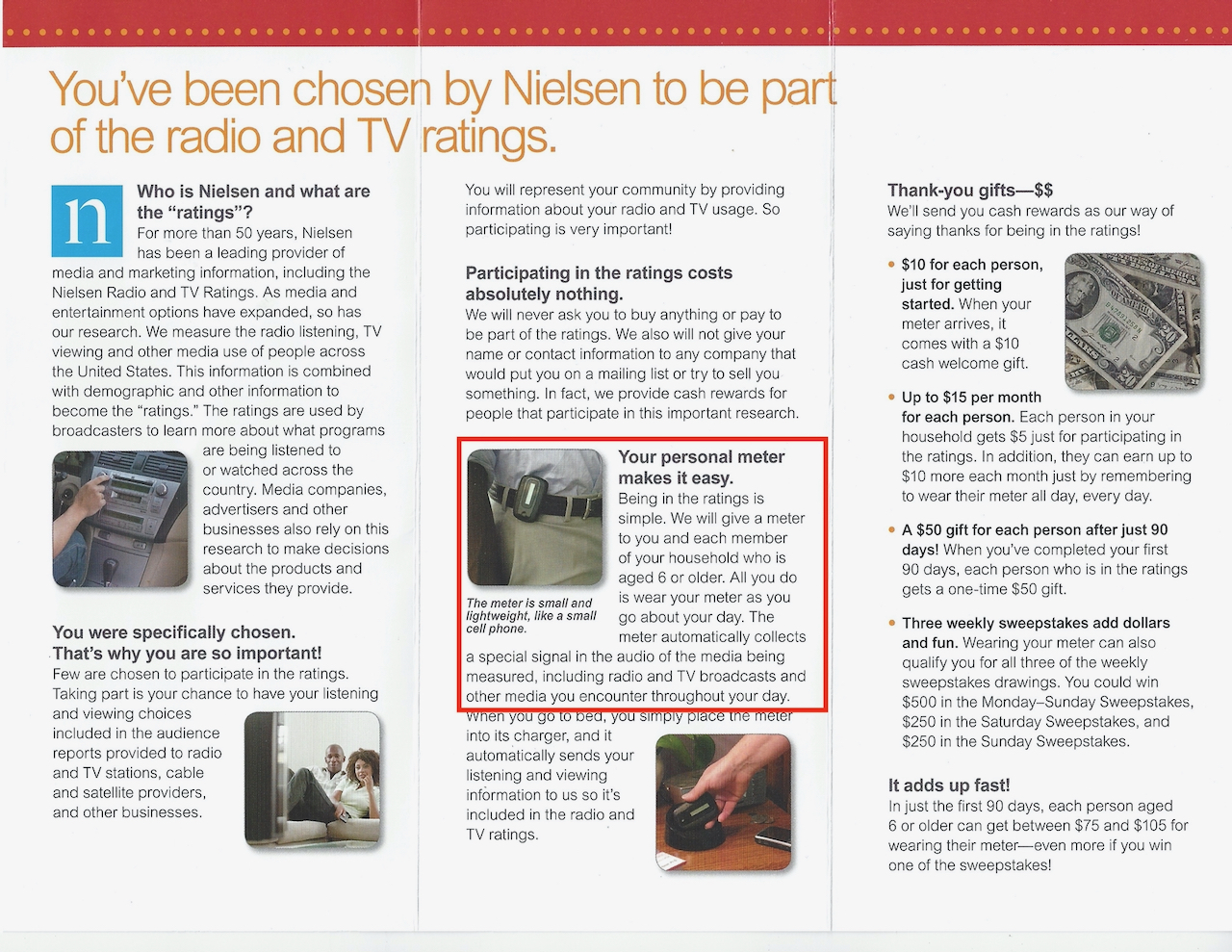
Wearing a personal meter all day is a bit more invasive than a 1970's set-top box
When broadcast television was the dominant medium, I thought that it would be a personal coup to be an A.C. Neilsen member. Not only would the company pay a stipend to allow it to track my T.V. viewing, I would be an influencer long before that became a word. I could put Star Trek back on the air by watching reruns 24/7!

When consumers began viewing programs whenever they wanted over a multitude of devices, Nielsen found it difficult to gather reliable, comprehensive ratings data. Their solution to replace the old set-top box:
"All you have to do is wear your meter as you go about your day."
It may be inevitable that privacy is dead, but we don't have to speed its demise. Sorry, Nielsen, I'm not going to be a member.

Later in life I've found that I don't want many of the things that I wanted in my youth.

Besides, I have to catch up on the more than half-dozen Star Trek series that have been produced in the past 30 years.

Monday, June 24, 2019

Moment Captured

Allie, the humpback whale, breaches with SF in the background (Susie Kelly photo)
In a photo reminiscent of Star Trek IV: The Voyage Home a humpback whale breaches in San Francisco Bay.
Humpbacks have long pectoral fins and distinctive knobby heads and can grow to 52 feet long and weigh almost 80,000 pounds. The species, known for its acrobatic breaching, makes its north-south migration about this time every year, but unlike grays, which make a beeline to the arctic, a lot of them feed along the coast off San Francisco.

Humpbacks were first seen entering San Francisco Bay in significant numbers during the spring and summer of 2016. Since then, [Bill Keener of the Marine Mammal Center] said, 70 humpbacks have been identified feeding in the bay and many more congregate between April and November outside the Golden Gate, in Monterey and Bodega bays and around the Farallon Islands. This is the first one he has seen that isn’t healthy.
"Allie's" mottled skin shows that she's in poor health. Most humpbacks not only are in good condition, but their numbers are growing.

That's a hopeful sign that Star Trek's 23rd-century whale-extinct universe will stay fictional.

Monday, June 04, 2018

The Old Ways Are New Again

Star Trek: Ascendancy - a new, old-school game.
Several millennial family members are late-arriving fans of table games. Your humble blogger--an avid game-player (e.g., bridge, chess, Scrabble, cribbage, mahjong) in his youth because, if truth be told, there were no electronic options---responds favorably to invitations to join in.

There are health advantages--socializing can ward off dementia and handling cards or game pieces maintains fine-motor dexterity--but more importantly it's an in-person way of spending time with family and friends. Also, as the Wall Street Journal advises, it's a way for seniors to have fun.
older adults have more time to have fun—7½ hours of leisure a day compared with 35-to-44-year-olds, who have only around 4 hours, according to a 2016 study by Merrill Lynch and Age Wave...

many adults forget how to have fun. They’ve spent the past 40 years showing up for work every day, paying off mortgages, getting kids through school and taking care of aging parents. Having fun and being spontaneous —a key element of fun and play—gets lost. It’s considered nonproductive, which makes some people feel guilty.

Fun is important at every age but can be even more beneficial as we grow older. The very things associated with it—laughter, levity, enjoyment, diversion—can act as antidotes to stress, depression, and anxiety. It often involves being with others, and social connections are linked to better cognitive health in later life and lower likelihood of developing dementia.
In Star Trek: Ascendancy, however, I may have bitten off more than I could chew. ST:A has instructions that are more voluminous than Monopoly, bridge, or chess. (A well-designed game, IMHO, has simple rules but may take years to master; a good example is Texas Hold'em.) The seemingly arbitrary rules reminded me of "Fizzbin", a game discussed by Captain Kirk in a 1968 Star Trek episode.

The millennials had blank looks when I mentioned Fizzbin, so it was time to pass on this important cultural reference to the next generation. Take that, Angry Birds.

Friday, August 11, 2017

In the 21st Century We Still Care a Lot

One of the running off-camera jokes in Star Trek was the follically challenged Captain Picard: [bold added]
(Photo from startrek.com)
At a press conference about Star Trek: The Next Generation, a reporter asked Star Trek creator Gene Roddenberry about casting Patrick Stewart, commenting that "Surely by the 24th century, they would have found a cure for male pattern baldness." Gene Roddenberry had the perfect response.

"No, by the 24th century, no one will care."
Finding the causes and cure for hair loss has been slow. While a few men embrace the condition by shaving their remaining hair,
most men who suffer from male pattern baldness are extremely unhappy with their situation and would do anything to change it. Hair loss affects every aspect of their life. It affects interpersonal relationships as well as their professional life. It is not uncommon for men to change their career paths because of hair loss.
Minoxidil (brand name: Rogaine) has regrown hair in about 40% of patients. Other sufferers resort to hair transplants and toupees.

Your humble blogger has long suspected that a hirsute maternal grandfather was the reason he is able to retain his hair past middle age. The science confirms:
androgenetic alopecia....affects around 80% of men by the time they are 80 years old (and about 50% of women, though it’s less obvious), and is characterized by thinning at the top of the head and receding at the front. Genes are primarily to blame, says [UCLA professor Carolyn] Goh. The most consistent is found on the X chromosome, “which means it came from your mother’s side,” she says.
But why do I have more hair than my younger brothers? As I was saying, progress has been slow....

Wednesday, May 03, 2017

Making the Navy Great Again

The Zumwalt in San Diego (NRO photo)
Amidst the hoopla of the election, we missed the commissioning of the U.S. Navy's $4.4 billion battleship, the Zumwalt.

The first of the "Zumwalt" class of destroyers, the ship has been plagued by cost overruns and failures of unproven technology.

When (and if) it becomes fully operational, according to Vice Admiral Tom Rowden
Its advanced technology and capabilities allow it to do a range of defensive and offensive missions, and project power, wherever it is needed, and that's generating tremendous excitement within the Navy, Rowden said.
USN Capt. James A. Kirk
We are nevertheless confident that its missions will be successful. The commander of the Zumwalt is (drumroll)...Captain James Kirk!

Saturday, September 10, 2016

Memories of the Five-Year Mission

(Photo from startrek.com)
Though we didn't have a strict rule against watching on school nights, I missed most of 1960's television. In those days, kids, there were after-school activities, homework frequently required researching "books" in "libraries," and free time was much better spent with friends than looking at grainy black-and-white images displayed on a tiny box in the living room.

I missed Star Trek's debut on KHON in Hawaii on September 15, 1966--there was a one-week lag from the Mainland debut as programs had to be flown in on "tape-delay"--and only managed to catch a few episodes during its three-year run on the NBC affiliate. (I distinctly remember the Devil in the Dark, which had the monster that turned out to be a mother protecting her young; William Shatner called it his favorite episode.)

After we got jobs and bought a television, we would relax every night by watching Star Trek reruns.

Volumes have been written about Star Trek's impact on the culture---the crew's diversity, the first inter-racial kiss on network television, the coverage of controversial themes in an outer-space setting---but for your humble blogger, who had the rules of proper English drummed into him throughout elementary school, the most jarring aspect of Star Trek occurred at the beginning of each episode when William Shatner intoned "to boldly go where no man has gone before."

Breaking the Prime Directive is bad enough, but splitting an infinitive? In space no one can hear English teachers scream.

Wednesday, May 27, 2015

In Space No One Can Hear You Wrinkle

Space fantasy: the women of Star Trek (marysue.com image)
Engine whooshes in airless space, transporter beams, and faster-than-light speeds aren't the only scientifically questionable features of Star Trek episodes; a crew that is supermodel-beautiful is just as impossible.

Over the past 20 years some astronauts have reported "deleterious effects" (lesions, thinning, loss of elasticity) on their skin. An examination of six mice who spent 91 days on the International Space Station suggests that the cause may be more than space capsule air:
The astromice suffered profound changes to their skin during their sojourn. The team found that the skin of the astro-mice was 15% thinner than that of their grounded counterparts.....The more that researchers look for detrimental physiological changes in animals and humans that have been to space, the more they seem to find.
Too much sunlight on the earth's surface ages the skin. In space the sun's radiation is over a thousand times more powerful. As they say, do the math.

Friday, February 27, 2015

The Death of Spock

(Popular Mechanics photo)
Leonard Nimoy, the actor who played Spock, died today at the age of 83.

I missed Star Trek when it first came out but became an avid viewer of the reruns during the 1970's. We joined the legions that yearned for more tales (there were only 79 episodes in the original series) of the Starship Enterprise. Yes, we confess to watching the cartoons--excuse me, the animated series--on Saturday mornings.

The spectacular success of 1977's Star Wars caused the studios to green-light numerous science-fiction projects, Star Trek among them. By 1982, when Star Trek II: The Wrath of Khan was released, Kirk, Spock, the Enterprise, and other members of the cast had become popular icons.

We saw the Wrath of Khan the first weekend (movie critics were diligent about not revealing spoilers), and watched in stunned silence as Spock died at the end to save the Enterprise. How dare they kill off a beloved character?

I confess to shedding a tear at the memorial service, in which William Shatner's short eulogy ranks with his best acting as Captain Kirk. The ceremony culminated with the release of Spock's casket into space, accompanied by the bagpipe strains of Amazing Grace, an instrument-music combination that has since become a cliché.

Spock's character was resurrected in Star Trek III two years later, an interval that we fans felt interminable, and Leonard Nimoy went on to more success not only playing Spock but directing, writing, hosting, producing, and acting. A life that brought many hours of enjoyment to millions of fans came to a close earlier today, but it was his character's movie death that I'll always remember. R.I.P.
Wednesday, February 20, 2013

And How Do YOU Look 25 Years Later?

1987: Slim and Sleek (Sfgate photos)
2012: the spandex would be even more uncomfortable
Initially hesitant, I became a faithful viewer of Star Trek: the Next Generation through its seven seasons from 1987 to 1994.

To fans of the original "Star Trek Classic", it was disconcerting to encounter a universe where the Klingons were (surly) allies, and phasers were unholstered only as a last resort.

Captain Jean-Luc Picard, played by Patrick Stewart, was an educated Frenchman whose English accent suited Star Fleet's preference for diplomatic solutions. Unlike the previous century's James T. Kirk, Captain Picard largely left the romancing and fighting to an athletic cast of underlings.

25 years later, the actors have aged gracefully for the most part, but noticeably. High-resolution close-ups won't make for a boffo box office, so the Enterprise-D has given way to a re-imagining of the Classic series on film with a young, attractive crew. The Next Generation has become passé and old, the fate of everything that was once bright and shiny.

Monday, December 10, 2012

Though It's About the Future: "We don't have music like that anymore."

I'm not too proud to admit that I'm enough of a geek to get goosebumps when the full-orchestral version of the Star Trek theme [flash required] plays on the stereo. (It could just be the appoggiatura.) "We don't have music like that anymore."
For all of its visions of weird life-forms, "Star Trek" was at heart a drama about human beings. So creator and executive producer Gene Roddenberry elected to depict their emotional states through time-honored and accessible means—with instruments and orchestras, not synthesizers, theremins or other trendy electronic gimmicks.
In the four-minute video below the late, aptly-named composer Alexander Courage describes how he put together the piece in one week and how it was taped in a single session. His solution to find an appropriate sound (the "swoosh") for the spaceship moving across the screen was especially inspired:

Saturday, November 19, 2011

The Man Knows Turkeys

William Shatner makes a timely public service announcement about the dangers of turkey fryers:
Shatner says in real life, he has burned himself, and almost burned his house down, as a result of mishaps stemming from deep-frying turkeys.
In 1989 William Shatner nearly killed off the Star Trek franchise when he wrote, directed, and starred in Star Trek V: the Final Frontier, universally judged to be the worst Star Trek movie ever.