Showing posts with label Surveillance. Show all posts

Thursday, February 15, 2024

No Panacea

(Vancouver Sun photo)
In the nether world between jail and release-upon-recognizance, ankle monitors are a tool favored by the justice system. However, one example shows how ineffective they can be:
Over a span of three years, judges had placed [Shaun] Bailey on electronic monitoring four times — and all four times, Bailey violated the conditions of the program, the filing said. On two occasions, he cut off his ankle monitor. In two other instances, he absconded from a treatment program the day he was admitted.

Yet, despite the arguments of prosecutor Rachel Schneider, Superior Court Judge Victor Hwang placed Bailey on electronic monitoring a fifth time. Roughly a week later, Bailey was arrested again on suspicion of robbing someone at an ATM machine on Columbus Avenue. His defense attorneys declined to comment.

To some law enforcement officials, elected leaders and court watchdogs, Bailey’s brushes with the criminal justice system illustrate a larger problem: that in an effort to release people from jail before trial, judges rely too much on electronic monitors as a form of supervision, even though evidence shows that the monitors often don’t work to deter criminal behavior.
The use of ankle bracelets is exploding, though effectiveness is, to say the least, spotty. [bold added]
San Francisco’s use of pretrial electronic monitoring rose more than twentyfold from 2017 to 2021, according to a 2022 report by UC Berkeley’s California Policy Lab.

Before 2018, the city averaged 75 cases a year. By 2021, the number had jumped to 1,650. As of Feb. 11, Sheriff Paul Miyamoto’s office was supervising 408 people on ankle monitors, all but two of them awaiting trial.

But the devices didn’t seem to be working well. People were cutting them off, tampering with them, throwing them in garbage dumps or in the bay, forgetting to charge the batteries or venturing outside their designated boundaries.

In July 2021, Miyamoto said his office was overseeing 328 people on ankle trackers, and more than a third of them — 126 — had an arrest warrant out for failing to comply. One person in the program between 2020 and 2021 was accused of breaching the rules nine times.

The California Policy Lab report found that in 2021, 60% of defendants placed on electronic monitors prior to trial in San Francisco violated their terms, with more than one-fifth arrested for new crimes.
Abolishing the carceral state is a goal of Progressivism. The least Progressives can do is put resources behind improving the monitoring technology to protect both the public and the criminals who they feel such sympathy for.

In related news thousands of illegal aliens have been released and subsequently tracked with ankle bracelets. In an August, 2023 report
Less than 2% of families arrested at the border in recent months have been selected to be put into FERM [Family Expedited Removal Management], but administration officials have said the program is rapidly expanding and they hope to eventually put a majority of families crossing the border illegally through it.
Hope that works out!

Tuesday, April 14, 2020

Too High a Price

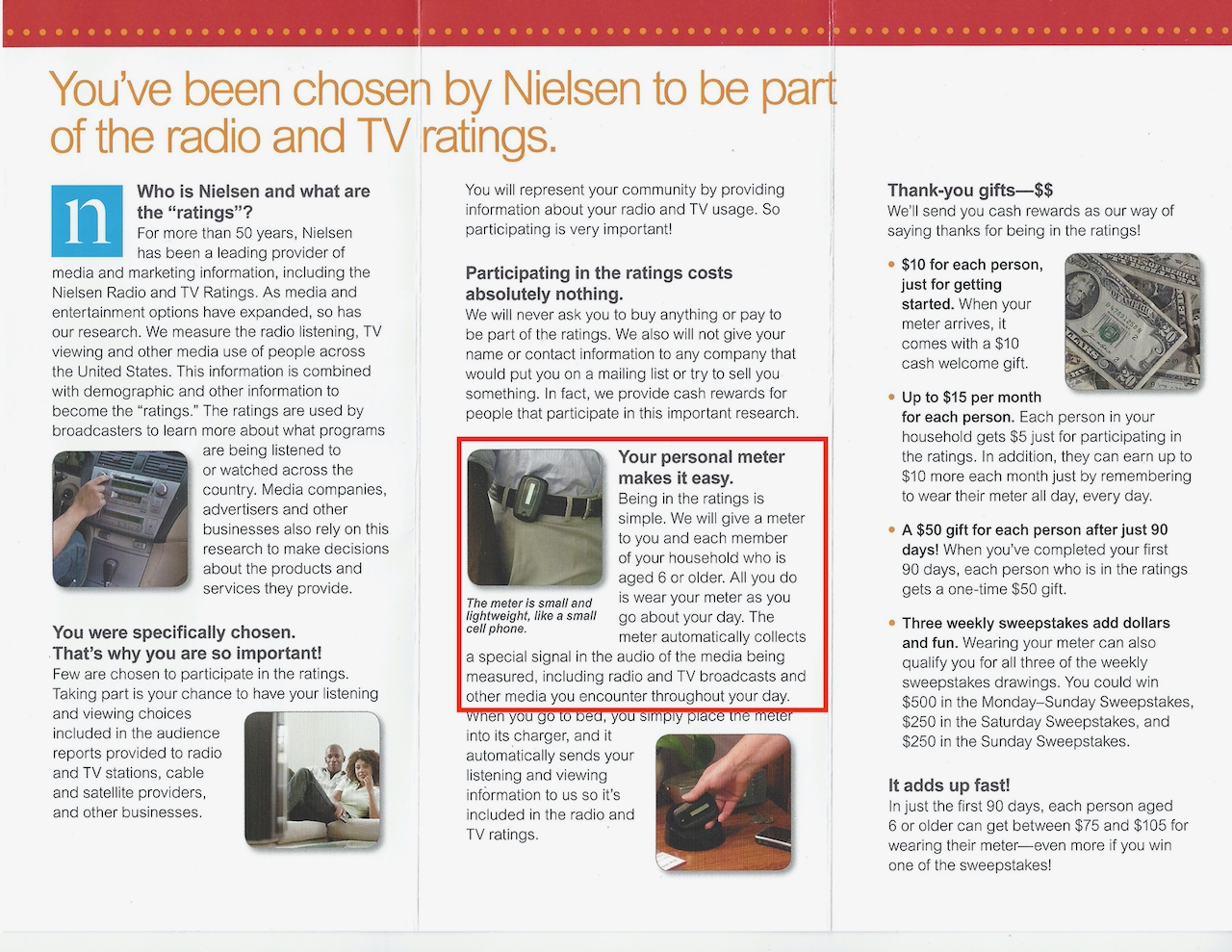
Wearing a personal meter all day is a bit more invasive than a 1970's set-top box
When broadcast television was the dominant medium, I thought that it would be a personal coup to be an A.C. Neilsen member. Not only would the company pay a stipend to allow it to track my T.V. viewing, I would be an influencer long before that became a word. I could put Star Trek back on the air by watching reruns 24/7!

When consumers began viewing programs whenever they wanted over a multitude of devices, Nielsen found it difficult to gather reliable, comprehensive ratings data. Their solution to replace the old set-top box:
"All you have to do is wear your meter as you go about your day."
It may be inevitable that privacy is dead, but we don't have to speed its demise. Sorry, Nielsen, I'm not going to be a member.

Later in life I've found that I don't want many of the things that I wanted in my youth.

Besides, I have to catch up on the more than half-dozen Star Trek series that have been produced in the past 30 years.

Saturday, April 06, 2019

Reaction Reconsidered

Trashed too soon?
In recent years I've been ignoring pleas for donations to colleges. The ones that contact me
a) have multibillion-dollar endowments and don't need my help; and
b) have allowed the silencing of points of view that differ from the dominant orthodoxy on college campuses. Without a moment's thought I threw the message from Marvin Chun into the trash folder.

Who is Marvin Chun?
Chun, dean of Yale College, the Richard M. Colgate Professor of Psychology, and professor of neuroscience, was born and raised in California by his immigrant parents. When he was 12, his family moved back to Korea where he attended junior high, high school, and college.

Chun was recognized by the foundation for his work in cognitive neuroscience. From images of brain activity alone, his lab has recreated faces viewed by subjects. In a separate line of work, they can read out an individual’s attention levels, intelligence, and personality.
Marvin Chun, who has MIT, Harvard, Vanderbilt, and Yale on his c.v., is studying "mind-reading." From a 2014 article: [bold added]
Pretty good, and that was in 2014.
“It is a form of mind reading,” said Marvin Chun, professor of psychology, cognitive science and neurobiology and an author of the paper in the journal Neuroimage. [snip]

One of Chun’s students, Alan S. Cowen, then a Yale junior now pursuing an advanced degree at the University of California at Berkeley, wanted to know whether it would be possible to reconstruct a human face from patterns of brain activity. The task was daunting, because faces are more similar to each other than buildings. Also large areas of the brain are recruited in the processing of human faces, a testament to its importance in survival.

“We perceive faces in a much greater level of detail than we perceive other things,” Cowen said.

Working with funding from the Yale Provost’s office, Cowen and post doctoral researcher Brice Kuhl, now an assistant professor at New York University, showed six subjects 300 different “training” faces while undergoing fMRI scans. They used the data to create a sort of statistical library of how those brains responded to individual faces. They then showed the six subjects new sets of faces while they were undergoing scans. Taking that fMRI data alone, researchers used their statistical library to reconstruct the faces their subjects were viewing.
By strapping some electrodes to your head the scientists could approximate the faces you were seeing, and that was in 2014. One can only wonder the state of the science today ("an individual’s attention levels, intelligence, and personality") and how much--not whether--the government is involved.

I'm sorry, Dr. Chun, for my overly quick reaction to your e-mail. Yale is extremely important to me and my family, whose continued health is also extremely important. Where do I send the check?

Wednesday, April 04, 2018

SF vs DC

Economist Tyler Cowen makes an observation, then a prediction.

The observation: [bold added]
today’s America has two fundamental and really quite different cultural and intellectual centers: Washington and its environs, and the Bay Area (including Silicon Valley, San Francisco and, if I may cheat a little, Seattle).
His prediction is conflict:
To date, these two new cultural and intellectual centers have proceeded on largely separate tracks, each with its own strengths and weaknesses, ignoring each other as much as possible....

But that won’t be the case going forward. The law-making and regulatory state will expand to cover more of tech, and tech has scaled so effectively that its products -- such as autonomous cars or the possible ability to influence elections -- are running into more legal and political issues.
Professor Cowen, given the space constraints of a newspaper column, had to make his case for American bi-polarity without delving into too much detail. History has shown that there are always tensions between power centers, be it New York v. Washington, San Francisco v. Washington, or even San Francisco v. Los Angeles.

In his particular example there are also strong ideological commonalities. The Bay Area supports powerful government, as long as the latter advocates, for example, the climate-change agenda, diversity of race and sex (but not ideology), gun confiscation, and immigration non-enforcement. During the Obama years big tech freely (except possibly for Apple) turned over the tools of the surveillance state to Washington ostensibly for security reasons, with the furtherance of the progressive agenda as an ancillary benefit.

If Tyler Cowen is right, the looming battle between SF and DC will be a "rude awakening," but IMHO the American people will have more to lose if there is no conflict at all.

Saturday, February 17, 2018

Banning Guns vs. The Surveillance State: Pick One?

Guns are big and scary-looking to us in the Bay Area (BYU)
Gun-confiscation and banishment advocates---I meet them every day in the Bay Area---have no answer to the following questions: 1) Why would passing such a law solve the mass shooting problem, when the laws don't work in stopping illegal immigration? 2) ....Or in curing the drug epidemic? 3) Shall police invade the homes of millions of owners who refuse to turn in their guns? 4) Just what is the plan to repeal the Second Amendment, which requires the assent of 38 state legislatures?

Absent changing the law about gun ownership, the most promising solution is unpalatable to many -- increasing drastically the power of the surveillance state:
technology potentially changes the equation in important ways. Big data.....can help us know who might be planning [a mass shooting] next week: Who got kicked out of school, failed to show up for a court-assigned counseling session, made a big purchase at a gun store, posted a deranged or threatening message on social media, prompted an uptick in alarmed social-media chatter by friends and acquaintances.
If we don't set up extensive surveillance, and if we don't repeal the Second Amendment, then we're stuck with the status quo: the occasional mass shooting, images of weeping families, and mourning young lives lost way too soon. We're stuck with 10,000-15,000 gun deaths per year, of which 300-500 are mass shootings, defined as "a single shooting incident which kills or injures four or more people, including the assailant". (The latter number, by way of comparison, is about the same as the number of childhood deaths from brain cancer.)

The acrimony floating around this subject makes it likely that change will happen. Let's hope that we'll gain more than we lose.