Showing posts with label Privacy. Show all posts

Monday, June 10, 2024

Apple: the Primacy of Privacy

AAPL sold off 2% today
After its run-up to the Worldwide Developers Conference, Apple stock sold off 2% today, as traders greeted Apple's introduction of its artificial-intelligence products with a yawn.
Apple said its new software will retrieve information from across apps and scan personal information to help users proofread text, call up photographs of specific family members or gauge traffic patterns ahead of an atypical commute. Users can create images and emojis and even convert rough sketches into polished diagrams...

For certain complex Siri requests, Apple will surface a prompt to ask if the user wants to connect with ChatGPT to get a better answer. Apple is also allowing ChatGPT to connect with other areas of the operating system, such as using the AI to help with composing text. Apple said it gives users the ability to control when and if they want to use ChatGPT...
Apple's AI features didn't overtake the competition technically, but as an Apple customer I really liked the emphasis on privacy. (By way of contrast Microsoft Windows' AI tool "Recall" takes snapshots of users' screens every five seconds and stores the images on an unencrypted database that is easily hacked.) [bold added]
Privacy is at the heart of Apple’s new AI capabilities, a feature that could further lock users into its ecosystem. Most processing will be done on a device instead of shipping to the servers in the cloud. But the company said for running larger AI models Apple will keep it private by running its own servers with what it calls Private Cloud Compute. It will only send data relevant to the task to these servers. The data isn’t stored or accessible by Apple for further training, the company said.

ChatGPT queries from Apple devices will be routed to OpenAI servers, but user information won’t be shared with OpenAI, and the startup won’t be able to identify the queries from specific Apple users. Apple will use a version of ChatGPT that is available free elsewhere online, but those with premium ChatGPT subscriptions will be able to link their accounts.
Users' data is stored on the device itself. If more processing power is needed, then tasks are diverted to Apple's private servers. Users can call on Open AI's ChatGPT, but even here protections are in place.
user information won’t be shared with OpenAI, and the startup won’t be able to identify the queries from specific Apple users.
As an Apple investor and a customer with privacy concerns, I appreciate the fact that Apple will be using its own silicon and not be as beholden as everyone else to external data centers running on Nvidia chips.

This fall I'll be buying a new iPhone 16. My six-year-old iPhone XS Max has served me well, but it's time to move on to the brave new AI world (as well as a much better camera and battery).

I'm not so presumptuous as to believe that hundreds of millions of iPhone, Mac, and iPad customers think like me and will soon upgrade their hardware, but there's a good chance that will be true, so if I didn't already own Apple stock, I'd be buying some.

Tuesday, January 16, 2024

Pod People

Zenbooth solo pod
Forget open-office configurations; the trend is toward privacy booths.
As Covid-19’s remote-work surge fades, some workplaces are quieter and odder than ever. Employees have returned only to park themselves in deserted conference rooms or sound-muffling chambers. Colleagues grumble about booth-hogging co-workers, and some companies have started enforcing time limits on them.

The pods, some resembling old-school telephone booths, have emerged as one of the hottest segments in the $24 billion North American office-furniture industry.
The portable booths aren't walled or curtained like traditional offices. The main benefit seems to be quiet.
Booth-inclined office workers say their needs have changed post-Covid, and they have a harder time concentrating among noise and distractions.

At CrowdComms, a U.K.-based maker of event technology, managing director Matthew Allen got used to working in near-silence at the office during the pandemic. When colleagues returned, their phone calls—even at normal volume—annoyed him so much he bought a sound-dampening booth.

Though it was ostensibly for the entire office, he soon moved in.
If employees merely want peace and quiet, employers can save themselves the expense of converting to a pod-office by allowing their cubicled workers to wear sound dampening headphones. Some business etiquette rules will have to change, but they have to be modified anyway as people battle over booth reservation times.

Have I mentioned that I'm glad to be retired?

Wednesday, September 20, 2023

Re-Compartmentalization

(Image from weworkremotely)
Back in my day (OK boomer) we compartmentalized, that is, we didn't bring our personal problems to work. Compartmentalization was a societal value: employees wanted privacy, and employers were happy to comply. Managers were taught to evaluate workers on their performance only and ignore the personal stuff.

Then we de-compartmentalized. Over time it became acceptable to discuss family, health, financial, and even political issues, and the red lines between work and personal life were all but obliterated during COVID.

We are now seeing the beginnings of a pushback. Boundaries are re-appearing in worker-to-worker relationships.

Headline: Nobody at Work Wants to Hear About Your Student-Loan Payments
College debt is a new third rail in the workplace. The payment restart [after the COVID payment holiday] is proving more contentious than the halt at the onset of the pandemic...

Though some debt-free colleagues feel pity—and think student-loan forgiveness would be good for the economy—others can’t stand to hear griping. They tell me they know there are borrowers who didn’t understand what they were getting into and that student loans can be most cumbersome for people who didn’t finish their degrees. Yes, they’re aware that debt, or the absence of it, is often a function of privilege.

Mostly they view the college-debt crisis as a morality play. They did the right thing, paying back what they owe or making good decisions to avoid debt. Others should do the same or face consequences.

Better think twice before lamenting your loans in office chitchat.
For the record I had student loans from both college and graduate school. $10,000 seems like a pittance today, but that amount was over half of my annual first-year salary. I feel empathy but not sympathy for those who are saddled with student loan debt and poor job prospects.

If I were working today, I'd like more compartmentalization, please.

Saturday, April 02, 2022

They'll Have to Pry the Stick From My Cold, Dead Hands

The VW foils thieves who don't use a
stick. Also, there's no gas in the tank.
I have been thinking of selling the 1967 VW bug because modern cars are safer and more practical.

However, the rationale for keeping it, which I wrote about in 2020, has grown stronger:
A 2016 survey revealed that only 18% of Americans know how to drive a stick...Periodically one hears of a car hijacking that is foiled because the thief can't operate a manual transmission.

Other advantages of driving an ancient automobile:
1) no GPS for Big Brother to track;
2) A terrorist EMP attack would cripple newer cars only;
3) No biennial smog check.
The escalating costs of gas and car repairs are added reasons:
Manual-transmission cars are also easier and cheaper to repair. Although the latest automatic transmissions are more fuel-efficient than older versions, Consumer Reports suggests that manual transmissions can improve gas mileage by 2 to 5 miles a gallon, partly from the decreased weight of the car. The purchase price of a new car often runs $800 to $1,000 lower.
And for those who are prone to distractions, having to keep both hands and legs occupied focuses the mind:
Using a manual transmission might even make you a safer driver. A study from the National Institutes for Health found that manual transmissions enhance the attention and driving performance of adolescent males with ADHD. The study concluded that “objectively, participants drive safer in the manual transmission mode.”
Safer, cheaper, simpler, and the kids can't steal it. Guess I'll hold on to it for a bit longer....

Thursday, July 22, 2021

TikTok: It's Like Reading Your Mind

TikTok is one of the fastest growing social-media networks in history. Developers post 15-second videos on any subject, and TikTok deduces the types of videos that the users prefer and steers them onto the next. TikTok has close to one billion users and is enormously influential among young people.

The Wall Street Journal determined how TikTok's algorithm works by creating artificial users ("bots") that did not reveal their interests, e.g., yoga, sadness, forestry, to TikTok. To be clear, TikTok did not ask for user data, spy on text messages, etc. The algorithm found out users' preference from just one thing:
How long you linger over a piece of content. Every second you hesitate or rewatch, the app is tracking you...

Tiktok fully learned many of our accounts' interests in less than two hours. Some it figured out in less than 40 minutes.
Your humble blogger enjoyed TikTok last year until President Trump accused the company of spying for China and tried to force its sale to a U.S. entity. I immediately deleted the app because the benefit of laughing at 15-second vignettes wasn't worth the possible risks. The sale fell through, no proof of perfidy emerged, and President Biden reversed the Trump restrictions. TikTok hasn't been cleared, however, and is still under investigation by various U.S. government agencies.

Now I only watch TikTok videos about once a month when someone sends a link. The vast majority of videos that I have seen are mildly enjoyable and some are astonishingly creative. However, they are not necessary to life and happiness.

Below is one of the most popular (2 billion views...really?) TikTok videos:
@zachking

They rejected my application to Hogwarts but I still found a way to be a wizard. 🧹##illusion ##magic ##harrypotter

♬ Zach Kings Magic Broomstick - Zach King

Wednesday, June 23, 2021

Apple v. Epic Games: Giving the Side Eye to Sideloading

Tim Apple wants to protect the walled garden (WSJ)
Think of all the words that are prefixed with "side"---sidewinder, sidesaddle, sideeye, sideswiped, sideways---many have a negative connotation. Added to the list is sideloading: [bold added]
Apple’s defense of its mobile operating system, or iOS, comes ahead of an expected debate Wednesday in the House Judiciary Committee on a package of bills aimed at reining in the nation’s largest tech companies.

Provisions in one of the bills, known as the American Innovation and Choice Online Act, could effectively give Apple’s customers broader control over which apps to download on their devices. It could prohibit Apple from continuing to block a practice known as sideloading, in which users install apps directly onto their iPhones without having to go through the company’s App Store. In Europe, the Digital Markets Act was introduced in December and is making its way through the legislative process. It too includes provisions to open the door to sideloading.
One of the reasons we are loyal Apple subscribers is because of the company's privacy protections. As is happening increasingly, we are loading apps from health-care providers onto the phones (with COVID testing and vaccinations we are almost forced to use them for travel and work). These apps contain personal information that could very easily be used for identity theft.

Anything that erodes these protections is anathema, and for Congress to force Apple or any company to do so for the sake of a game company's profits is crazy, stupid, reprehensible, outrageous, and...not surprising.

Tuesday, April 14, 2020

Too High a Price

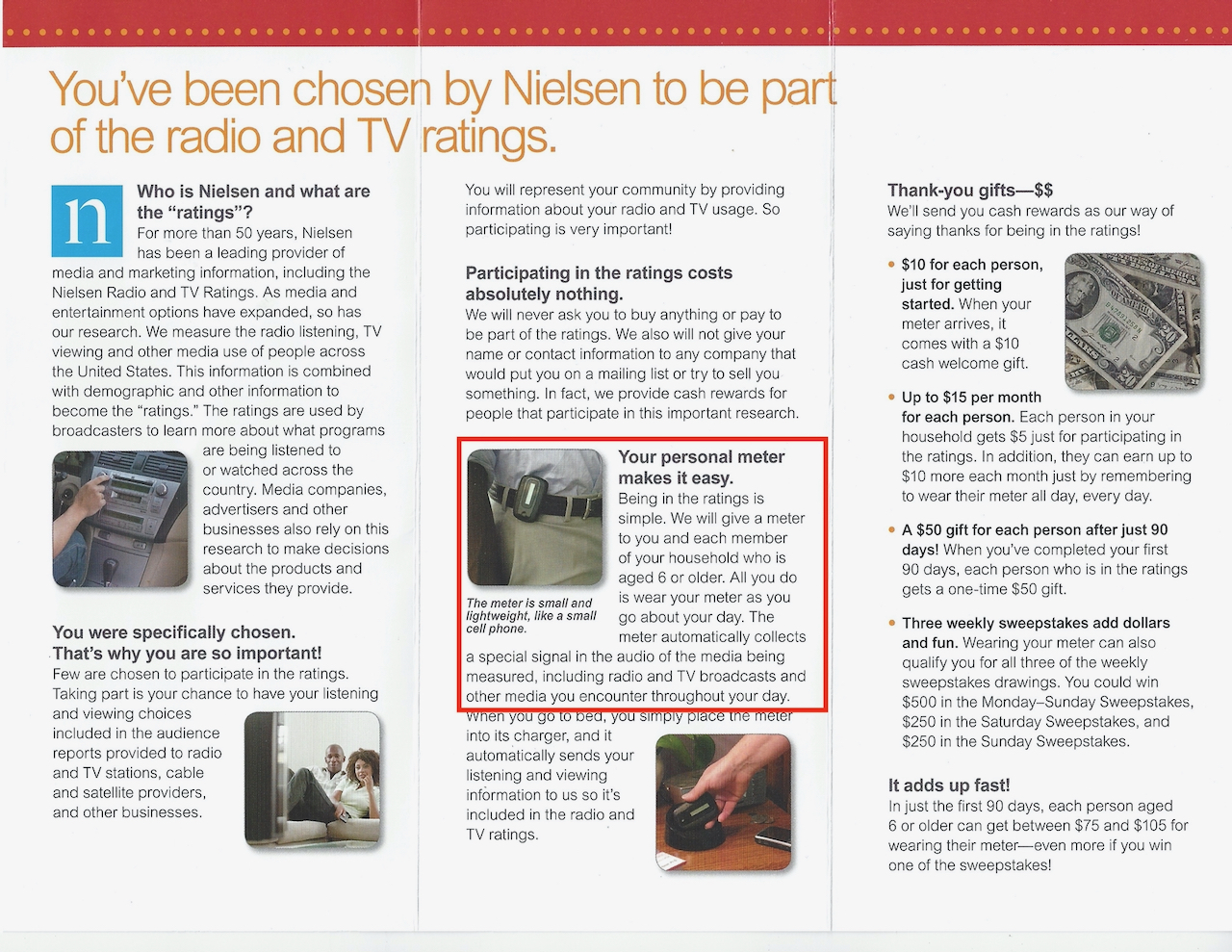
Wearing a personal meter all day is a bit more invasive than a 1970's set-top box
When broadcast television was the dominant medium, I thought that it would be a personal coup to be an A.C. Neilsen member. Not only would the company pay a stipend to allow it to track my T.V. viewing, I would be an influencer long before that became a word. I could put Star Trek back on the air by watching reruns 24/7!

When consumers began viewing programs whenever they wanted over a multitude of devices, Nielsen found it difficult to gather reliable, comprehensive ratings data. Their solution to replace the old set-top box:
"All you have to do is wear your meter as you go about your day."
It may be inevitable that privacy is dead, but we don't have to speed its demise. Sorry, Nielsen, I'm not going to be a member.

Later in life I've found that I don't want many of the things that I wanted in my youth.

Besides, I have to catch up on the more than half-dozen Star Trek series that have been produced in the past 30 years.

Monday, January 13, 2020

How Dumb Do They Think We Are?

(image of ad on a finance website)
My retirement, bank, and brokerage accounts are all separate. Despite entreaties from these large, well-known institutions to input each others' information into their respective websites--all to "help" me with planning--I've resisted.

I don't want any of them, or hackers who are probing their databases, to know all my business. So why would I provide this information to an app that I never heard of?

Word of the day: risible.

Saturday, February 09, 2019

Nice Resume and Experience, But May I See Your Yearbook?

Our first grade class would get rambunctious during nap time, and Mrs. Alkire would threaten us by saying she would make a notation on our permanent record. Today we can laugh about our gullibility, but Sixties pre-teens didn't question teachers, especially since we needed them to tell us what to do when the Russians launched their missiles.

60 years later we've stopped laughing about the permanent record. Databases have recorded all our communications, photos, web searches, geographical movements, and financial and medical information for nearly 20 years. Worse, the data gatherers are vacuuming up as much information as they can from the pre-Internet days.

Headline: ‘I Was Young’ Isn’t an Excuse: Business Leaders Need to Revisit Yearbooks
Executives and business owners would be wise to know what potentially offensive photos, audio recordings and writing attributed to them in their younger days exist and could come to light, career coaches and crisis management professionals say...

As a best practice, companies should be doing background checks on all senior level and board hires, digging in 25 years or more. “You have to go back both virtually and physically,” he said, identifying “high school and college activities, fraternities, nicknames, everything.”
Eric Dezenhall, crisis consultant: “Nowadays, ‘I was in my youth’ is no longer an explanation...And racism is the cyanide pill of scandals. There’s no way to get out of it.”

In middle school we traded racial insults about Chinese, Japanese, Korean, Samoan, Filipino, Hawaiian, Mexican, Polish, black, and Jewish people, Other joke genres were religious (Buddhists, Muslims, Catholics), sexual, and intellectual (jocks and dumb blondes). Yes, it was cruel and crude, but if one is ever to go through a racist, sexist, or any other -ist phase, it's better to do so before one is an adult.

We Boomers prided ourselves on having overthrown the vestiges of Puritanism in 20th-century America. Frankly, the censorship and sanctimony on display today are much more pronounced, and the consequences--unemployment and social shunning--are more severe.

40-year-old job applicants in 2019 have to produce a high-school yearbook. Thank goodness I'm retired.

Monday, August 27, 2018

Protection

"Free" privacy & security comes at a price.
One technology contretemps largely escaped notice, but it's useful for highlighting the differing philosophies of two of the largest companies in the world.

The issue concerns Virtual Private Networks, which are a method of protecting internet privacy:
A virtual private network (VPN) is a technology that creates a safe and encrypted connection over a less secure network, such as the internet. VPN technology was developed as a way to allow remote users and branch offices to securely access corporate applications and other resources. To ensure safety, data travels through secure tunnels and VPN users must use authentication methods -- including passwords, tokens and other unique identification methods -- to gain access to the VPN.
Last year Facebook offered a free VPN app, Onavo Protect, to its users:
Onavo allows users to create a virtual private network that redirects internet traffic to a private server managed by Facebook. The app, which bills itself as a way to “keep you and your data safe,” also alerts users when they visit potentially malicious sites.
However, as with most "free" internet services there was a price: [bold added]
Facebook is able to collect and analyze Onavo users’ activity to get a picture of how people use their phones beyond Facebook’s apps.
Onavo Protect did not comply with Apple's new privacy guidelines, and Apple and Facebook mutually agreed to remove Onavo from the App Store. There has been some posturing back-and-forth but the bottom line is:
Apple’s decision widens the schism between the two tech giants over privacy and is a blow to Facebook, which has used data gathered through the app to track rivals and scope out new product categories.
Except for brief experimentation with Google's Android in 2010, I've always used Apple's iOS, iPhone, and iPad products, and I'm glad I did.

Thursday, May 31, 2018

In Tim I Trust

The Apple Watch has already breached my defenses.
The inputs: a person's
  • internet searches,
  • driving patterns ("the number of trips taken, duration of trips, left turns versus right turns and time spent on the highway versus local roads"),
  • how he or she uses a computer mouse or touchpad.
  • the time it takes to fill out a weekly online health questionnaire.

    The black box: artificial intelligence and big data.

    The output: the probability that he or she has early-stage Parkinson's or Alzheimer's Disease .

    The above is a trend sweeping health care: the use of artificial intelligence (AI) to help better diagnose and treat patients. [bold added]
    A Duke University doctor working with Microsoft researchers sifted through data on the physical movements of computer users that came from millions of internet searches. Their study found links between some behaviors—such as tremors when using a mouse, repeat queries and average scrolling velocity—and Parkinson’s disease. They used artificial intelligence, or a computer analysis, to identify which of the metrics separated a control group from those searching for Parkinson’s disease symptoms.
    It used to be that family members were the first to notice that something is amiss. The machines that we touch every day--cars, phones, computers--are now more accurate, quicker, and smarter diagnosticians than loved ones. But what about individual privacy?

    I HOPE that Apple lives up to its standards.
    For those who are too cautious to buy a TV that can watch them, or a smart speaker that monitors what they're saying, the promise of real-time health monitoring may the lure that allows the Internet of Things(IoT) into personal space.

    As for me, it's too late. My Apple Watch, which has been tracking me for 1½ years, knows more about me than my doctor.

    In Tim Cook I trust (because I don't have any choice).
  • Thursday, March 22, 2018

    Not Taught About Much

    The Wall Street Journal's intrusive, irritating pop-up afflicts subscribers daily.
    When website memberships were new, I furnished the minimum information necessary to gain access; often it was just a name, which could be a pseudonym, and an email address.

    I was more forthcoming with Amazon, Netflix, and iTunes, which required real credit cards, names, and addresses, but when the requests became more intrusive, say with a birth date, I left it blank if it would let me, or inserted a fake birthdate.

    Lately I've been declining to join any website that wants more than basic contact information. That means no rewards clubs for restaurants, hotels, and other merchants, even those that are frequented often.

    A number of websites are always displaying nagging pop-ups to "complete [my] profile". Now, given the revelations about how personal data has been used, I am glad not to have filled out the forms.

    But there's no outrage. Facebook and other sites are not subject to strict privacy laws (in America, not Europe) like financial institutions, hospitals, or the IRS, which demand sensitive information while providing necessary services. Social media members voluntarily provided Facebook, Twitter, LinkedIn, etc. with personal information and posted trip photos. Control was lost once the file was uploaded.

    The source of much of this mess was boastfulness and pride, in other words users' look-at-me-ism. The ancients considered pride to be the deadliest of the sins, but they aren't taught about much any more.

    Thursday, December 21, 2017

    Luddite, or Just Suspicious?

    iPhone 6: still trucking.
    As I scribbled in October, I am still using an iPhone 6, which Apple sold in the U.S. through 2016. I am holding on despite proof that operating system (iOS) updates cause older iPhones to slow down and that this phenomenon was caused by Apple, ostensibly to preserve older batteries' life.

    (Disbelieving iPhone users say that Apple is pushing users to upgrade. IMHO this is easily solvable by giving users a choice to turn this feature on or off in the Settings/Battery menu. I don't play "twitch" games where speed is of the essence, so I don't mind being slowed.)

    When I do upgrade it will be to an iPhone 8. Not only is the "8" cheaper, but I am perfectly happy with the thumb-ID feature.

    In fact, I prefer the 8 to the X. Not only do I not need facial-recognition-ID, I don't want it.

    News item: Facebook Wants Your Face and You'll Probably Let Them Have It. While everyone's got photos of themselves online, the data needed for the iPhone X facial recognition technology is much more voluminous. I trust Apple with this data much more than I would Facebook, based on both companies' behavior, and even with Apple I am not entirely sure.

    Upgraders, beware.

    Tuesday, June 27, 2017

    Data Sneak

    When I see a product or service that I'm interested in, I fill out a contact form on the Web. When the request gets too personal (date of birth, social security number, income), I usually stop and don't submit the information. In the case of Quicken Loans the entries are transmitted as soon as you type it on the form, whether or not you hit "enter."
    You change your mind and close the page before clicking the Submit button and agreeing to Quicken’s privacy policy.

    But it’s too late. Your email address and phone number have already been sent to a server at “murdoog.com,” which is owned by NaviStone, a company that advertises its ability to unmask anonymous website visitors and figure out their home addresses. NaviStone’s code on Quicken’s site invisibly grabbed each piece of your information as you filled it out, before you could hit the “Submit” button.
    Yes, child, we used to get our apps on "CD's"
    We've been actual customers of Intuit for nearly 20 years and use Quicken, Quickbooks, and Turbotax on both the Mac and PC platforms. All the products contain sensitive financial data, much more extensive than on a web inquiry or contact form.

    We will be much more guarded in our future dealings with Intuit and will consider switching to their competition.
    whoever is dishonest with very little will also be dishonest with much.
    ---Luke 16:10

    Saturday, May 20, 2017

    Not Norwegian, Either

    We can easily imagine how technologies like facial recognition can affect privacy adversely, especially if those tools are in the hands of the wrong people. Maybe we can take comfort that those technologies---at least in consumer versions---are far from perfect.

    I've known "Timothy" for a long time, and "he" is definitely not Swedish.

    Thursday, October 06, 2016

    Cracking It Open: Not All It Was Cracked Up to Be

    Sergei Skorobogatov (BusinessInsider)
    Remember the brouhaha over the FBI trying to force Apple to unlock a terrorist's iPhone? (Though there were only 10,000 possible four-digit codes, ten false tries ran the risk of wiping the iPhone's memory.)

    In March it was revealed that the "FBI paid under $1 million to unlock San Bernardino iPhone". (An earlier estimate had been $1.3 million.) It now looks like the FBI overpaid. Cambridge University professor Sergei Skorobogatov performed the feat using equipment costing less than $100 [bold added]:
    NAND mirroring makes a copy of a phone’s memory in its undisturbed state. Using an iPhone of his own, Dr Skorobogatov was able repeatedly to overwrite its memory with the copy he had made before he began his guesses. This caused the instrument to forget that he had made any guesses at all, avoiding any temporary lockouts and ensuring that the data would never be wiped clean. That, in turn, permitted him to brute-force the PIN six guesses at a time, resetting the phone to its original condition between each batch of guesses.
    Dr. Skorobogatov first came to popular attention in 2012 when he claimed that a "backdoor" had been built into U.S. military systems' computer chips made in China. These claims were denied by the defense industry. His work, including the iPhone demonstration noted above, since that episode has only enhanced his credibility, while U.S. government systems have proved to be wildly insecure.

    On the other hand, why should we believe a Russian-surnamed English guy over the American government?

    Thursday, July 14, 2016

    A Concern I Didn't Use to Share

    Pokémon Gym at the local church:
    One way to attract the younger crowd.
    The younger members of our household have been playing Pokémon Go since it was released on July 6th. Estimates of the number of players run about 20 million, the fastest rate of acceptance of any game in history---and it has yet to be distributed in Asia.

    Like many tech inventions, a simple description makes it hard to see what the fuss is all about:
    Pokémon Go is a smartphone game that blends the real and digital worlds, tasking players with exploring their neighborhoods to find creatures and treasure for in-game use....

    Go is almost boringly simple: Once you encounter a Pokémon in the wild, Go switches into “capture mode,” where users flick Pokeballs at the creature until they nab it.
    Staring at the smartphone instead of Cupid's Span (Chronicle)
    As might be expected, when millions of shut-ins get out and "go," there are consequences, good, bad, and weird. From the Chronicle alone, a few headlines from the past week:

    Animal shelters stand to benefit from rabid Pokémon Go gaming.

    The SF Zoo finds three Pokémon Go gyms on property, rolls with it

    4,500 say they'll hunt Pokémon together on the streets of San Francisco

    ‘Pokémon Go’ users help cops arrest attempted-murder suspect

    Players get hurt hunting for ‘Pokémon Go’ monsters


    Your humble blogger did download Pokémon Go but hasn't activated it due to privacy issues.

    No game is that important---to be sure, a concern I would not have shared 30 years ago.

    Wednesday, March 30, 2016

    John Oliver: Apple Vs. FBI

    One of the alumni of Jon Stewart's The Daily Show, John Oliver discusses the FBI vs. Apple controversy over breaking into a terrorist's iPhone.

    Typical of his video essays, Encryption is humorous, vulgar, and filled with information. While he does take Apple's side, John Oliver throws a few shots the company's way. And don't miss the last two minutes of the 18-minute video, which contains an example of a "little more honest" Apple ad about privacy and hacking.


    One more thing: it's no wonder that the younger crowd prefers to get its news this way than from droning heads on the nightly news.

    Wednesday, March 02, 2016

    A Benefit to Everyone

    iPhone 5C like the terrorists' (Newsweek photo)
    Mark Cuban sides with Apple in its battle with the government. The major issues have been well-publicized over the past two weeks, and there's no need to recount them here.

    However, he does raise an issue that I've not heard elsewhere, if the government should prevail: [bold added]
    Once the phone is “cracked” by Apple or any device or Operating System developer, whatever is found by the FBI or whatever government agency is involved, is going to be labeled “planted” or false evidence. The defendants lawyer is going to scream as loud as they can that whatever was found was not originated by their client. That Apple, in cahoots with the government agency, modified their software to not only unlock the phone, but to also write to the device everything the government agency needs to gain a conviction. Pictures. Texts. Logs. Files. Videos. All originated and/or imported by the code in order to gain a conviction.
    Encryption is a benefit to everyone, even to the government that refuses to acknowledge it.