Monday, September 06, 2021

Labor Day, 2021 In Hawaii: Unsettled

I sometimes wish that I was born later to experience all the technological marvels that I won't live to see. This Pollyannaish outlook is based not only on personal experience but also on extrapolating from the past pace of progress; how much better it is to be a middle-class American today than to be John D. Rockefeller, the richest man in the world 100 years ago.

However, not since the financial crisis of 2008-09 has a rosy continuation been so uncertain.

The coronavirus contraction, the optimism resulting from the recovery, and the re-imposition of lockdowns due to the delta, mu, and other Greek-letter variants, are unsettling to say the least.

Significant numbers of workers have lost their jobs permanently, while new jobs have opened up in industries and locations that these workers will have great difficulty moving to.

And nowhere in the United States is the tradeoff between safety and economic recovery as stark as in my home state. Just as the travel and leisure industry was re-opening, it's all being shut down again. [bold added]
A drop in visitor arrivals to Hawaii from the spread of the delta variant and COVID-19 containment measures is creating a new round of tourism sector layoffs, furloughs and reduced hours just as federal unemployment aid is ending.

Hawaii got a small spike in travelers for the Labor Day holiday, but not nearly as many as were expected before Gov. David Ige asked visitors not to come to Hawaii through October. Since that announcement, travel here has plummeted.

And it’s only expected to get worse next week when Honolulu Mayor Rick Blangiardi’s Safe Access O‘ahu kicks in and Maui Mayor Mike Victorino institutes a health pass. Both programs will make it more difficult for unvaccinated visitors who come to Hawaii on a pre-test exemption to patronize certain businesses.

The slowdown is welcome news for residents who are worried that the state’s health care resources aren’t adequate to handle surging COVID-19 cases. However, it couldn’t have come at a worse time for Hawaii’s economy.

Two programs — one that provides jobless aid to self-employed and gig workers, the other to people who’ve been unemployed for more than six months — are expiring today.
Hawaii's re-imposition of controls has occurred because hospitals are running out of ICU beds:
Healthcare Association of Hawaii’s Hilton Raethel told lawmakers every Oahu hospital, except for Tripler Medical Center and Kapiolani Medical Center, is at or near ICU capacity.

The state has 223 licensed adult ICU beds in all of its medical facilities.

Amid hospital crisis, governor pledges strict enforcement of COVID rules over holiday weekend “We’re getting close to not being able to provide ICU care for patients needing it, which means some patients will not get the optimal level of care to maintain health and potentially life,” he said.

During the pandemic’s peak last August, 131 COVID patients were hospitalized. Now there are more than 440 and the forecast isn’t promising.

“All the models say the hospitalization numbers will continue to climb into, if not through, most of September,” Raethel said.
Before the pandemic, there were nearly as many Native Hawaiians who live on the Mainland as in the Islands. Expect the exodus to increase, as the high cost of living and the dependence upon COVID-hamstrung tourism have made Hawaii a very tough place to find a job.

Sunday, September 05, 2021

The Power of That Vision

Christ the Redeemer, overlooking Rio de Janeiro
Christ the Redeemer is the most famous giant statue of Jesus, but it's only one of several, including the larger Christ the Protector under construction in southern Brazil:
Christ the Protector is one of about three dozen giant statues of Jesus that have been constructed around the world during the 20th and 21st centuries, mostly in Latin America but also in Europe, Africa and Asia. Financing usually comes from individual donations encouraged by local politicians.

Occasionally wealthy businessmen have made the figures their ego-boosting pet projects.

Colossal statues, such as the monumental medieval Buddhas of China and Central Asia that can tower over 200 feet, were not unknown before the 20th century. But their heavy material, usually stone, made it impossible to carve them free-standing at those heights. The Statue of Liberty’s substitution of copper sheathing for stone rendered her dauntingly expensive. But the invention of steel-reinforced concrete made it possible to build enormously tall free-standing statuary at a reasonable price.

Christ the Protector will be only the third-tallest statue of Jesus in the world so far. The tallest is Jesus Buntu Burake in Makale, Indonesia, completed in 2015 and soaring to 172 feet with its pedestal. But it may not hold the distinction for long: A 253-foot statue of Jesus has been planned in Tamaulipas, Mexico, although so far the project has stalled.
Large statuary causes the heart to rule the head. Through pictures and videos we can analyze the artist's message dispassionately. But in person, when we get physically close to the Statue of Liberty or the Lincoln Memorial or Michelangelo's David, something in the animal brain surfaces as the breath catches and the blood races.

Those who construct these representations of Jesus were paying tribute to their faith, and they were hoping to evoke the emotion they were feeling in others. Over a million annual visitors just to Rio alone can attest to the power of that vision.

Saturday, September 04, 2021

Stanford is Going Down the Toilet

(Stanford Medical News)
The headline is literal, not metaphorical.
It’s a smart toilet. But not the kind that lifts its own lid in preparation for use; this toilet is fitted with technology that can detect a range of disease markers in stool and urine, including those of some cancers, such as colorectal or urologic cancers. The device could be particularly appealing to individuals who are genetically predisposed to certain conditions, such as irritable bowel syndrome, prostate cancer or kidney failure, and want to keep on top of their health...

[The late Dr. Sanjiv] Gambhir’s toilet is an ordinary toilet outfitted with gadgets inside the bowl. These tools, a suite of different technologies, use motion sensing to deploy a mixture of tests that assess the health of any deposits. Urine samples undergo physical and molecular analysis; stool assessment is based on physical characteristics.

The toilet automatically sends data extracted from any sample to a secure, cloud-based system for safekeeping. In the future, Gambhir said, the system could be integrated into any health care provider’s record-keeping system for quick and easy access.
(WSJ image)
Companies are already working on bringing smart toilets to market: [bold added]
Some smart toilets are geared toward helping doctors monitor patients with chronic conditions or heightened risk for certain diseases, whereas other companies aim to sell the toilets—with price tags in the hundreds or thousands of dollars—directly to consumers as a tool to track or improve their own health and wellness.

Researchers at Stanford School of Medicine have outfitted a toilet bowl with cameras and trained a machine-learning algorithm to analyze the waste against a diagnostic chart. The toilet can also track the flow, color and volume of urine. It is equipped with a urine test-strip similar to a pregnancy test that detects specific molecules that can provide insight into a person’s health. To tell users apart, the toilet has both a fingerprint scan when a person flushes and a scan of their anus’s characteristics, or an anal print.
No doubt we'll have to suffer through smart-toilet humor as these products are rolled out. Once we get those out of our system, market acceptance should be rapid--no more taking stool samples, toddlers will enjoy toilet-training games, instantaneous feedback on a variety of health indicators, etc.

But "anal printing"? That is where I draw the line.

Friday, September 03, 2021

A Pleasant Afternoon

On this pitch Darin Ruf broke a 1-1 tie in the 8th with a double that scored Kris Bryant from 2nd base.


When one goes on a trip and doesn't know when one will go back to that destination, caution and credit-card limits are thrown to the wind.

And so it was that on our only Giants game of the season we sat behind home plate in the best seats that I had ever purchased for a major league baseball game. (My grand uncle Freddie had closer seats for the Triple-A Islanders back in the 1960's, but that was the only thing better then than now.)

My helmet had "SF", not "NY" (Bon Appetit)
The afternoon was warm, not hot, at Oracle Park with only a slight breeze. There was no need to don the sweaters that we always carry to San Francisco even during the summer.

Marking another first, I bought a $20 helmet nachos, a gross-looking but good-tasting mixture of nachos, cheese, guacamole, ground beef, sour cream, and jalapeƱo peppers ladled into a plastic bowl in the shape of a full-size SF batting helmet.

Did I mention that dietary restrictions were suspended as well?

The Milwaukee Brewers had won the first three games of the four-game series, dropping the Giants to second place in the NL West; the Giants needed the win to keep up with the Dodgers. Augmenting the tension, the game was a tight 1-1 pitching duel through seven innings. The Giants went ahead 2-1 on a double by Darin Ruf in the bottom of the 8th, and Thairo Estrada followed with a three-run homer to seal the deal.

The Brewers didn't go down quietly in the 9th, as a long ball down the right field line was initially ruled a two-run home run, then corrected to a foul ball. Adding to the crowds' pleasure, Brewer's manager Craig Counsell was ejected for protesting the call. After that, the Brewers were done.

A thrilling 5-1 Giants victory (the game was closer than the score indicated) and a pleasant afternoon in the San Francisco sun--it's rare that an experience exceeds high expectations. I'll start saving up for next year's game....

Thursday, September 02, 2021

Giants: Hope They Snap Out of It

Maybe the lucky hat will help.
The San Francisco Giants are on a four-game losing streak. More significantly, they fell out of first place in the National League West for the first time in three months to the rival LA Dodgers.

We are going to see them play the Brewers today at Oracle Park. This will be the first and probably only game we'll attend this year.

Hope we'll see them snap out of it.

Wednesday, September 01, 2021

Moving in With Your Parents to Grow Up

Paying off student loans more quickly is another
reason for moving home (USA Today)
Given escalating rents and costs of home ownership, this headline makes sense:

Millennials are buying more homes - after moving back in with their parents [bold added]
In July 2020, Pew Research reported that 52% of young adults were living at home with their parents, a jump from the 46% reported in January earlier that year. It was the first time that census data recorded more adults ages 18-29 living with their parents instead of with roommates, partners or on their own, the study said.

...the path back to childhood homes has allowed many Millennials to gain better financial footing. A 2020 study by Bank of America found that Millennials were saving more than ever before — 73% of respondents said they were able to add to their savings during the pandemic, up 10% from two years ago. Nearly 40% said that they were able to boost their credit score, and 27% said they were able to reduce their spending during the pandemic.
Unless they are born wealthy, people eventually have to make tradeoffs to achieve their long-term goals. They have to swallow their pride, move back in with their parents if necessary, not go out with their friends every weekend, and not buy the latest clothes or cars.

Owning a home is more than a pathway to wealth; it also shows the ability to defer gratification. In other words it's a sign of adulthood.

Tuesday, August 31, 2021

Trappings of Luxury Not Needed

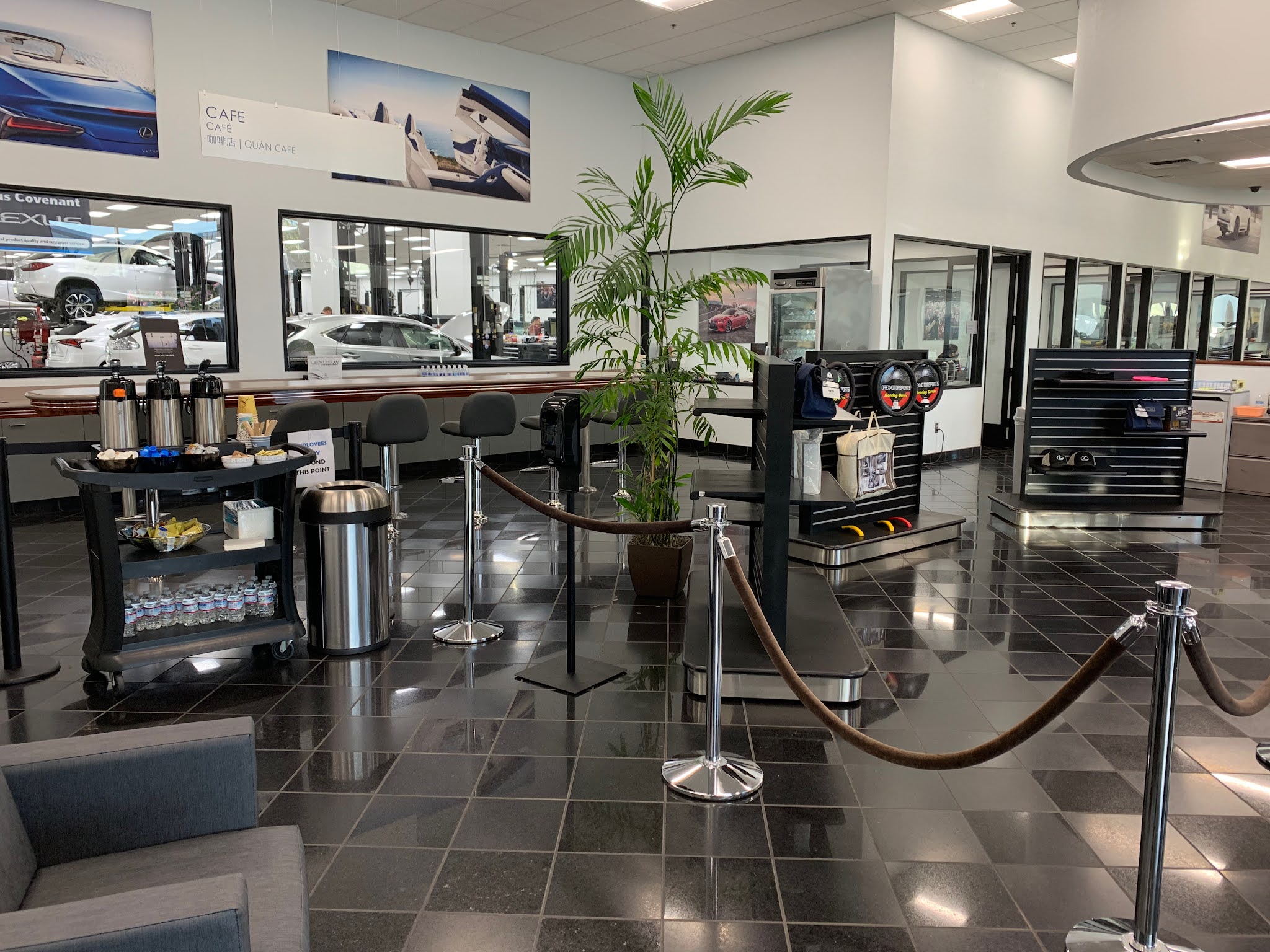
Gone are the snacks and sodas. The car display has been removed. The free shuttle service to the shopping center has been cancelled.

Lexus has pared back the appurtenances at the San Jose service facility.

Coffee and water were the only offerings. The lounge had a few circular tables, along with a dozen comfortable chairs, spaced far apart.

The place seemed half as busy as I remembered. Perhaps the brand is less popular, or perhaps Lexus customers have drastically cut back on their driving. We've only brought in the car twice in 2½ years; the original expectation in 2019 was for four service visits. The shop was done in two hours; if they're going to be this quick I don't need trappings of luxury.

Nothing's changed from last month's rumination about buying out the lease. At 8,000 miles in 28 months we've become the little old lady (not the one from Pasadena) who hardly takes the car out of the garage.

Maybe we'll end up like Bob Costas, who's driven his 14-year-old Lexus LS 460 only 50,000 miles:
Lexus makes good cars—they last a long time and have a classic design. If you spray it with a hose now and then, no one will know the difference between the 2021 and the 2007.
Spraying with a hose now and then---I wish it were as easy with these old bones.

Monday, August 30, 2021

Good Works: Don't Stop Trying

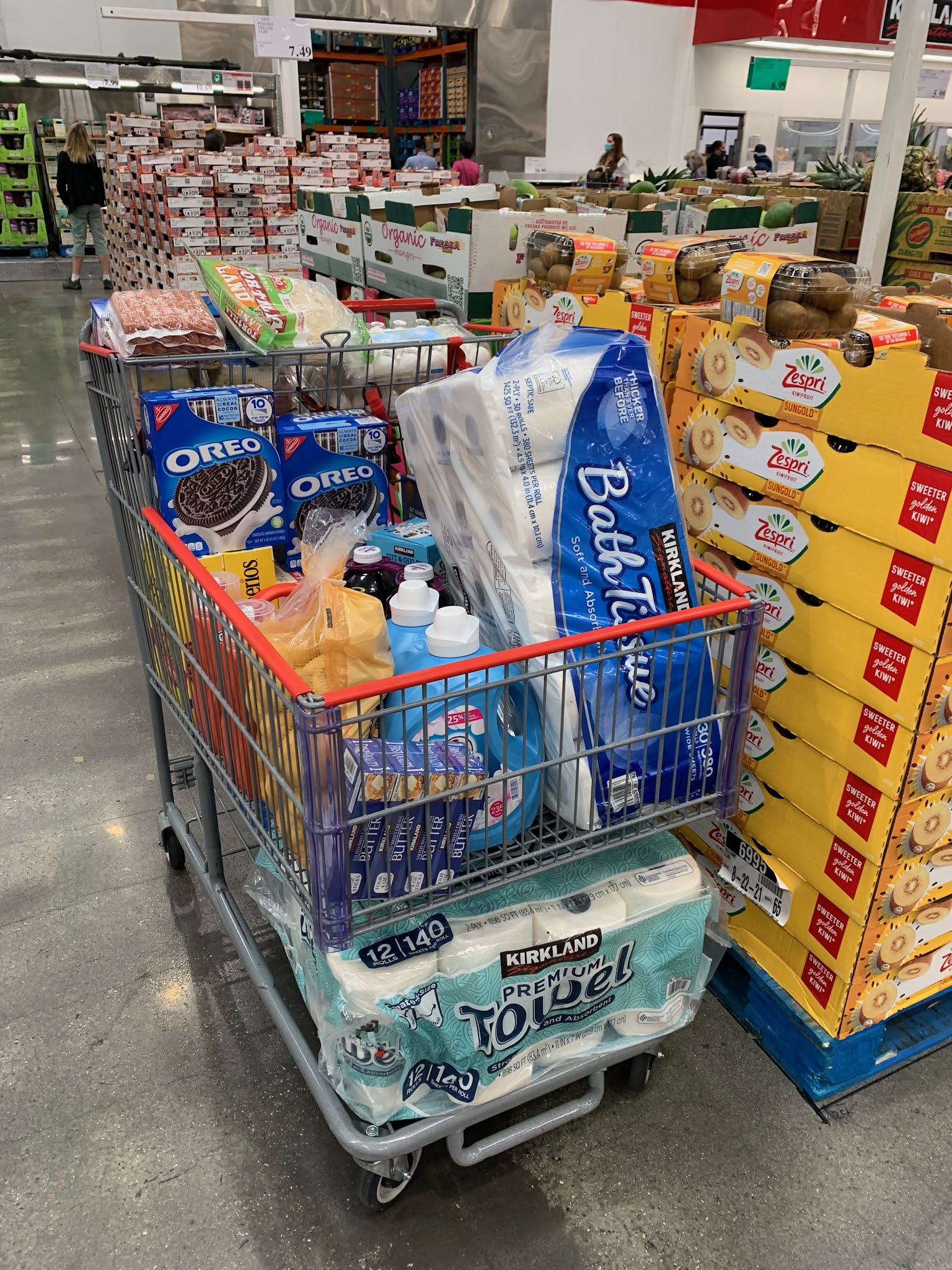
24 of the 40 items were bought at Costco
Charitable organizations have been just as affected, if not more so, by the pandemic as any institution in society. The 30 Peninsula churches and synagogues which comprise Home and Hope can no longer provide temporary family shelter on their premises. Housing is being furnished on a limited basis at hotels, and churches, rather than serving meals, have been asked to fill requests for food and supplies.

Our Episcopal congregation joined with Hope Evangelical Lutheran Church to complete the list for a total of four families, each church taking two.

On Friday we dropped off our purchases at Hope Lutheran, which made the deliveries.

Our friend at Hope Lutheran wrote:
This is the combination of groceries and supplies donated by St. Ambrose and Hope that we brought to 4 homeless families at Home & Hope this morning!

Thank you for your generosity and thoughtfulness for our neighbors. I had the opportunity to meet a couple of the lovely families, and they are so grateful and excited to have your care. The program manager also told me of an incredible single father with 3 small children in the program who relies on the city bus for transportation, so they were delivering his supplies to him later today. These families face substantial and heart-breaking challenges in their lives. With your gifts, you made a big difference for many people today!


It's discouraging: we have to put more money and time into doing good works, and the impact is not as great as it used to be. But that doesn't mean we stop trying.

Sunday, August 29, 2021

Sandwiches on Sunday - Happy to Help

On Saturday the sandwich assembly line came indoors. The 92°F-degree heat on a breezeless day and the poor air quality from the wildfires were the deciding factors.

We were four vaccinated, symptomless individuals, and the risk of contracting the virus was slight compared to the certain misery of working outdoors.

Learning from our previous mistake, inventory was taken before the commencement of sandwich-making.

Again we had to buy more bread, but the shortage was remedied before the noon start-time.

In 90 minutes we assembled 90 brown bags, each containing two sandwiches, one trail mix, and one apple.

The brown bags were stored overnight in refrigerators at the church and a parishioner's home.

There were 40 people in line at the Redwood City community center.

Garbage bags were the easiest method of transport.
The recipients don't care about appearances.
Some were so hungry they began devouring the sandwiches as soon as they got them.

Many asked for an extra bag or two for a spouse, kid, or a friend. There were sufficient supplies to satisfy the request immediately instead of waiting to make sure everyone got at least one bag.

After half an hour every potential "customer" had left. Antonio, the county worker who assists us on Sundays, said that no one bothers to show up after that, because everyone assumes that the lunches have been completely distributed.

I took the five remaining bags to the Catholic Worker House. There were three people waiting on the porch hoping that someone would come by with food. I was happy to help.

Saturday, August 28, 2021

Still Unsolved

(from Ellen Chung's Facebook page)
Following up on the mysterious death of a young family last week, the Chronicle reports little progress: [bold added]
Investigators said Thursday they have ruled out exposure to chemicals from a mine along the trail and use of a gun or other weapon in the mysterious case of a former San Francisco family who died along with their dog on a remote Mariposa County hiking route.

In its first update on the case in nearly a week, the Mariposa County Sheriff’s Office provided more details about the timeline of events, indicating the family was spotted heading to the trailhead on the morning of Aug. 15 by a witness.

Investigators believe the family hiked most of a grueling 8.5-mile loop — including 5 miles of steep southern exposure trail with little to no trees or shade in 103 to 109 degree heat — before succumbing on the return to their truck on a steep switchback.

The cause of death of Jonathan Gerrish, 45, Ellen Chung, 30, their 1-year-old daughter Aurelia Miju Chung-Gerrish and 8-year-old Aussie-Akita mix Oski remains a mystery, as authorities are waiting for toxicology reports and cell phone data. The baffling case has received international attention...

Searchers found Gerrish in a seated position on the trail with his daughter and dog next to him, and Chung was a little bit farther up the path.
Given the temperature, the distance hiked, and the hostile environment, heat stroke is another possibility, but the death of all parties implies a cascading sequence of unfortunate events that cannot be verified without additional evidence that has so far not been undisclosed. This may be a mystery that will not be definitively solved.

Friday, August 27, 2021

Not a Good Sign on a First Date

(WSJ illustration)
I've been guilty of phubbing, and perhaps you, too, dear reader: [bold added]
using one’s smartphone during face-to-face interactions—has been termed phone snubbing or “phubbing.” Most people perceive it to be rude, and it can have serious repercussions for the level of satisfaction in a friendship. But it often has more to do with the phubber’s personality than with lack of interest in the conversation.

In a 2021 study of young adults, the authors found that depressed and socially anxious people are more likely to phub their friends. This is likely explained by the fact that people with social anxiety find online communication less uncomfortable than in-person conversations. On the other hand, phubbing is less common among people who score high on “agreeableness,” which psychologists define as striving to avoid conflict. Agreeable people make an effort to be polite and friendly in order to maintain social harmony.
Throughout the four decades that spanned my teenaged years to the day I got my first smartphone, I was the silent one at group gatherings. Reinforcing this tendency was your humble blogger's introversion (high score on the Meyers-Briggs scale) and agreeableness (see definition above).

But that didn't mean I wasn't engaged. Observing and listening, I was ready to jump into the conversation at a moment's notice.

When smartphones became ubiquitous, it didn't require much of an effort to refrain politely from looking at them in social settings. I will admit, however, that when I'm in odd-number parties, and the conversationalists pair off in animated discussions where I'm little more than a potted plant, I do check e-mails and stock prices.

(By the way, one of the dying arts of conversation is to survey the group and try to involve everyone sitting at the table.)

It's okay to phub if no one cares or notices that you're doing it, and it's still more polite than falling asleep at the dinner table, which I did once long ago when I was the host, but that's a tale for another day.

Thursday, August 26, 2021

Fit as a Cello

While everyone was enjoying pastrami sandwiches
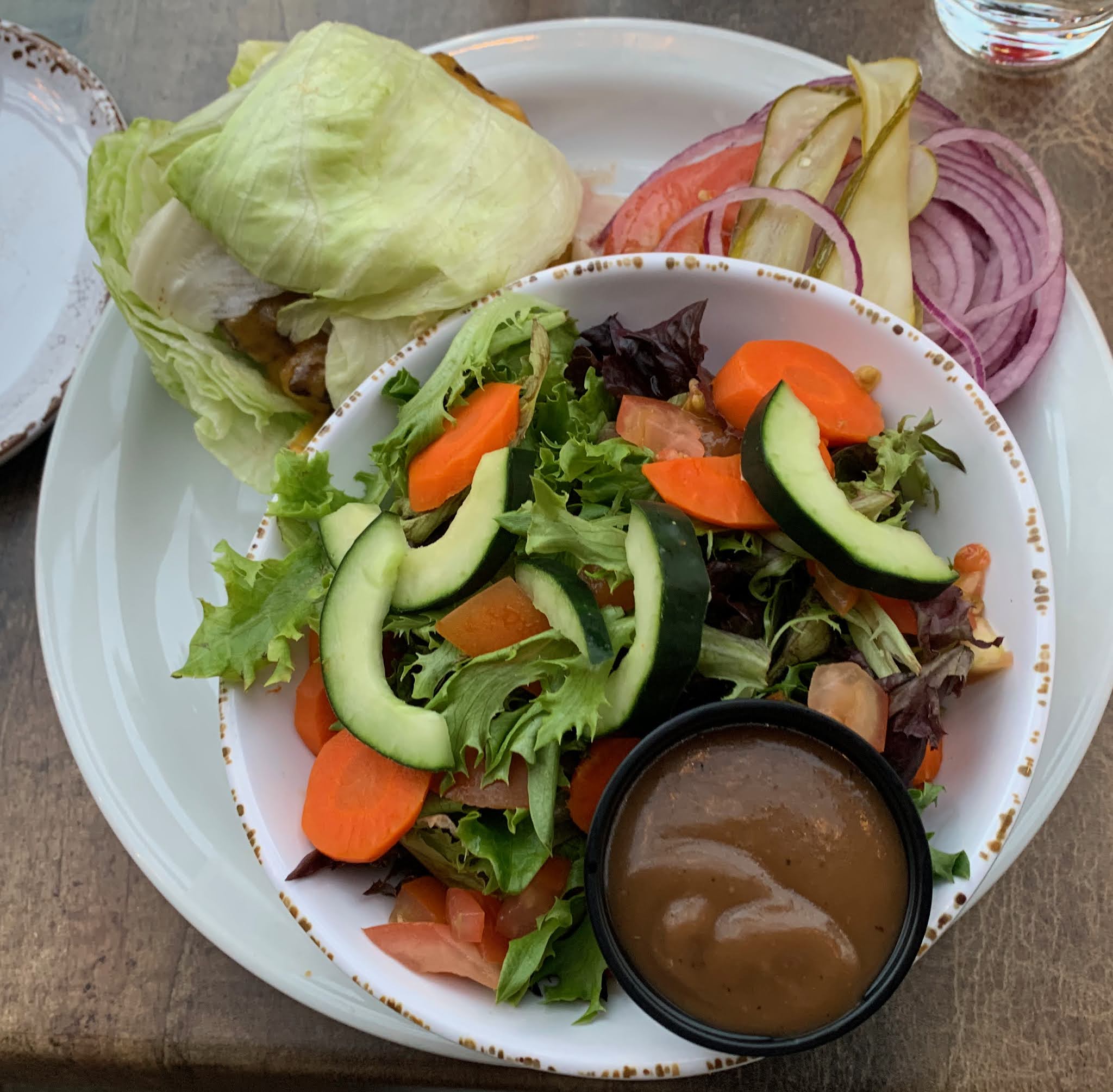
at the Refuge this week, I had the low-carb plate.
As expected, the blood test showed an A1C level of 7.8, well over the 7.0 threshold for diabetes. A lifetime of poor eating habits had caught up with me. The doctor repeated his annual instructions to cut the sugar, exercise, lose weight, etc. but added a prescription for Metformin to control blood sugar.

My father, upon being told that he was diabetic nearly 30 years ago, lost 50 pounds over the ensuing decade, walked every day, and was able to get off prescription medications. Living to the age of 94, he showed how it is possible to win the battle against diabetes.

Do I have his discipline? We'll find out soon enough.

Wednesday, August 25, 2021

Yellow Flakes, and Not Just the Tuna

(Chron photo)
The Swan Oyster Depot is a San Francisco institution. It's over a hundred years old and has changed ownership once, when it was sold from a Danish family to the Sancimino family in 1946.

SOD is small, hard to get into, and has street parking only. My brother and I had a pleasant dining experience in 2012.

Now it's the center of a social-media contretemps because of allegedly racist remarks. [bold added]
In his posts on Instagram on Friday, Tin Dinh said he and his sister, Tu Dinh, who are Vietnamese, were called “dim sum” several times by a Swan Oyster Depot staffer after placing their order at the popular Polk Street restaurant on Aug. 20. His posts spread across social media over the weekend and into Monday.

Tin Dinh also shared Yelp reviews from several years ago that also called out Swan Oyster employees for reportedly racist behavior. He said he hopes the attention brought by his posts will pressure the restaurant to acknowledge its “racist language” and issue a public apology...

Jimmy Sancimino, whose family has run the Polk Street institution for decades, confirmed that he used the phrase “dim sum” in his interactions with the Dinhs last Friday, but denied that doing so was racist. Swan Oyster uses the term, he told The Chronicle, to refer to customers who order from more than one staff member, as is common at a dim sum restaurant.

Tin Dinh said he started ordering food from Sancimino. He said Sancimino walked away during the process, so his sister finished ordering from another employee. When they told Sancimino that when he returned, he walked away, pointed to them and yelled “dim sum.”

“We have a little saying in here when people want more than one person to wait on them at once. We say it’s like a dim sum restaurant (where) you can have 10 different waitresses come by and drop off food at your table. But that’s not the way it works here,” Sancimino said. “Unfortunately this man (and) young lady took it the wrong way. I’m terribly sorry about it. But they obviously were in more of a rush and they wanted better service than I could provide.”
Comments:
  • The definition of racist language has expanded far beyond the use of obvious pejoratives. Once-innocuous phrases are taken as racist because the listener assumes what is in the speaker's heart. In this vast gray area listeners should do a little investigation before casting aspersions.
  • Double ordering costs the restaurant time and possibly money if expensive product has to be thrown out. "Dim sum" was the restaurant's internal alert, a choice of words that everyone would have ignored back in my day but today's Asian snowflakes (yellow flakes?) take umbrage at.
  • Going further, even if one is called a racial epithet, ignore it. As a boomer Asian-American, I've been called racist names, which indeed were hurtful at first, but after a while I came to realize that the use of such language reflects very poorly on the speaker, and I actually felt sorry for the person.
  • Our parents and grandparents, who fought in wars and experienced much more physical violence than we ever did, would have laughed at what pains the kids today.
  • Tuesday, August 24, 2021

    The Aloha Spirit

    Honolulu Star Advertiser:
    Tourists should stay away from Hawaii, and residents should restrict travel to essential business only at least through the end of October, Gov. David Ige said Monday.

    “Now’s not a good time to visit Hawaii."
    In time-honored political fashion, the Governor leads with blaming outsiders when locals are also at fault:
    “Most” new cases are the result of residents traveling off-island and coming back home to spread COVID-19 in the community, Ige said...[State Sen Glenn] Wakai agreed that Ige’s call to tourists could be designed to placate antitourism unrest as island tourism has come roaring back.

    “Somehow we believe that the tourists are the scoundrels in all this, when it’s not just them,” he said. “Locals are partially to blame. Locals are sometimes bad actors as well. It’s unfortunate that all of our economic and environmental and health issues have been pointed at the tourists.”
    Comments:
  • Governor Ige leaves much of the economic consequences of his decisions to his successor. His second term ends in December, 2022, and he is prohibited from running again for four years.
  • Thank goodness most of my friends and relatives don't work in the travel and leisure industry.
  • Monday, August 23, 2021

    Laundry Inequality

    (WSJ photo)
    When we stretched our finances to buy our first house--it had three bedrooms--over 40 years ago, we had to sit on bare floors in the living room and two of the bedrooms.

    Despite the lack of furniture our first major purchase was a Kenmore washing machine and dryer from Sears. The time wasted driving a half-mile to the nearest laundromat and waiting in line for a machine on the weekends (each of us was working more than 40 hours a week and driving at least a half-hour each way) was at least half a day.

    Compared to the nearby coin-operated machines in college or the apartment complex, the time-sink was intolerable.

    Never had we derived such pleasure from new equipment--and we're talking about a time when we got our first color television and our first microwave oven (both gifts). It's not much of an exaggeration to say that having one's own washer and dryer is a big step to achieving the American dream.

    We were reminded of that distant past when we read about a new problem, a coin shortage, that has afflicted the appliance-deprived: [bold added]
    Now I need quarters only for San Francisco parking
    meters,which currently charge $2.50/hr. minimum
    (and I'd rather not give the new meters a credit card).
    The scarcity of spare change—brought on as people leaned on digital transactions and fewer coins circulated—has pushed the quarter-dependent to extremes. Many have spent hours trekking across their cities in search of coins they used to easily procure from local bank branches. One couple hauled four loads of laundry across several states where they could use a relative’s machines. And in some buildings, the yearning for clean sweatpants has resulted in neighbors forging closer bonds.

    The flow of change first slowed in the spring of 2020. Restaurants and retailers posted signs encouraging digital and credit card payments and even asked people to exchange spare coins. The problem eased toward the end of 2020 but made a comeback in March as businesses were preparing for an influx of cash transactions after vaccination rates ramped up. Around that time, coin requests from banks began to outpace deposits, according to the Federal Reserve, which provides cash to banks through its regional banks.

    Now there isn’t enough coin to go around, and the central bank is limiting orders on pennies, nickels, dimes and quarters. Banks and other financial institutions deposited about 15% fewer coins at their local Fed banks through mid-July compared with the same stretch last year, the central bank said. Coin deposits were 45% below 2019 over the same period.

    Some bank branches are saving coveted coin rolls for their customers, according to apartment dwellers who have asked for quarter rolls at banks where they don’t have accounts. Other banks are telling would-be washers that they have no change to spare....

    Digital options, such as reloadable payment cards or smartphone apps are gaining ground, but quarters have long been the default payment option, said Matt Miller, president of Coin-O-Matic, which outfits laundry machines with a variety of payment systems.

    Demand for machines equipped with digital payment capabilities has roughly doubled since the start of the pandemic, Mr. Miller said. The most popular digital payment method is an app that users load money for laundry and connects to laundry machines via Bluetooth. Washers and dryers that accept credit or debit cards are less common because they require real-time Internet connections, which can be difficult to guarantee in the basements where many laundry rooms are located.
    Wealth inequality manifests itself in housing, transportation, health care, and diet, but take it from one who's been there, the washer-dryer gap is more important than everyone thinks.