Showing posts with label Fish. Show all posts

Monday, March 31, 2025

"Potato Chips for Our Dogs"

(Dickson/Chronicle photo)
Bolinas Beach was covered with jellyfish-like velella velella yesterday:
Velella velella are most commonly found on Northern California beaches in spring or early summer, according to scientists at Point Reyes National Seashore. The oval-shaped creatures are related to jellyfish and are typically bluish in color, measuring up to 4 inches long.

“When the prevailing winds shift, such as during a storm, the Velella are driven towards the coast, where they often are stranded on beaches in great numbers,” according to the national seashore’s website. “As the Velella dries out on the beach, it becomes brittle and transparent, looking like a cellophane candy wrapper.”

One velella velella, aka "by-the-wind sailor" due to its
functional sail on top (Bedolfe/One World One Ocean)
As a Southern California native, [retired professor Del] Dickson said he was familiar with Velella velella but had never seen them in such abundance. He said his German shepherd and Cairn terrier excitedly snacked on the sea creatures, which have a small disc of cartilage surrounded by a translucent sail-like structure.

“We call them potato chips for our dogs,” he said.
The sail is not manipulable, so the by-the-wind sailor, as the name indicates, goes where the wind takes it, even if it means to its doom.

Your humble blogger found velella velella to be interesting, but what piqued his interest was its name. How many other creatures have such repetitive names? Grok said these are tautonyms:
Living things with repetitive names, like *Velella velella*, are relatively rare but not unheard of in scientific nomenclature. These names, where the genus and species are identical, are called tautonyms. Tautonyms are allowed in zoology under the International Code of Zoological Nomenclature (ICZN), but they are prohibited in botany under the International Code of Nomenclature for algae, fungi, and plants (ICN). This means that repetitive names can only occur in animals, not plants, fungi, or algae.

Some well-known examples of tautonyms in the animal kingdom include:
  • *Gorilla gorilla* (Western gorilla)
  • *Rattus rattus* (Black rat)
  • *Bison bison* (American bison)
  • *Gulo gulo* (Wolverine)
  • *Meles meles* (European badger)
  • *Velella velella* (By-the-wind sailor)

    Determining an exact number of living things with tautonyms is challenging because no comprehensive, up-to-date global list specifically tracks this across all animal species. Taxonomy is a dynamic field, with species being discovered, reclassified, or synonymized regularly. However, we can estimate based on known patterns and examples.

    Zoologists estimate that there are around 1.5 to 2 million named animal species as of recent years (with millions more potentially undiscovered). Tautonyms are a small subset of these names, often arising when a species is the most representative or only known member of its genus at the time of naming. Based on anecdotal evidence and lists compiled by taxonomists, there are likely a few hundred tautonyms in zoology. For instance, a casual survey of mammals, birds, reptiles, and invertebrates yields dozens of examples (e.g., *Canis canis* for a wolf species, *Iguana iguana* for the green iguana, *Bufo bufo* for the common toad), but this is far from exhaustive.

    Given that *Velella velella* is a hydrozoan (a type of cnidarian), and considering the diversity of marine invertebrates, it’s plausible that many tautonyms exist among lesser-known groups like jellyfish, worms, or mollusks. However, without a centralized database specifically for tautonyms, a precise count remains elusive. A reasonable estimate, based on expert discussions and taxonomic trends, suggests there could be 200 to 500 tautonyms among living animal species today.
  • Monday, March 10, 2025

    Searching for Squid

    For the first time in a long time I had a hankering for home-cooked calamari. Back in the 1980's it was plentiful and cheap, and I became reasonably proficient at cleaning and slicing squid.

    I was surprised to see that Safeway did not carry calamari, either fresh or frozen. I searched Lucky supermarket and got the same result.

    Finally, I went to 99 Ranch, which has a large selection of fresh fish and shellfish, but I had to go to the frozen section to find calamari.

    The 99 Ranch freezer had a half-dozen calamari items, and most were from mainland China. The one box that was sourced in the USA was more expensive ($19 for three pounds) than the Chinese products, but I wasn't going to risk consuming a product that probably had higher levels of heavy metal contamination.

    The box label said that the squid was "wild caught in area FAO77." Below is the world fishery map from Wikipedia. Area 77 is the Eastern Central part of the Pacific Ocean.

    The squid is defrosting in the refrigerator. In a few days I'll wash, clean, and braise it. If it turns out well, I'll be returning to 99 Ranch for another box.

    Wednesday, February 12, 2025

    CA Water: Following the Rule Curve

    February storms have dispelled concerns over a dry January: [bold added]
    So much rain fell in the first week of February that California’s largest reservoir, Shasta Lake, near Redding, rose 22 feet. Shasta Lake is 34 miles long. The watershed at the state’s second-largest, Lake Oroville, in Butte County, has received 24 inches of rain in the past two weeks — five times the historical average — sending the reservoir level up 23 feet from Feb. 1 to Feb. 7.

    And now a new atmospheric river storm is forecast to soak the Bay Area and the rest of the state Thursday and Friday...

    The rain has been so plentiful that operators of the largest reservoirs have been increasing water releases in recent days to make space for the latest storm.

    The outlet valves at Shasta Dam on Tuesday,
    Feb. 11 (Merc/U.S. Bureau of Reclamation)
    At Shasta Lake, federal dam operators have let out 60,000 cubic feet per second since Saturday through the outlet valves at the massive Shasta Dam. That’s 450,000 gallons a second, the equivalent of 40 Olympic swimming pools every minute.

    It’s a delicate balancing act, experts say. If reservoirs fill to the top too quickly in big storms, large amounts of water are released down their spillways, causing flooding to homes and communities downstream. In extreme cases, water can overtop dams, causing a risk of failure.

    Operators at most large dams in California rely on a manual called a “rule curve” that is set by the U.S. Army Corps of Engineers. Evaluating decades of rainfall patterns, it recommends the highest level that each reservoir should be kept at every day, an amount that gradually increases later in the spring as winter storms dissipate.

    “You are playing the odds,” [UC-Davis professor Jeff] Mount said. “What you are trying to do is balance the risk of not ending up with enough water in the spring against the risk of having too much in the winter, where you’ll get flooding.”
    California is extremely lucky; says Professor Mount, "It’s unusual to get three wet years in a row.”

    The men and women who operate our water infrastructure are doing an excellent job managing a complex system that is subject to both physical and manmade (make sure the fish get their share!) constraints.

    Although funding was approved by the voters in 2014, it's a pity that, eleven years later, the Progressives who run the State haven't built any water storage to take advantage of the rain (the estimated completion date of the Sites reservoir is 2032).

    Sunday, February 09, 2025

    That Old-Timey Phrasing

    Duccio di Buoninsegna, “The Calling of the Apostles
    Peter and Andrew,” 1308-1311 (public domain)
    Today's lectionary Gospel from Luke 5:5-11 is the one about the disciples filling their nets with fish: [bold added]
    Simon answered,"Master, we have worked all night long but have caught nothing. Yet if you say so, I will let down the nets." When they had done this, they caught so many fish that their nets were beginning to break. So they signaled their partners in the other boat to come and help them. And they came and filled both boats, so that they began to sink.

    But when Simon Peter saw it, he fell down at Jesus' knees, saying, "Go away from me, Lord, for I am a sinful man!" For he and all who were with him were amazed at the catch of fish that they had taken; and so also were James and John, sons of Zebedee, who were partners with Simon. Then Jesus said to Simon, "Do not be afraid; from now on you will be catching people." When they had brought their boats to shore, they left everything and followed him.
    Matthew 4:18-22 omits the fish story:
    And Jesus, walking by the sea of Galilee, saw two brethren, Simon called Peter, and Andrew his brother, casting a net into the sea: for they were fishers.

    And he saith unto them, Follow me, and I will make you fishers of men.

    And they straightway left their nets, and followed him.

    And going on from thence, he saw other two brethren, James the son of Zebedee, and John his brother, in a ship with Zebedee their father, mending their nets; and he called them.

    And they immediately left the ship and their father, and followed him.
    I prefer Matthew's version for two reasons:

    1) the lesson of the story is not about the miracle catch of fish--which no mortal can emulate--but how Simon, James, and John answered the call to follow Jesus. Do not be distracted by shiny (or scaly) objects.

    2) I simply prefer the old-timey phrasing of the King James version. "Fishers of men" is memorable, "catching people" is instantly forgotten.

    Saturday, December 28, 2024

    Fish Story

    Thomas Czernik with his 6-ft catch (Luong/WSJ)
    Warm-water fish are showing up in New England waters, which would probably have gone unremarked except these fish include the giant tarpon:
    Now tarpon—nicknamed the Silver King after its majestic size and shimmering silver color—are surfacing in New England waters. The warm water trophy fish, which can grow to eight feet, weigh 280 pounds and live for 50 years, are prized by anglers who primarily fish for them in Florida.

    The massive prehistoric fish has been shocking Northeast anglers, who are normally looking for striped bass, fluke, bluefish and the occasional shark. Scientists and marine biologists are mystified.
    When confronting an invasive species, the first question should be: are tarpon good to eat? Unfortunately, no. Per Google AI:
    No, tarpon are generally not considered good to eat because their flesh is full of small, hard-to-remove bones, making them more trouble than they're worth, and most people choose to catch and release them as a sport fish instead of eating them.
    A giant fish filled with small bones, Tarpon are sport fish that are usually tossed back. Look for their presence to grow in the North Atlantic.

    Wednesday, November 13, 2024

    Two Became One

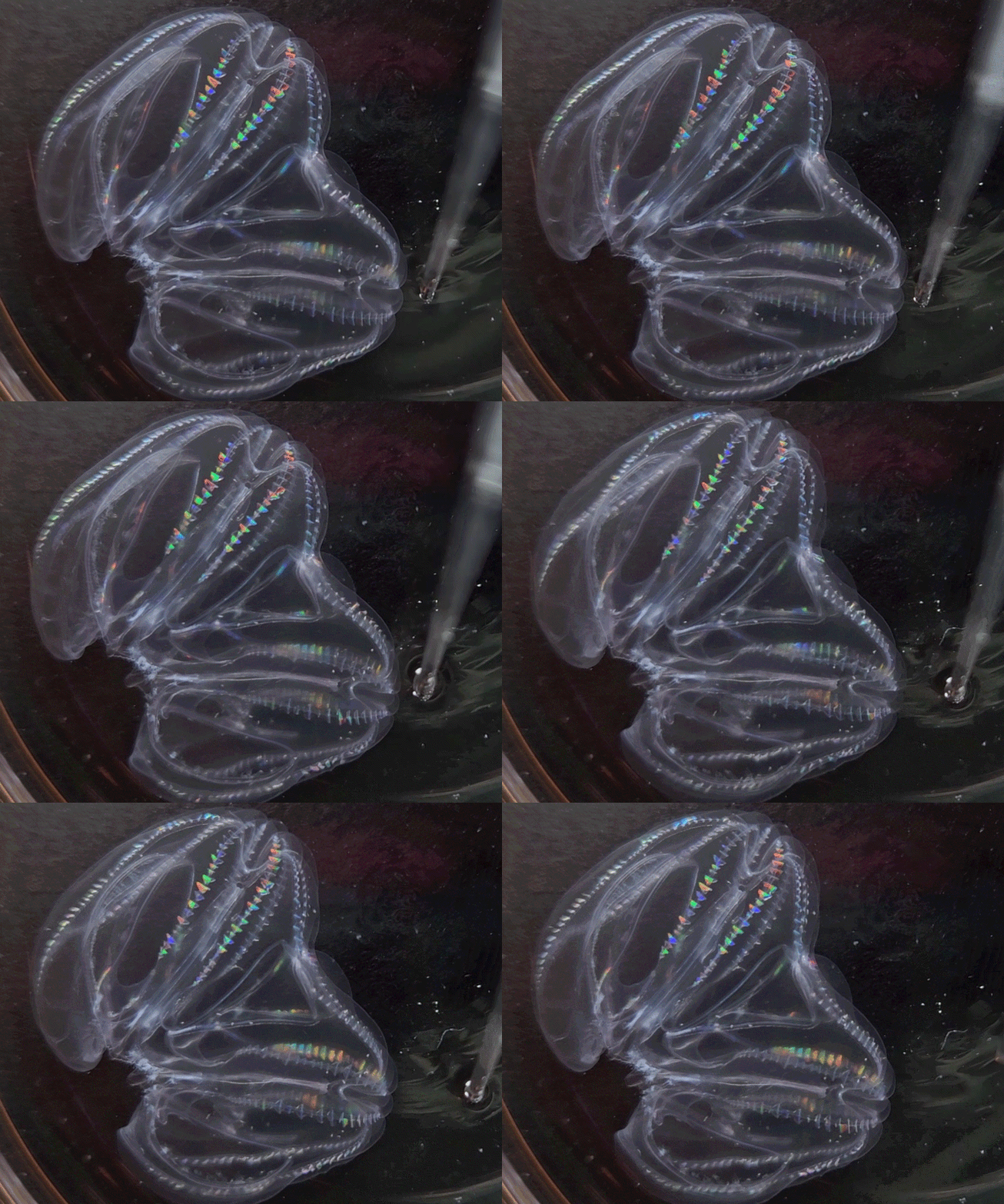
    Synchronized contractions when poked (Nature gif)
    Two comb jellies merged into a single organism in a Massachusetts lab:
    In a strange episode in the animal kingdom, a captive marine animal merged with another of its kind to become a single individual.

    The organisms that merged are comb jellies, translucent invertebrates that resemble jellyfish but belong to a different group of marine animals called ctenophores. They grow to about 4 inches long by 2 inches wide, eat plankton and are found throughout the northern and southern Atlantic Ocean.

    Marine scientists discovered the merger when one comb jelly went missing from a laboratory tank, while another appeared unusually large. After taking a closer look, the researchers found that the big one was two individuals now sharing digestive and nervous systems...

    The researchers fed the combined comb jellies fluorescent brine shrimp and watched as the bits of food made their way through their shared digestive system.

    [Postdoctoral researcher Kei] Jokura speculated that the animals—also known as sea walnuts—sustained minor injuries in the tank, which activated the merger process. To prove this, he and colleagues put 10 pairs of injured comb jellies near each other. Nine of the 10 pairs successfully fused together.

    “In just about two hours, their muscle contractions became synchronous in functional fusion,” he said. “It was remarkable and incredible.”
    This discovery has possible implications for human health. Just as in the case of anglerfish sexual parasitism, the sea creatures lose the sense of self that distinguishes foreign tissue from their own. Overcoming this normally valuable protective mechanism is crucial to prevent rejection in transplant surgery.

    Saturday, May 25, 2024

    Anglerfish: Two Become One

    Male anglerfish fuses with larger female (scitechdaily)
    We can't avoid lingering on the sensational aspect of anglerfish reproduction before getting serious: [bold added]
    These anglerfishes, called ceratioids, reproduce through sexual parasitism, in which the tiny males attach to their much larger female counterparts to mate. In some species, the males bite the females and then release once the mating process is complete. In others, the male permanently fuses to the female. In a process called obligate parasitism, the male’s head dissolves into the female and their circulatory systems merge. He transforms into a permanent sperm-producing sexual organ.
    The theory is that it is so difficult to find a mate at the bottom of the ocean that the male latches onto the female and becomes a "permanent sperm-producing sexual organ." (Insert jokes here.)

    Somehow the female's immune system does not reject the male's foreign tissue, as it would in every other species. Despite her absence of protective "killer T" cells, the female is able to stave off infection by other means. Research into the anglerfish mechanisms could have profound implications for human health, where foreign tissue rejection is a major problem for transplant surgery.
    “Better understanding how deep-sea anglerfishes lost adaptive immunity could one day contribute to advances in medical procedures, such as organ transplants and skin grafting, where suppressing immunity is crucially important,” [Yale Professor Thomas Near] said. “It’s an interesting area for future medical research.”
    The science is interesting and important, but my takeaway is that the next time your friend says he's lost his mind over a woman, tell him that's nothing compared to the male anglerfish.

    Friday, May 10, 2024

    God Giveth, and California Regulators Take It Away

    "Lake" Oroville on July 22, 2021 (Chronicle photo)
    In 2017 the Oroville dam was in danger of breaching, and downstream communities had to be evacuated. In 2021 the Oroville hydroelectric plant was shut down due to lack of water (picture, right).

    Today the Oroville reservoir is at capacity. [bold added]
    Lake Oroville contains 28% more water than it historically has on this date. While the lake also filled to the brim last year, three years ago water levels sank to their lowest point ever, a testament to California’s increasingly variable climate.

    Oroville today (Chron photo)
    This year, snowpack in the northern Sierra measured 123% at its peak, according to state data, helping boost flows in the Feather River, which feeds Lake Oroville.

    Federally managed Shasta Lake, which is California’s largest reservoir, was 97% full on Monday, or about 115% of average.
    At the beginning of this rainy season water managers were worried about too much rain.
    Heading into the winter, many water managers were concerned that if huge atmospheric river storms pounded the state in November and December, that could have caused major flooding because there was less space left in the big reservoirs than in most years to catch runoff
    Whether by luck or divine intervention California had a Goldilocks winter--above average rainfall but not too much to cause flooding. With plentiful water for everyone there would seem to be no need for austerity---unless regulators make Californians cut back because they know what's best for everyone.
    Even with Lake Oroville at capacity, and other reservoirs above average, state water officials have said they expect to provide only 40% of the water requested by communities and irrigation districts in the coming year...

    One of the reasons for the limited deliveries, state officials say, is an ongoing issue with the pumps that move the water. The State Water Project pumping facility in the Sacramento-San Joaquin River Delta often draws in fish and kills them, including delta smelt, chinook salmon and steelhead trout. In response, the state reduces how much water is pumped.
    Who built the faulty pumps? Who decided that fish were more important than the needs of millions of Californians? Those questions are never answered in the one-party State, whose decrees must be obeyed.

    Monday, March 04, 2024

    Living Fossils

    Alligator gar (Yale News)
    No, this isn't a post about politics.

    "Living fossils," (Darwin's term) specifically the gars, have little species diversity and have evolved so slowly that their genome is nearly the same as gars during the age of the dinosaurs. Importantly, understanding gars' cellular mechanisms could lead to a cure for cancer (!).
    The researchers speculate that gars have an unusually strong DNA repair apparatus, allowing them to correct somatic and germline mutations — alterations to DNA that occur before and after conception — more efficiently than most other vertebrates.

    If confirmed, these findings could have profound implications for human health, said [Prof. Thomas J.] Near, the Bingham Oceanographic Curator of Ichthyology at the Yale Peabody Museum.

    “Most cancers are somatic mutations that represent failures of an individual’s DNA repair mechanisms,” he said. “If further study proves that gar DNA repair mechanisms are extremely efficient, and discovers what makes them so, we could start thinking about potential applications to human health.”
    Another Eureka moment in science, this time from a species that is little changed from its ancestors a hundred million years ago.

    Tuesday, November 28, 2023

    The Advantage of Being a Night Owl

    The nocturnal sturgeon survived, while the
    dinosaurs did not (NYNHP image)
    Evolutionary biologists, by using computer modeling, genetics, and datasets that weren't available until recently, theorize that nocturnal behavior helped species avoid extinction.
    Researchers already knew that many nocturnal mammals survived the mass extinction that followed an asteroid strike 66 million years ago, whereas the dinosaurs, which were largely diurnal, did not (except for birds). The new study extends that pattern to other catastrophes and other species, including aquatic ones.
    But how did researchers know that species that lived millions of years ago were nocturnal (fossils provide very little information)?
    Maxwell Shafer, an evolutionary biologist at the University of Toronto, and his colleagues at the University of Basel focused on living fish, which represent half of all vertebrates. They combed the literature to determine the day-night behaviors of almost 4000 bony fish species and 135 cartilaginous ones, such as sharks, and plotted these behaviors on a fish tree of life. Then they carried out many computer simulations of possible day-night activity patterns in the ancestors of modern fish, until they came across the one that best reproduced the day-night patterns of today’s species.
    The nocturnal "advantage" may also apply to mammals:
    Previous studies had suggested early mammals were nocturnal to avoid dinosaurs. After those predators disappeared, mammals switched to being active during the day. Amphibians and other land vertebrates also tended to be nocturnal throughout much of their evolution, according to other studies, but more and more have become diurnal. Shafer’s team proposes that for all vertebrates, nocturnality was a survival advantage during catastrophes.
    Our family is a mixture of night owls and early birds. It's comforting to know that some of us have an improved shot at surviving an extinction-level event.

    Friday, August 04, 2023

    Nico's Pier 38

    On Wednesday night there's still a 20-minute wait
    After a week of non-stop eating, my traveling companions asked that first-world question, "Where are we going for dinner?"

    They don't come to Hawaii as often as I do, so we had different perspectives on opportunity and opportunity costs. (I'm being too subtle, so let me be clear: I'm fine with skipping a meal, they weren't.)

    I suggested Nico's Pier 38, a fine-dining bar and restaurant with an open-air informal atmosphere. It's a favorite of the tourists because there's a nice view of Honolulu Harbor during the day.

    The locals go there because there's plenty of free parking on the dirt lot. I like but don't love Nico's as many reviewers do, but if one is okay with high quality and small portions it's a good place to go.

    I got an appetizer while my tablemates ordered fish and shrimp entrees. Table service was slow due to staffing shortages, but on the bright side it gave everyone an opportunity to put down their phones and talk to each other.

    I took another look around the room: generously spaced tables, live music, enough ambient noise to keep every group's conversations private, a broad selection of drinks. It's a place where Mainlanders, the majority this evening, felt comfortable.

    In the right context I can see why people give it five stars.

    Friday, January 13, 2023

    The Delta Smelt: Let's Have a Debate

    Delta smelt (Mercury News photo)
    Environmental regulations that protect endangered species, specifically the delta smelt, have drastically reduced the amount of storm water that can be pumped to reservoirs:
    But 94% of the water that has flowed since New Year’s Eve through the Sacramento-San Joaquin River Delta, a linchpin of California’s water system, has continued straight to the Pacific Ocean instead of being captured and stored in the state’s reservoirs.

    Environmental regulations aimed at protecting a two-inch-long fish, the endangered Delta smelt, have required the massive state and federal pumps near Tracy to reduce pumping rates by nearly half of their full limit, sharply curbing the amount of water that can be saved for farms and cities to the south...

    In the 1950s, the federal government built huge pumps near Tracy to send water south to farmers and cities through the Central Valley Project. In the 1960s, former California Gov. Pat Brown built even bigger pumps two miles west, near Byron, that pumps Delta water into the State Water Project, which serves 27 million people.

    The pumps are enormous and over time have disrupted fish and wildlife in the Delta, including smelt and salmon, sometimes grinding them up, sometimes making sloughs run backward, and other times removing up to half the Delta’s fresh water. Once plentiful, smelt and salmon numbers crashed. This winter, only five smelt have been found in the Delta by scientists.
    A small fraction of the Delta storm water can be diverted by the pumps to storage, and smelt restrictions reduce even that amount by 40%:
    When the state and federal pumps are fully running, they can move roughly 10,800 cubic feet per second. That means they are unable to catch most of the current deluge even if maxed out. But since Jan. 1, they have averaged just 6,415 cfs per day — far less than their capacity.
    The water districts say that they "do not have much flexibility under the law." The law is a creation of men and can be undone by men. It's time to have a full-throated debate over why preventing the extinction of a small fish is more important than the lives and livelihood of millions of Californians.

    Wednesday, December 21, 2022

    Sounding Off

    Swedish offshore wind farm (tos)
    Two weeks ago we noted that environmentalists claim that lobster fishing is killing North Atlantic right whales (it's speculative because no whale carcasses have been found entangled in lobster-fishing lines.)

    But environmentalists have ignored the danger that cacophonous offshore wind farms pose to the whale population.

    The harmful effect of noise on whales is well documented:
    Anthropogenic noise can change a whale's behaviour, such as causing the marine mammals to feed less or to produce fewer calls. Shipping noise also cause whales to become stressed, with the build-up of stress related chemicals linked to growth suppression, lower fertility and poor immune system function.
    To environmentalists wind farms are more important than whales, which are more important than the lobster industry.

    Your humble blogger likes both whales and lobsters and hopes technology will provide a solution to whale entanglement, if indeed it's proven to be a problem.

    As for offshore wind power, not only does it kill whales, it's not keeping anyone warm on freezing, breezeless nights. I'll take always-on natural-gas or nuclear power plants. And so will our friends, the whales.

    Friday, December 09, 2022

    Saving the Whales and Lobster Dinners

    During last month's birthday we treated ourselves to our first lobster dinner in a year.

    The enjoyment of the meal, however, was slightly tinged by reports that North Atlantic right whales were dying because of entanglement in the trap lines that lobster fishermen use. Now it appears that this problem may be solvable through technology:
    Mr. [Rob] Martin is one of more than two dozen lobstermen now testing new, ropeless fishing gear designed to protect the North Atlantic right whale, a docile giant whose numbers in recent years have plunged, from an estimated 481 individuals in 2011 to 340 in 2021. The endangered whales can have trouble feeding or breathing—sometimes with deadly results—after becoming entangled in the ropes that secure the lobster traps to the buoys.

    The hope is that the ropeless gear will help ensure the whales’ survival while keeping the fishing industry afloat.

    Several kinds of ropeless gear are being evaluated in the program, which includes a total of 30 lobstermen actively testing the gear and 20 who are waiting to join their ranks. The program aims to identify which gear works best and might be scaled up for broad commercial use.
    WSJ illustration: the lines are stowed on the traps and rise to the surface when pop-up buoys, inflatable
    bags or buoyant spools are activated by a signal from a boat. Then the traps are hauled up.
    The incentive is more than academic:
    A federal judge ruled in July that NOAA [National Oceanic and Atmospheric Administration] hadn’t done enough to protect the right whale and in a subsequent ruling gave agency officials two years to come up with a plan to reduce whale deaths by 90 percent.
    The whales vs. lobster industry dispute has become heated because of the lack of direct evidence that the lines are the cause of the whales' decline. "Researchers rely on indirect evidence, since most dead whales aren’t found." Meanwhile, we applaud the NOAA for funding, designing, and testing solutions where both sides can win.

    We'll treat ourselves to another lobster dinner this Christmas season.

    Tuesday, November 22, 2022

    A Few Comestibles

    You can't find octopus jerky (right) in California
    One of the first shopping expeditions on this Hawaiian trip was to Costco. 90% of the items in Honolulu consisted of goods that were available in California, but I was interested in food, clothing, and gifts that you couldn't get back in my adopted home.

    The refrigerated section had lau-lau, poi, kalua pig, Portuguese sausages, and lomi salmon. I picked up a few comestibles to be consumed later on the vacation.

    The Hawaii Costco also has seafood jerky that Mainland warehouses don't carry. Fish jerky isn't cheap--between $15 to $20--but I enjoy these much more than beef and pork products that are too heavy and oily for my taste. I threw a couple of packages in the suitcase to bring back.

    BTW, I've been shopping at the warehouse stores to buy local products since 2006.

    Thursday, September 22, 2022

    Fishy Emanations

    Over 100 years ahead of its time
    Lawyers sometimes use logic that's so convoluted that the results seem absurd to us common folk.

    Headline: Yes, bumblebees may be fish, California Supreme Court agrees
    a state appeals court ruled in May that [the California endangered species act] was flexible enough to allow the state Fish and Game Commission to consider protecting four imperiled species of bees under the category of “fish.”
    Sure, it seems crazy, dear reader, but what you're missing is an intermediate species, the Trinity bristle snail: [bold added]
    In the 3-0 ruling, Justice Ronald Robie acknowledged that a fish, “as the term is commonly understood ... lives in aquatic environments.” But he said state lawmakers, when they approved the current law in 1984, knew that the Department of Fish and Wildlife, which enforced the law, had found that it protected invertebrates living on land.

    The Legislature “could have expressed disagreement” with the department, but instead expressly extended protection to all creatures covered by the law before 1985, including the Trinity bristle snail, Robie said. By the same logic, he said, the law must now be interpreted to allow protection of bumblebees.
    Because of recent U.S. Supreme Court decisions, California has claimed that its jurisprudence is superior.

    Well, that didn't last long. Ruminations over a simple mollusc have made the California judiciary a laughing stock.

    Friday, July 08, 2022

    Hope for the Sea Around Us

    Anchovies at Bolinas Lagoon (SFGate)
    Global warming Climate change is supposed to poison the oceans, but so far that 2003 model prediction hasn't conformed to reality. In fact, the opposite may be happening.

    Sea life is thriving off the coast of Northern California.
    According to [Fishing Association President Larry] Collins, the water this year is the coldest local fishermen have seen in a long time, and the anchovies are a testament to that.

    “It's just totally healthy ocean out there right now. I heard guys telling me about pelicans that, instead of diving to fill their mouths up, they’re just skimming the water and getting full mouths of anchovies,” Collins said.
    Helicopter photo of Antarctic fin whales (YouTube)
    Fin whales (only blue whales are larger) are returning to the coast of Antarctica.
    Large numbers of fin whales have returned to their ancestral feeding areas near Antarctica for the first time since hunting of the animals was banned almost half a century ago, scientists said in a paper published Thursday in the journal Scientific Reports.

    The unexpected finding offers a hopeful sign not only for efforts to conserve the giant animals, according to the researchers, but also for the health of the ocean ecosystems in which they live. Whale feces fertilize microscopic plants known as phytoplankton. Those are eaten by tiny, shrimplike animals known as krill, which in turn sustain dolphins, seals, penguins and other marine species...

    The population of fin whales in the Southern Hemisphere has reached nearly 8,000, the study showed. That is up from about 3,000 when the International Whaling Commission issued a moratorium on hunting of the whales in the Southern Hemisphere in 1976. Whaling before that time killed an estimated 700,000 fin whales.
    There be dolphins here (WSJ photo)
    Dolphins are coming back to the East River:
    Partly because New York City waters aren’t as foul as they once were, dolphins have been visiting in greater numbers of late...

    Scientists believe the marine mammals may be arriving in warmer months in pursuit of one of their favorite foods, the Atlantic menhaden, which are congregating in the area thanks to robust conservation efforts. The waters surrounding the city are cleaner now than at any time since the Civil War, said Ted Timbers, a spokesman for the NYC Department of Environmental Protection.
    "...since the Civil War"--the baby boomers' yearning for Walden (1854) may not be a pipe dream after all.

    Unlike some climate-change alarmists, your humble blogger won't be so bold as to claim that three data points prove a hypothesis. However, they are an indication that the situation isn't as dire as the alarmists claim, and that there's hope that some of the damage is reversible.

    Wednesday, June 29, 2022

    "Just Totally Healthy Ocean Out There Right Now"

    Upwelling (illustration from Visualizing Science)
    Global warming Climate change is responsible for heating the oceans, but scientists are now saying that it's the reason for ocean chilling.

    The Pacific Ocean near San Francisco has been the coldest it’s been in more than a decade.
    a weather buoy at Bodega Bay recorded water temperatures as low as 47.8 degrees on June 21, the coldest it’s been that day for over a decade. That compares with a mean over the decade of around 51 degrees for June, typically the coolest month for that buoy, and other buoys in the area have shown similar trends. It’s been so cold that some fish appear to have been staying in the warmer waters of the bay...

    Such cold spells this time of year are a unique feature of the Central California coast. They are triggered by high winds that stir up cold water from the deep in a process known as upwelling...

    Upwelling delivers essential nutrients particularly to what are called forage fish, like sardines and anchovies, said [Monterey Bay Aquarium researcher Henry] Ruhl. Over time, salmon get pinker and richer-tasting from their abundant diet, and whales come close to shore to feast on anchovies and krill. With more to eat, seabird populations can boom, and kelp forests, the vital habitat for marine life that have recently been decimated by climate change, grow stronger.
    Fish, plants, marine mammals, and birds are all prospering:
    Upwelling delivers essential nutrients particularly to what are called forage fish, like sardines and anchovies, said Ruhl. Over time, salmon get pinker and richer-tasting from their abundant diet, and whales come close to shore to feast on anchovies and krill. With more to eat, seabird populations can boom, and kelp forests, the vital habitat for marine life that have recently been decimated by climate change, grow stronger.
    Anchovies are so plentiful that seabirds can't eat any more and are dropping them during flight. Fish are "raining from the sky."
    Local fishers and researchers are blaming seabirds that, because of an explosion in the anchovy population off the coast of the Bay Area, now have more fish than they know what to do with...

    According to [Fishing Association President Larry] Collins, the water this year is the coldest local fishermen have seen in a long time, and the anchovies are a testament to that.

    “It's just totally healthy ocean out there right now. I heard guys telling me about pelicans that, instead of diving to fill their mouths up, they’re just skimming the water and getting full mouths of anchovies,” Collins said.
    "La Niña should last through the end of the year," which means cool oceans and wet weather in the near future.

    With any luck we will get real rain, not just fish, falling upon our heads this winter.

    Saturday, June 25, 2022

    Klamath Tear-Down: Trust the Cost-Benefit Analysis

    (Chronicle map)
    California has dire need for both water and electricity. Hydroelectric dams provide both, and do so without producing carbon emissions. One would be hard pressed to find a more beneficial example of human engineering.

    At first blush it doesn't make sense that four hydroelectric dams on the Klamath River will be torn down.
    the largest dam-removal project in U.S. history is expected to begin in California’s far north next year.

    The first of four aging dams on the Klamath River, the 250-mile waterway that originates in southern Oregon’s towering Cascades and empties along the rugged Northern California coast, is on track to come down in fall 2023. Two others nearby and one across the state line will follow.
    Environmentalists and fishermen are eagerly anticipating the restoration of the Klamath chinook salmon run, which once totalled in the hundreds of thousands but is now 10% of that number. But the principal reason for the tear-down is that the cost of maintaining aging dams exceeds the benefit of electricity generation, and "the dams are not used for irrigation, municipal water or flood control."
    The plan to raze the dams is the product of at least 20 years of debate over what to do with the river’s old and increasingly problematic infrastructure.

    Owned by power company PacifiCorp, a subsidiary of billionaire Warren Buffett’s Berkshire Hathaway, the dams have long needed major upgrades, including fish ladders, which are believed to cost more than the dams’ worth as hydroelectric assets...
    Despite the cost-benefit analysis, some residents are reluctant "to surrender any power source and [have] less water available for fighting wildfires." We just have to trust that Warren Buffett's company knows what it's doing, a good bet based on Mr. Buffett's past record of determining value.

    Related: in 2018 Stanford University brought together environmental groups and hydropower interests, who are known for their vehement disagreements, to discuss how to generate more electricity while improving the health of rivers. They already can point to some successes.

    Wednesday, May 25, 2022

    Animal Tales

    Catching up on local animal news:

    Mother's burden: stuck and heavily lactating (Chron)
    Mother Raccoon stuck in roof
    A mother raccoon trying to reach her babies in an attic got stuck as she chewed through the roof of a home in the Santa Cruz Mountains on Monday morning, wildlife rescue officials said.

    The raccoon may have been trying to get to her babies in the attic, following the homeowner’s repair of an attic vent...

    Construction workers nearby then helped the homeowner, and the raccoon made its way back to her babies...It was unknown how many baby raccoons were in the attic.
    The lesson is that we need to check for critters before undertaking home repairs. No love for animals is required, just self-interest--no one wants dead animals in their roof, basement, or walls,

    (Intl Bird Rescue / Chronicle photo)
    Pelican Crisis
    California’s brown pelicans are suffering from a mysterious affliction that has landed more than 200 of them in wildlife rehabilitation centers in recent weeks, resulting in what wildlife officials are calling a major “pelican crisis.”...

    Determining a cause for the pelicans’ conditions has been difficult because the issue appears to be affecting pelicans of all ages in different ways, and the injured and hungry birds are coming from all over..

    The affliction, whose cause could take years of research and tracking to fully understand, could be the result of a combination of factors, [International Bird Rescue spokesperson Russ] Curtis said. Young fledglings are just now learning to feed on their own, and IBR officials believe there could be a lack of available fishing stocks, meaning pelicans are struggling to find enough fish to eat or taking unusual risks in search of food.

    International Bird Rescue is spending about $2,000 on 1,000 pounds of fish every day....“They are voracious eaters,” Curtis said. “We got a lot of mouths to feed.”
    The quail is both the State and City bird. (Chron photo)
    Coyotes may help bring California quail back to San Francisco (?!?)
    The last California quail known to live in the Presidio was a male...Scientists gently collected it in 2008 and brought him to the San Francisco Zoo. The hope was that at least the bird’s genetics would live on, even if its flock had not.

    Coyotes reduce predators like rats, raccoon and feral cats that threaten quail and its eggs. The effect is significant.

    The presence of coyotes in urban parks increased the odds quail would live there, too, by 73.3%, according to an analysis of data on quail sightings.
    Today there are "5 to 10" coyote in the Presidio. They eat the rodents that dine on quail and quail eggs. Thanks to coyote, the park service is considering reintroducing quail to Golden Gate Park.

    California newt (Chron photo)
    Amphibians Need Road Crossings, Too
    Every winter, a road in Tilden Regional Park closes to vehicular traffic so California newts can safely get to water during their breeding season. They’re lucky. Elsewhere in the Bay Area, thousands of newts get squashed every year by unaware drivers.

    ...Despite their size, newts share something with mountain lions: They’re top predators on the forest floor, with a steady diet that regulates the invertebrate population and may even help combat climate change.

    ...In Santa Clara County, over 7,000 newts have been killed on a stretch of Alma Bridge Road this breeding season. It’s the highest known roadkill rate of any other species in the world, according to the UC Davis Road Ecology Center.
    Given the weightier issues of the day, these tales des animaux seem frivolous. I for one am glad that so many people know so much about and care for our fellow creatures.