Showing posts with label Credit. Show all posts

Saturday, August 31, 2024

Freeze Your Credit Now

(Image from Dealing with Dementia)
In early 2015 I read about how freezing one's credit can provide protection against one consequence of identification theft: a crook being able to open a new loan, credit card, or line of credit in my name.

I paid $10 to each of the three major credit-reporting agencies, Experian, Transunion, and Equifax, not to furnish credit reports to new lenders who come asking. It has been a minor hassle to unfreeze the accounts to obtain car leases and a new Apple Card, but it's been worth the $10 charge to sleep a little easier every night.

Credit freezes have cost nothing since 2018, so everyone should do it.
The good news is that freezing your credit is less of a pain than it used to be. It became free and simpler under a 2018 federal law following the massive Equifax breach the year before. But it does take a little more effort than locking your door...

Aside from making it a little less convenient to apply for a loan or credit card, freezing your credit costs nothing and has virtually no downside. It doesn’t hurt your credit score. Landlords and employers can still run a credit check. Existing creditors can increase your credit limit.

Making it harder to open new lines of credit might also be a form of financial discipline, since you won’t be able to sign up for buy now, pay later offers or store credit cards without first unfreezing your credit...

To freeze your credit, you must go online and request a freeze at all three of the major credit bureaus: Experian, TransUnion and Equifax. Reversing the process requires going through each bureau again.

To prove who you are, you will need to have a government ID, like a driver’s license, pay stubs and utility bills. Once set, it should take less than a half-hour to complete the process, says Miklos Ringbauer, a financial adviser in California. He encourages clients to keep their credit frozen and only lift the freeze for short periods, such as when they plan to apply for loans. After the initial setup, the freeze can be turned on or off with a few clicks, he said.
Freezing credit doesn't relieve one of the need to review one's existing bank, credit-card, stock-brokerage, retirement, etc. accounts for unfamiliar transactions, but it's a necessary part of a scam-protection program.

Monday, March 11, 2024

Easy Risk Evaluation

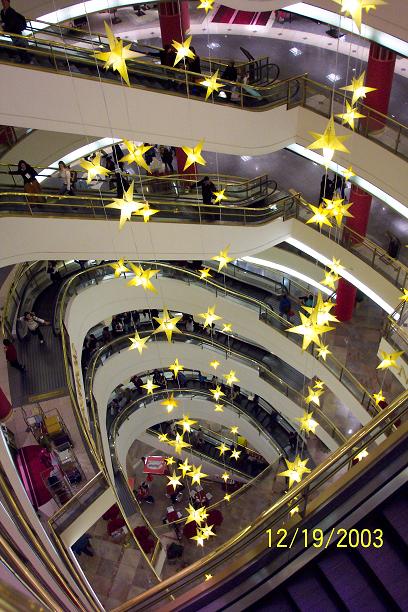
The now half-empty San Francisco
Centre was filled in 2003
It's no surprise that banks are experiencing losses on property loans in U.S. cities: [bold added]
two banks that have reignited worries about property lending in recent days are one based in the New York region, New York Community Bancorp, and one based in Japan, Aozora Bank. Shares of both banks plunged this past week after they reported increased credit concerns related to commercial property risks in the U.S...

At Aozora, the at-risk property loans identified were concentrated in big cities. Of the 21 nonperforming U.S. office loans, with $719 million outstanding, that it reported this past week, the largest chunks by city were $171 million in Chicago and $127 million in Los Angeles. “The volume of property sales remains very low,” the bank wrote about Chicago’s office market in a presentation.

In a January report, Moody’s Analytics found the biggest percentage-point increase in office vacancies among U.S. metro areas over 12 months was in San Francisco, followed by Austin, Texas.
Other concentrations of problematic real estate loans were in New York and Los Angeles. Note: every single one of the cities named in the article has a Democratic mayor. Were your humble blogger a bank risk officer he would simply deny real estate loans to cities that had Democratic leadership. (Yes, I'd miss out on some profits in, for example, Knoxville, TN or Columbia, MD, but in banking big write-offs are to be avoided more than profits on risky loans are sought). Then I'd go home and have an untroubled sleep.

Saturday, September 09, 2023

Cash: Still the King

You still need to carry both
Square has expanded beyond its roots in mobile payments and now offers an array of services, such as inventory and payroll, to businesses. The risk to small enterprises is that their dependency on one provider like Square could be disastrous when the provider shuts down:
During what would become an hours-long [Thursday noon - Friday morning], nationwide outage of payment system Square...restaurants and bars throughout the Bay Area who rely on Square to take payments were left frustrated and scrambling. Many posted to social media, telling customers to bring cash.
Contingency planning is often neglected, and this experience should be a wake-up call to small businesses to work on back-up plans.

But customers need to be prepared, too. I've had to pay cash on two different occasions this year when the systems on fast food franchises went down. As noted earlier this year,
My thicker wallet undoubtedly reflects personal insecurities. I carry at least $100, 1 debit and 3 credit cards, a driver's license, a gym membership, a health insurance card, and an auto club card.
It has to be said: every small business I deal with--independent restaurants, dry cleaners, and hair salons-- prefers cash. When I handed a cab driver cash instead of the credit card he was expecting, his eyes lit up.

So carry a little green in your wallet: it insures against system outages, and it seems to make merchants happier!

Wednesday, July 12, 2023

FICO Score: Shrinking Like a Lot of Other Things

Unofficial FICO score from one of our credit cards. Others show
scores in the 700's. Nice, but we're not applying for loans anyway.
ID crooks not only steal from bank and brokerage accounts, they also take out new credit cards and loans in victims' names.

As a protective measure we froze our accounts at the credit-reporting agencies in 2015; a thief could apply for a loan under our ID but the agency will not give a credit report to the prospective lender--hence, no loan.

Since 2015 we've had to "unfreeze" the Equifax, Experian, and Transunion accounts temporarily when we took out car leases and added a credit card. In general, however, we've been simplifying/consolidating our accounts and reducing debt obligations.

Reducing debt is commonly viewed as a virtuous activity, but it does lower one's credit score. Why do credit scores matter if we, like many retirees, don't intend to take out loans? [bold added]
Even people with pristine records of on-time payments can expect their scores to slip after they stop working. While stopping work doesn’t ding your credit directly, living on a fixed income and paying off old loans can lower a score, said Ethan Dornhelm, vice president of scores and analytics at FICO.

Credit scores matter to millions of retirees even if they are less likely to apply for mortgages, loans or other debt, financial advisers said. Scores are used in a range of insurance and healthcare decisions, from setting your premiums to whether you are accepted to an assisted-living facility.
We do have enough set aside for assisted living, if that indeed is our destiny, so keeping a high credit score is not important for that purpose.

The ego had already been crushed when the IQ score started shrinking and there was nothing I could do about it.

As we go gently into that good night, the high (IQ, credit, energy) shall be made low and the low (weight, A1C, blood pressure) shall be made high.

Friday, February 10, 2023

Successfully Claiming the Middle Class Tax Refund

The California Middle Class Tax Refund (MCTR) card came three weeks ago. It was time to get the money.

From news reports scammers are able to drain the account after the card is activated, so I delayed that move until I was ready to use the card.

At the local Citibank branch this afternoon, I phoned the 1-800 number on the sticker and dutifully typed in the last six digits of my social security number. A computerized voice instructed me to create a 4-digit PIN, at which point it specified the card value.

The teller asked me to insert the Citibank ATM card, input its 4-digit PIN, then insert the MCTR Visa card and type its 4-digit PIN. I said that I wanted the entire amount transferred to my checking account. The teller said that the maximum daily amount was $600 (unclear if that was a card or Citibank limitation). He transferred that sum immediately and suggested that I come back tomorrow to claim the rest.

Fearful of waiting another day, I drove to the Bank of America branch to deposit the remaining funds. After I inserted the BoA ATM card and PIN, the teller inspected my driver's license, then processed the MCTR card. She took more time with the forms than the Citi teller. In the end all was well; the rest of the money was put into the checking account.

Comments:
1) Neither bank imposed a transaction fee.

2) The fund-draining scam clearly isn't occurring at the bank branches but at other venues, like online merchants, where Visa cards can be used.

3) Today the IRS finally ruled that the MCTR payments are not taxable by the Federal government (California declared them not to be taxable by the State last year).

4) I don't see why the Franchise Tax Board couldn't issue checks, like it did in the old days. Theft losses will still occur, but the crooks will have a much harder time.

Saturday, December 03, 2022

Fixers, Fix Yourselves

(NuTech illustration)
Consumers who struggle with loan payments often turn to credit-repair consultants that purport to improve consumers' scores by the credit-reporting companies Equifax, TransUnion, and Experian.

The problem is that some fixers employ illegal methods: [bold added]
In recent years, a government website has made it easier for people to file claims of identity theft so they can remove fraudulent accounts from their credit reports...These companies file false identity-theft claims on items that bring down customer’s credit scores, like delinquent credit-card debt, often without that person’s knowledge.

The move often removes that information from the consumer’s credit reports while the claim is investigated. The practice is known in the industry as credit washing, since a person’s credit reports can look better than they really are, at least temporarily, and so can their scores...

Naftali Harris, chief executive at SentiLink, a company that works with lenders to help stop identity fraud, said many lenders tell him that 80% to 90% of the claims they receive about identity theft are fraudulent.
More details on how identity-theft protections can be exploited:
When a person provides the required paperwork to Equifax, Experian or TransUnion stating that an unpaid loan or other negative information on a credit report is the result of identity theft, the companies in many cases must remove the information within four business days if they can’t verify it is legitimate. They and the lenders can continue to look into the claim, and later reinstate the account if it’s found to be legitimate. Meanwhile, the borrower is in a better position to apply for new loans from other lenders.
There are ethical companies in the credit-repair industry who do help those who suffer from identity theft.

Unfortunately, bad behavior (e.g., cryptocurrency, misleading "news" reporting, pharmaceutical claims, nonprofit politicking) have caused the public to distrust entire industries and institutions.

Friday, February 05, 2021

Eviction Moratorium: Unintended Consequences

(Image from Fullerton Observer)
As we noted last week, the moratorium on evictions has been extended to June 30th. However well-intentioned the extension, when government unilaterally overrides contracts for an extended period the precedent will have lasting effects on the availability of rental housing and perhaps even beyond the real-estate industry.

But there's another feature of the eviction bill that also has unintentioned effects: landlords must ignore unpaid rent--and evictions--on tenants' records when they apply for a new lease: [bold added]
One part of the law that is likely to be particularly hard to enforce is a clause that prohibits landlords from denying housing based on rent debt accrued during the pandemic, said Leah Simon-Weisberg, legal director with Alliance of Californians for Community Empowerment, an organizing group that advocates for low-income households. Prospective landlords often screen tenant candidates through their former landlords, allowing them to learn of debts they aren't supposed to base decisions on.
When the government orders that damaging information be concealed, the benefit to the protected group is usually small--in this case having a lease application accepted--in relation to the potential harm to another party, in this case the higher probability of a landlord having to endure months of unpaid rent and incur property damage.

Landlords not being allowed to ask specific questions is similar to "ban the box" laws that forbid asking about a job applicant's criminal record.
While advocacy groups including the NAACP have praised ban the box legislation, the laws are often being passed without enough data to support whether or not the policy is actually improving employment outcomes for people with a criminal history.

Some studies show that ban the box laws could actually have a negative impact: When employers aren't allowed to ask about applicants' criminal background early in the hiring process, they may be more likely to assume certain applicants – especially black and Hispanic men – have a criminal history, denying jobs to qualified applicants who don't have a criminal history.
In other words, not being able to find out about a criminal record causes some employers to look to other attributes that--however mistakenly--are indicators of law-breaking, for example, being male, Black or Hispanic, tattooed, etc. The innocent job applicant is screened out because he can't be asked about a criminal past.

Similarly, if a landlord is not permitted to find out about a prospective tenant's rent history, then the landlord is left to look at other risk factors: employment, assets, the ratio of income to rent, etc. In the Bay Area many tenants are barely able to afford rent, and sympathetic landlords often give the marginal applicant a break if they have a spotless record.

By suspending evictions the government has shown that a one-month security deposit is inadequate. By blocking information the government has made good renters suffer. And because of the much greater riskiness of being in the rental business, property owners--and I know some personally--are withholding their rentals from the marketplace or are converting their properties to sell.

As often happens, a government whose stated objective is to increase the supply of housing has enacted policies that do the opposite.

The LA Times article notes how an eviction often leads to a downward spiral in a tenant's life and includes interviews from various constituencies. (Entire article reprinted below without indentation.)

Monday, September 30, 2019

In the Cards

Goldman Sachs is one of the premier investment banks on Wall Street. It's been trying to leverage its prestige by entering the consumer space:
I caved to the marketing hype
Goldman’s new consumer bank, which operates under the brand Marcus, has lost $1.3 billion since launching in 2016. It spent heavily to buy startups and cloud-storage space, hire hundreds of techies, and build call centers in Utah and Texas. Loans have gone bad at a higher rate than that of rivals.

and got an Apple Card
Marcus launched without a collections team to chase down delinquent borrowers, resulting in early loan losses, people familiar with the matter said. A credit card developed with Apple Inc. was a coup, but a costly one: Thousands of engineers across Goldman were diverted to finish it in time for an August debut, delaying other projects.

Apple ads for the card carried the phrase: “Designed by Apple, not a bank”—a line that didn’t appear in a giant banner ad in Goldman’s lobby this fall.
It's easier for an upscale line to go down-market than the reverse. The risk is watering down the brand, and a failure in execution could tarnish Goldman's name. Even if the Apple Card succeeds, the cultural changes wrought from managing millions of retail accounts might prove too much for the venerable investment bank, and it wouldn't be surprising if a spin-off or even a divestiture is in the cards.

Thursday, August 15, 2019

Too Much Information, Too Often

Alerts since May are fast and furious
One indicator of a person's financial health is the FICO score ("the credit scores created by Fair Isaac Corporation").

As with other perceived meaningful measurements (IQ, BMI) the FICO rating is being used in areas removed from its original function as a loan-payment predictor; FICO is now a factor in employment decisions and matters of the heart. It's become important!

So it was that your humble blogger began subscribing to Experian reports about my FICO score. The problem is that Experian sends alerts about changes that are only a few points up or down, though the credit strata are about 50 points wide.

Though I pay off all the credit cards on time each month, if the balances are a thousand dollars higher that will lower the FICO slightly, and vice versa.

Having learned to have perspective on the day-to-day changes in the investment portfolio, I'll now do so with the FICO score.

Thursday, January 24, 2019

Still Going Strong

"YES": the 3 leading currencies (Dreamstime graphic)
In 2011 Standard & Poor's downgraded the U.S. credit rating from AAA to AA+. The rating agency cited government debt (then $11.4 trillion) and mismanagement of fiscal policy. Not following suit, Moody's and Fitch, the other two major rating agencies, maintained their triple-A rating on U.S. Debt

7½ years later, outstanding government debt has nearly doubled. Citing this as his reason, Starbucks chairman Howard Shultz is running for President: "I think the greatest threat domestically to the country is this $21 trillion debt hanging over the cloud of America and future generations."

Meanwhile, S&P, Moody's, and Fitch have not changed their respective ratings on U.S. debt since 2011.

But what does the rest of the world think? WSJ -- Dominant Dollar Bests Challengers:
after a drawn-out crisis in the eurozone, and a more recent slowdown in China, the dollar’s international pre-eminence looks safer than ever. Concerns that a U.S. administration with an America First platform would diminish the dollar’s global role haven’t been borne out, either.
U.S. debt may be risky, but the dollar is still on top because currencies, which are an imperfect proxy for national strength, are graded on a curve.
International use of the euro, once the dollar’s clearest challenger, has diminished since the eurozone sovereign-debt crisis raised the specter of default on debts previously believed safe. The euro’s share of global reserves shrank to 20.5% in the third quarter of 2018 from 28% in 2009...

But to make the yuan an international force, economists and investors have long maintained, Beijing must permit freer movement of money across its borders.

Instead, facing a flood of capital outflows in 2015-16, it clamped down on investment outside of China.
You can't replace something with nothing, and the dollar is more something than its rivals.

Wednesday, May 30, 2018

Experience Trumps a Training Manual

The cashier was also a barista who made my cold brew.
Just ahead of me a 12-year-old girl tried to pay for a purchase using a credit card.

The cashier peered at the proffered plastic. "What's the name on the card?" The girl looked and read the name.

"Is this yours?"It's my Mom's. Because she had not answered quickly, there was a chance she was lying.

"You can't use someone else's card." Holding the charge plate, the cashier pondered; I could tell that she was thinking about keeping it. Eventually she handed it back.

The girl huddled with two friends who were giggling. If forced to guess, I would have said she was probably telling the truth about the card being her mother's, though I doubt she was given carte blanche as to its use. They walked away.

The lady at Starbucks radiated the authority of someone twice her size. Perhaps she had been a teacher or an office manager, sticking to principles that no longer matter to most people. She taught these girls a lesson they won't soon forget.

Millions of strangers interact with each other every day, and not all interactions are handled well. If Starbucks had hired people with life experience and good judgment, they wouldn't have had to close more than 8,000 stores yesterday for antibias training.

Friday, March 16, 2018

If at First You Don't Succeed, Lie, Lie Again

(No, this post isn't about politics.)

One of the latest trends in fraud is to create fictitious people to take out loans. How can this happen in the age of Big Data, i.e., when large companies know more and more information about everybody? [bold added]
(WSJ graphic)
Synthetic-identity fraud exploits a vulnerability in America’s consumer-credit system. Lenders often consider a loan applicant legitimate if the applicant has a credit report at Equifax Inc., TransUnion or Experian PLC. But a new “credit file”—essentially a precursor to a credit report—often gets created when someone simply applies, even if the loan doesn’t come through.

Some lenders approve loans after reviewing credit files, which helps turn those files into full credit reports. That’s how a fictitious person, or 300 fictional people, can end up with a credit card.
Crooks know that the first application will be rejected, but it will allow the fake identity to get into the system and maybe some business-hungry lender will approve the next application.

Three comments:
1) The consumer-credit business is much less secure than other lending. Recently I've helped shepherd two real-estate deals through closure; in both cases the loans were under $500,000, the borrower's equity was 25-50%, the document requests were voluminous (tax returns, W-2's, brokerage statements, and balance sheets with questions about every line item), and numerous phone calls between borrowers and lenders.
2) Financial institutions who make personal loans to fake people deserve the consequences. No bailouts for them!
3) Fake identities are better than stolen identities. At least no consumers were directly harmed.

Tuesday, September 12, 2017

Easy to Overlook

Two years ago we paid $10 each to credit agencies Experian, Equifax, and TransUnion to "freeze" information about our data, which will make it more difficult for identity thieves to take out credit in our names. Last week's heavily publicized data breach at Equifax has made us glad we took that precaution.

Everyone's hypersensitivity to Internet security is being exploited by other crooks. On Sunday we received an email purportedly from the "Apple Store" (right). Of course, it wasn't from Apple; there are dead giveaways in the content of the email, the to and from addresses, and the grammar--foreign scammers have difficulty with the proper usage of articles "the", "a", and "an".

One has to be vigilant about passwords for not only one's bank and loan accounts but also other websites, like Apple's iTunes and Amazon, that are linked to credit cards. The Internet has made our lives much easier, but the costs are easy to overlook.

Monday, August 28, 2017

Check Out My Number

The only photo that's necessary.
Good looks, athleticism, and popularity are no longer the attribute most important to the opposite sex:
when it comes to looking for a prospective partner, one's credit score is hugely important, reports Bloomberg. One new survey from the parent of dating sites like Tinder finds that 69% of 2,000 online daters surveyed rank financial stability as very or extremely important, putting it slightly ahead of humor (67%) and well ahead of attractiveness (51%), ambition (50%), courage (42%), and modesty (39%), per a press release.
Ladies, check out my number, then take a number. Ladies? Ladies? Where'd you go?

Tuesday, August 09, 2016

Build on It

As part of a standard credit-check, I tried to contact the person's human resources department to verify employment. The tech company is well-known locally, its market cap between $10 and $15 billion.

Drilling down through three menus to find the phone number on the company's website, I dialed the main switchboard. It rang for half a minute then dropped the call. I tried again and got the familiar message "if you know your party's extension, dial it at any time." When a voice-recognition routine started, I asked for "human resources," which the disembodied voice didn't recognize. No human operator came on to help.

Using other sources, I was able to get enough information to satisfy the credit-check. However, it was disappointing that I had to forego one of the standard, easy means of foiling fake references, that is, calling the employer directly and not using the numbers given by the person being checked out.

The irony is that one of the company's best-selling services is internet security. In the old-school world security relied on practicality, common sense, and talking with, or better yet, meeting people. In the new world security is provided by companies whose technology is understood by few. A word of advice to the kids running these companies: don't throw out the old, build on it.

Friday, July 08, 2016

Payments Revolution or Devolution

The new Costco Visa has a chip but the
Costco machines are swipe only. Maybe
Costco doesn't trust the technology?
Despite nearly a year of preparation, the transition has not gone smoothly. [bold added]
The new Costco credit card was supposed to make everybody happy.....

As soon the switch went into effect, though, Costco members reported problems with the card and vented their frustrations on social media. Cards weren’t mailed on time, there were long delays on customer service lines, and in some cases cards couldn’t be activated at all. Citi, the card’s new issuer, has spent the past couple of weeks extinguishing fires.
Comments:

1) I activated the Costco credit card by doing it the old-fashioned way and used the phone. I then used it at Costco (without a hitch). Properly established, I set up an online ID on the Citi website and linked it to the credit card. However, the first payment will be via check.

2) When starting with a new vendor, bank, or credit card company, I always pay via check for a few months.

Get your account flowing---it's not good to miss your first payment---then set up the "modern" payment method (website, mobile pay, automatic transfer, etc.) that you prefer. Checks-mailed-to-a-lockbox are a proven system that has been around for decades, and the paperless methods for most companies are bolted on top of the existing system. Yes, planning ahead a few days is so very difficult, it's such a hassle writing a check and stamping an envelope, so go ahead and take your chances....

3) It's one's right to be a demanding customer and post complaints on message boards, but have you noticed that the majority who do the complaining are themselves quite slovenly in their work product? Conscientious workers know how hard it is to make things perfectly and make allowances when complex products are introduced.

Wednesday, October 21, 2015

A Small Pleasure

Exceeds what I get, but not by much (ideas.repec.org)
Apparently, the banks think I'm simultaneously rich and poor, educated and uneducated.
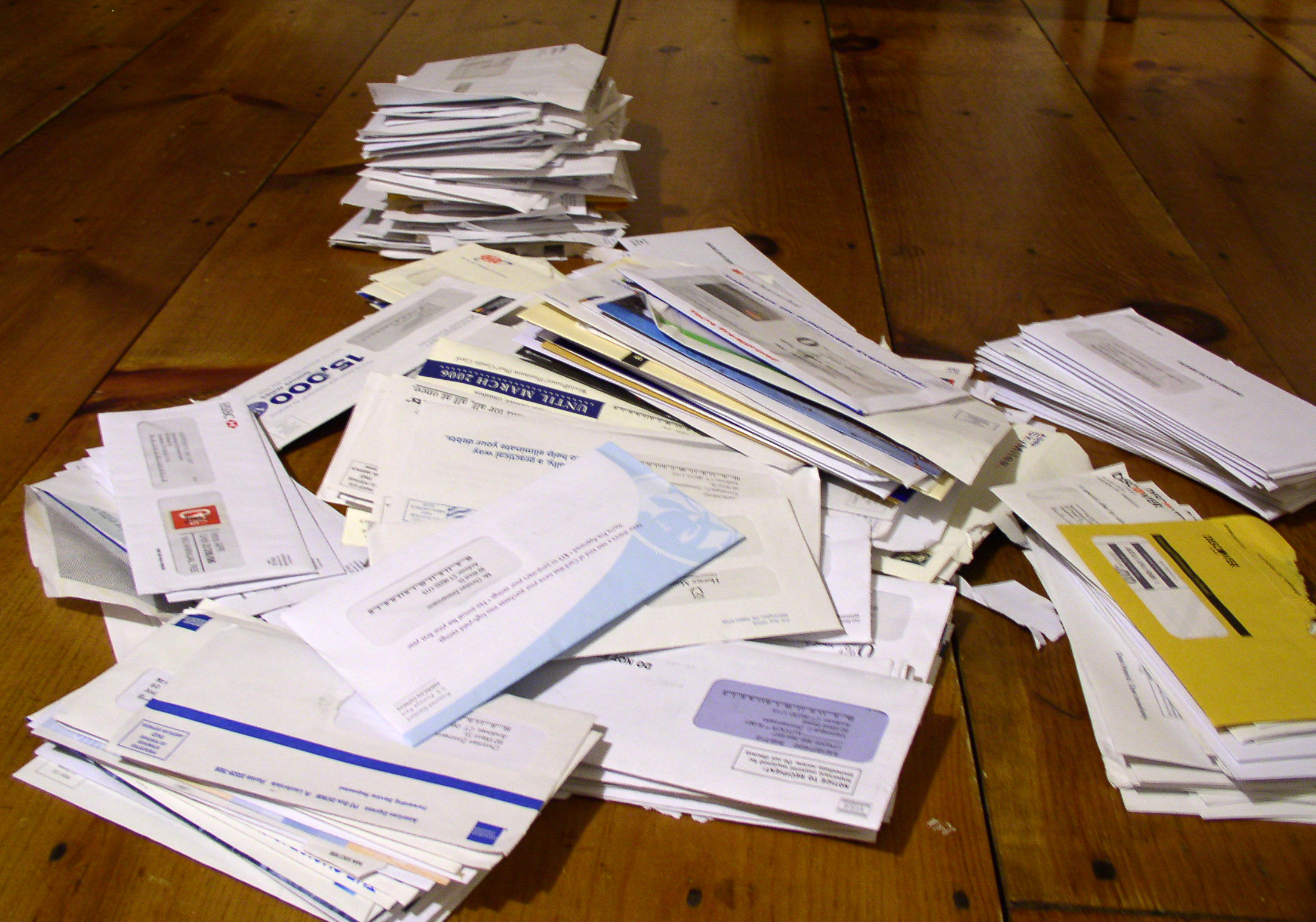
If you want to know what credit card companies think of you, look at your mail.

Are you “pre-screened” for lots of mileage-reward cards? Banks think you’re rich and educated.

Do you mostly see offers for low-APR teaser rates? Banks think you’re poor and uneducated — and, perhaps, vulnerable to financial traps.
I show my appreciation for the big data segregation and analysis that goes into junk mail by churning it all together in the shredder. It's a satisfying feeling.

Monday, September 21, 2015

Civilizational Breakdown

We stopped at Taco Bell to pick up dinner. Tonight's greeting was different:

Welcome to Taco Bell. Our computers aren't working. Can you pay cash?

There was some confusion in the drive-through, as some customers who intended to pay with credit or debit cards couldn't exit the line.

All orders were hand-written on scraps of paper, then added up manually with taxes applied at a partially working register. Young man, that's how we did it back in the day. Our order was ready in five minutes. The kitchen had minimal computerization, thank goodness.

On the way home I noticed that the city's electronic billboard (the Foster City Marquee) had been taken down. It will be replaced in 2016. City residents will have to post notices old school: putting up flyers in the supermarkets and running ads in the local newspapers.

It will be difficult to cope, but people are resilient.

Thursday, May 14, 2015

Trust, but Verify.....the Credit Card Statements

Not your granddad's gas pump.
I pulled up to the stall, swiped the Costco American Express card, and began filling the gas tank. The lady in the next car over said that she had left her Costco card in another purse. Could I swipe my card to activate her pump? She flashed the debit card that she would use to pay for her gas. No problem.

Back at my own car a few minutes later, I realized that, by pressing a button, the lady could charge her purchase to my AmEx account. But I was too chicken to go back and watch her and openly demonstrate a lack of trust.

So I surreptitiously photographed her license plate and typed in a reminder on the smartphone to check the April 21st gas purchases later. Today the AmEx statement arrived, and all was in order.

A rational person would have just ignored the whole thing---the maximum possible exposure from filling her sedan would have been about $40 and I wasn't going to chase her down for that amount---but curiosity kept the matter alive.

"Do not let your hearts be troubled. Trust in God; trust also in me." [John 14] Obviously, Jesus never had any credit cards.

Tuesday, April 07, 2015

A Small Price to Pay

Five years ago there was a data breach at the very large financial institution that managed my employer's retirement plans. I signed up for the three-year free credit monitoring service, and every monthly report was clean.

Since then there have been data breaches galore at credit-card, insurance, health, and retail companies, some of whom we regularly deal with. Offers of free credit-monitoring provide scant comfort, since it is very likely that our social security numbers, dates of birth, and other personal information are known to the bad guys.

This week we paid $10 each for a credit freeze at the three major credit-reporting companies:
Equifax
Experian
TransUnion
A credit freeze
lets you restrict access to your credit report, which in turn makes it more difficult for identity thieves to open new accounts in your name.
A credit freeze does not address the problem of stolen credit cards, but cc theft is less of a concern because losses are capped at $50 per card. A credit freeze may be a nuisance if one is in the market for new financing (home mortgage, credit cards, auto leases, etc.), since delays may occur in lifting the freeze, and each lift costs $10. However, we're not expecting to add credit in the next couple of years.

An identity thief could open new accounts and steal many thousands of dollars. It can take years to sort everything out and clear our names. Paranoid? Perhaps, but $30 is a small price to pay to sleep a little easier. © 2015 Stephen Yuen