Showing posts with label Violence. Show all posts

Saturday, July 13, 2024

America Dodged a Bullet

Bloodied but unbowed (AP photo)
Here's what we know at 10 PM Eastern Daylight Time, according to the WSJ:
A suspected shooter fired multiple times toward the stage in Butler, Pa., where former President Donald Trump was holding a campaign rally Saturday, according to the U.S. Secret Service. The shooting occurred at approximately 6:15 p.m. Here’s what we know so far:
  • Secret Service personnel “neutralized” the suspected shooter, who is now dead, according to Anthony Guglielmi, chief of communications for the bureau.
  • The shooter was firing from an elevated position outside the rally venue. Witnesses said he was on a roof.
  • One spectator was killed and two others were critically injured in the incident, which is under investigation as an attempted assassination.
  • Trump has said on social media that he was shot in the upper right ear.
  • He was rushed to a medical facility for evaluation; his campaign said he was fine.
  • An “AR-style rifle” was recovered at the scene, law enforcement officials said.
  • President Biden was briefed on the shooting and was “grateful to hear” that Trump is safe.
  • The shots rang out about 10 minutes into Trump’s speech at a fairground 35 miles north of Pittsburgh. Secret Service members jumped to the stage and surrounded Trump, leading him away. Photos and video showed blood on Trump’s ear and face.
  • Thousands of people attended the rally, which came just two days before the Republican National Convention begins in Milwaukee, where Trump will formally become the party’s nominee.
  • As a former president, Trump continues to receive Secret Service protection. As a result, his rallies involve intense security protocols, with attendees being restricted to carrying only small bags and having to pass through metal detectors when they arrive.
  • Tragic as the deaths and injuries are, the outcome could have been much worse. Had the gunman's aim not been off by an inch, or had former President Trump not turned his head at the last second, the assassination of Donald Trump might well have triggered a real civil war.

    Such a "war" would perhaps be not as violent as the 19th-century version but one that could have resulted in open defiance by individuals, even entire States, of a Federal Government against which grievances have been building for at least a decade.

    Do you think January 6 was an insurrection? Despite the rhetoric, that wasn't one, and if we're lucky we won't find out what a real one looks like.

    Thursday, June 02, 2022

    Relevant Article

    Deadlines are not friendly to headline writers. Current events can impart unintended meaning and emotions to an unlucky choice of words.

    The Yale Alumni Magazine (YAM) cover story is a cheery one.

    The women's ice hockey team made it to the NCAA Final Four ("Frozen Four"), where the Bulldogs lost to the eventual champion, Ohio State, 2-1.

    Speaking of current events, YAM also has a relevant article on research into the effect of trauma on children's brains.
    Children who have endured chronic stress, such as living in a violent neighborhood or within an unstable home life, tend to have thick branches near the brain’s alarm system (the amygdala) and weaker ones near its off switches (the hippocampus and prefrontal cortex). The alarm system blares and there’s nothing to stop it...

    (Wiley Online Library)
    For children who have endured severe trauma, one option is Trauma-Focused Cognitive Behavioral Therapy (TF-CBT). Dylan Gee is involved in a study designed to assess TF-CBT. Previous studies have shown that it works very well for about half to two-thirds of those who go through it, but less well for others. Her goal is to figure out which children are most likely to benefit from TF-CBT and what might improve the process for those who don’t.

    Gee is assessing volunteers, aged 10 to 17, before and after therapy. The theory is that the reason many children show fewer symptoms of trauma after TF-CBT is because the therapy strengthened their regulatory centers. In other words, the children have better control over their brain’s alarm center than they had before.
    Children exposed to traumatic events, especially those involving extreme violence, will, of course, need therapy ("TF-CBT").

    The Yale study indicates that physical intervention in the development of children's brains at the cellular level is also necessary to right the ship.

    Although we are years, if not decades, away from devising the methodology, at least we know the direction in which we're headed.

    Tuesday, June 29, 2021

    Lucky Come Hawaii

    It's a good time to be in Hawaii, which sounds inane because as my Mainland friends say, it's always a good time to be in Hawaii. But look what's happening back in Northern California.

    Lava Fire at Weed, CA, 10 mi. from Mr. Shasta (Chron)
    California's burning again. Lava Fire explodes to more than 13,000 acres
    The Lava Fire, ravaging through steep and rugged terrain near Mount Shasta and Lake Shastina in Siskiyou County, tripled in size over the last 12 hours and was burning across 13,300 acres as of Tuesday morning.

    Wind gusts as high as 50 mph contributed to the wildfire’s spread Monday to the east and southeast toward Mount Shasta, said Michelle Carbonaro, spokesperson for the inter-agency team managing the fire.
    Lake Shastina is 300 miles from the Peninsula, but the high winds will not only make the fire difficult to control but will degrade the air quality throughout the region. Those of us with respiratory problems will have to stay indoors and run the filters.

    Assault and robbery reached their lows in August
    and October, respectively, and are nearly back
    to their 2019 levels. (Chronicle graph)
    Violent crime is coming back: San Francisco crime is starting to look more like it did before the pandemic
    The violent crimes we analyzed, robbery and assault, declined for the first six months or so of the pandemic, until COVID-19 cases began surging nationwide in late October. Both robberies and assaults spiked through late February, though robberies remained below 2019 levels for every month except February 2021, when they reached 11% above where they were pre-pandemic.

    As of May 2021, both types of violent crime are hovering slightly below pre-pandemic levels, but above their pandemic-era lows.
    Going backwards (2019 Chronicle pic)
    Burglaries may be down overall, but not for tourists. Car break-ins are up as tourism returns to San Francisco [bold added]
    The reopening of San Francisco’s restaurants, hotels and entertainment venues and the gradual return of visitors to the city has swiftly collided with a sharp rise in smash-and-grab thefts from cars in tourist-heavy parts of the city, according to city data.
    It's only property, declare the people who run the City and State governments, as they divert funds from the police to social services. Florida smash-and-grab victim Kinga Sojka advises:
    "Just don’t take valuable stuff with you. Take as little as possible and nothing of big value — no laptops, no jewelry — don’t bring it at all and if you do bring it, even a passport or car keys, carry it with you. Don’t leave it in your car.”
    And don't forget about the Hayward and San Andreas faults. The good news: the quake was only 3.9 on the Richter scale. The bad news: the epicenter was 20 miles from Foster City. 3.9 quake felt in the Bay Area, epicenter near San Leandro

    Lucky I come Hawaii.

    Tuesday, May 25, 2021

    Mexico: Where Political Assassinations are Normal

    Politics is indeed a rough business, with opposition researchers delving into every aspect of a candidate's past. What was once personal and off-limits is now fair, or should we say foul, game.

    Once in a while Americans should be reminded how lucky they are to have political campaigns that destroy candidates, but only metaphorically.

    Popular mayoral candidate and former prosecutor Abel
    Murrieta was killed on May 13. (Mexico News Daily)
    Headline: Dozens of Mexican Candidates Have Been Killed in a Bloody Election Season [bold added]
    Even in a country with a history of electoral violence, this vote is shaping up as the most bloody in recent memory as more, smaller criminal gangs viciously compete to control local areas by intimidating or killing off politicians.

    From February to April, 46 elected officials, members of political parties and candidates for office were killed, a 44% jump compared with the 2018 elections, according to Integralia, a Mexican political consulting firm. Since September, when the electoral process began, 82 politicians have been killed, most of them gunned down.
    With politicians unable to protect themselves, many of them have withdrawn their candidacies. The gangs are the authority in various towns, and with little or no resistance to confront them, are expanding their operations:
    Aside from trafficking drugs to the U.S., these gangs smuggle migrants, sell black-market gasoline, and extort legal businesses which range from avocado farms to taco stands. Once in control of local governments, the gangs also take a cut of tax money meant for public works, according to organizations that track and analyze crime trends.

    As more of their income comes from activities such as extortion, these groups’ success depends on their ability to control territory. That means controlling, through threats and bribery, the local mayor, police chief, and other top officials. Those who don’t cooperate are often killed.
    The environment in Mexico is so horrifying that we can't imagine how it could be transplanted here.

    Meanwhile the progressive leadership in California is pushing for open borders, defunding the police, and more restrictions on private gun ownership. I really do need to learn Spanish...

    Monday, March 22, 2021

    Do Not Attribute the Sins of Individuals to the Group

    The 32 killed by Seung-Hui Cho in 2007; at least 27 (84%) were non-Asian. Was he racist?
    Seung-Hui Cho will never be forgotten by the families of his victims, yet few in the general public remember his name 14 years after he killed 32 people, then himself, on the Virginia Tech campus.

    Asian-Americans universally deplored the massacre, and some feared that they would suffer reprisals from other Americans. The story of Seung-Hui Cho was swept up in the anti-gun-violence crusade of the period, and no sweeping generalizations were made about Asian hatred and violence toward non-Asians.

    Asian activists, however, do not hesitate to call the white gunman who killed eight people, six of them Asian-American women, in Atlanta on March 16th an exemplar of white culture. [bold added]
    “This mass shooter was targeting Asian women and their businesses. This isn’t an isolated incident. There have been 500+ hate crimes targeted at Asian people this year alone,” social media specialist Mark Kim wrote on Twitter. “This Atlanta tragedy lies at an intersection of race, gender, class and the legacy of America’s history of colonization and violence in Asia,” journalist Elise Hu said on the site. “I don’t have the words. I’m just despondent. Protect Asian women, solidarity with sex workers, #StopAsianHate.”
    So far the killer has claimed that his motivations stemmed only from hatred of sex workers. It's still possible that race was a factor, though even if it were, to assume that millions of white Americans hold the same beliefs is a gross generalization not supported by concrete evidence. Besides, if the society were so biased, how could Asian-Americans have succeeded in great numbers in the culture that activists decry?

    America aspires to judge people by their individual words and deeds (obviously not always successfully), and not judge members of groups that wayward individuals share some characteristics with.

    Asian-Americans should be grateful that the sins of Seung-Hui Cho were not attributed to them, and they should grant the same consideration to others who have nothing in common with the Atlanta gunman but their race.

    Thursday, March 04, 2021

    Guns: Stuck in the Same Old Arguments

    SF Police Commissioner John Hamasaki (Chron)
    Speaking as one who has never owned a gun, I nevertheless comprehend the motivation of law-abiding citizens to own guns, especially if they believe the police cannot reliably protect them. Reducing gun violence must accommodate the on-the-ground reality of living or working in dangerous neighborhoods. That's why it was refreshing to see San Francisco Police Commissioner John Hamasaki call for understanding for the teen when the NY police seized a gun from the 17-year-old:
    “Uncomfortable truth,” Hamasaki wrote in the tweet. “Taking a gun from one kid may as likely stop violence as end up in that kid getting killed. It may feel good to post this photo, but I’ve known too many kids who were killed for being in the wrong neighborhood (often their own) & being unable to protect themselves.”
    San Francisco Supervisors Catherine Stefani, Myrna Melgar, and Ahsha Safai immediately called for Commissioner Hamasaki's resignation because he deviated from the absolutist no-gun position. IMHO, he responded reasonably:
    Hamasaki responded that he “actually work(s) and spend(s) time in the communities impacted by gun violence.”

    “I have had clients and their families killed by guns, and I have consoled the fathers, mothers, and children killed by guns,” he continued. “The world is bigger and more complicated than D2 and the Marina.”

    Hamasaki said he was not calling for teens to be armed, but for nuance in the debate.

    “I think the reading of (the tweet) that some people took was a little bit disingenuous,” Hamasaki said. “I don’t want, approve or encourage people to use guns to solve their problems.”

    Hamasaki said while it’s a great idea to take guns off the streets, the realities for some neighborhoods are more complex.

    “When you simplify it, it justifies the system of mass incarceration that we have,” he said. “I just have a real hard time passing the same level of judgment to a kid who’s living in a neighborhood infested by drugs and violence.”
    The politics of the main actors may be a little surprising:
    Stefani and Safai are known as the two moderate Democrats on the Board of Supervisors, while Hamasaki more closely aligns with the city’s more left-leaning contingency.
    It's not an election year, so now is the time to question and test assumptions about gun violence without worrying about what political opponents will say. Otherwise, we'll stay stuck in the same decades-old arguments.

    Saturday, January 05, 2019

    Often Wrong But Never in Doubt

    (Marijuana map from governing. com)
    In addition to taxes and regulations stunting sales, there may be another reason for business projections falling short where marijuana has been legalized: the public doesn't trust the enthusiasts who say it's no worse and may even be less harmful than alcohol.

    Headline: Marijuana Is More Dangerous Than You Think. Coincident with the rise of marijuana use has been an increase in the incidence of psychosis and paranoia, though we must be careful to state that marijuana has not been proven to be the reason because correlation is not necessarily causation. [bold added]
    And last September, a large survey found a rise in serious mental illness in the U.S. too. In 2017, 7.5% of young adults met the criteria for serious mental illness, double the rate in 2008.

    None of these studies prove that rising cannabis use has caused population-wide increases in psychosis or other mental illness, although they do offer suggestive evidence of a link. What is clear is that, in individual cases, marijuana can cause psychosis, and psychosis is a high risk factor for violence. What’s more, much of that violence occurs when psychotic people are using drugs. As long as people with schizophrenia are avoiding recreational drugs, they are only moderately more likely to become violent than healthy people. But when they use drugs, their risk of violence skyrockets. The drug they are most likely to use is cannabis.

    The most obvious way that cannabis fuels violence in psychotic people is through its tendency to cause paranoia. Even marijuana advocates acknowledge that the drug can cause paranoia; the risk is so obvious that users joke about it, and dispensaries advertise certain strains as less likely to do so. But for people with psychotic disorders, paranoia can fuel extreme violence. A 2007 paper in the Medical Journal of Australia looked at 88 defendants who had committed homicide during psychotic episodes. It found that most of the killers believed they were in danger from the victim, and almost two-thirds reported misusing cannabis—more than alcohol and amphetamines combined.
    What about predictions that legalization would reduce violent crime?
    The first four states to legalize marijuana for recreational use were Colorado and Washington in 2014 and Alaska and Oregon in 2015. Combined, those four states had about 450 murders and 30,300 aggravated assaults in 2013. In 2017, they had almost 620 murders and 38,000 aggravated assaults—an increase far greater than the national average.
    The broad effects of legalization---public health and mental illness, criminal justice, economic activity, taxation--will take years to make themselves known.

    But it's called a social experiment for a reason. We can guess at but don't know the results in advance. Possible harmful effects are already appearing. A little humility is called for, especially in the advocates, but I'm not expecting to see it.

    Sunday, March 04, 2018

    Diet, Exercise, and Pray

    (Graphic from Brainy Quote)
    After the Florida school shooting on Valentine's Day impassioned protestors marched on the State legislature in Tallahassee. Statements like these were typical. [bold added]
    “We’ve had enough of thoughts and prayers. If you supported us, you would have made a change long ago. So this is to every lawmaker out there: No longer can you take money from the NRA. We are coming after you. We are coming after every single one of you, demanding that you take action.”
    No, this is not a post about gun control or gun rights; it's about prayer.

    Denigrating prayer is, er, all the rage these days, especially by those who don't engage in it much. Your humble blogger prays at least once a week--in church on Sunday!--and has grown up with the tradition of saying grace before meals and to pray as soon as I can for those in extremis.

    Prayer is a worthless undertaking if there is no One listening at the other end. And even if there is a One, he/she/it may not answer, or answer in the way we want. So what good is it?

    Prayer seems to be good for one's health. [bold added]
    A number of studies have shown associations between attending religious services and living a long time. One of the most comprehensive, published in JAMA Internal Medicine in 2016, found that women who went to any kind of religious service more than once a week had a 33% lower chance than their secular peers of dying during the 16-year study-follow-up period. Another study, published last year in PLOS One, found that regular service attendance was linked to reductions in the body’s stress responses and even in mortality–so much so that worshippers were 55% less likely to die during the up to 18-year follow-up period than people who didn’t frequent the temple, church or mosque.

    ...prayer has been shown to be powerful, in at least one way. It triggers the relaxation response, a state of mind-body rest that has been shown to decrease stress, heart rate and blood pressure; alleviate chronic disease symptoms; and even change gene expression. This state is typically linked to activities like meditation and yoga, and research suggests it can also be found through praying.
    For the overwhelming majority of people who don't have the misfortune of being in an airplane crash or a school shooting or a raging firestorm, prayer seems to increase the odds of a longer life, specifically 33% to 55% higher. The science is settled.

    Afterword:
    Cynics may say that prayer was not helpful to the 17 people who died in the 2018 Valentine's Day massacre. Putting aside the question of how many of those murdered prayed during their last moments and whether their prayers were helpful in a spiritual reality that may exist, the rest of the 3,000 students at Marjorie Stoneman Douglas High School did live.

    How many of the 99.4% who survived prayed also? How many think that their prayers were answered? Have they come to some decisions about the rest of their lives? Are they enraged or grateful or both (though anger and gratitude don't often co-exist)?

    I'd like to hear more from the silent survivors, but I doubt that we will, because to reveal any thoughts or emotions that deviate at all from the current angry narrative opens oneself up to social opprobrium, and no high-school kid needs that.

    Sunday, June 18, 2017

    Glimmer of Hope

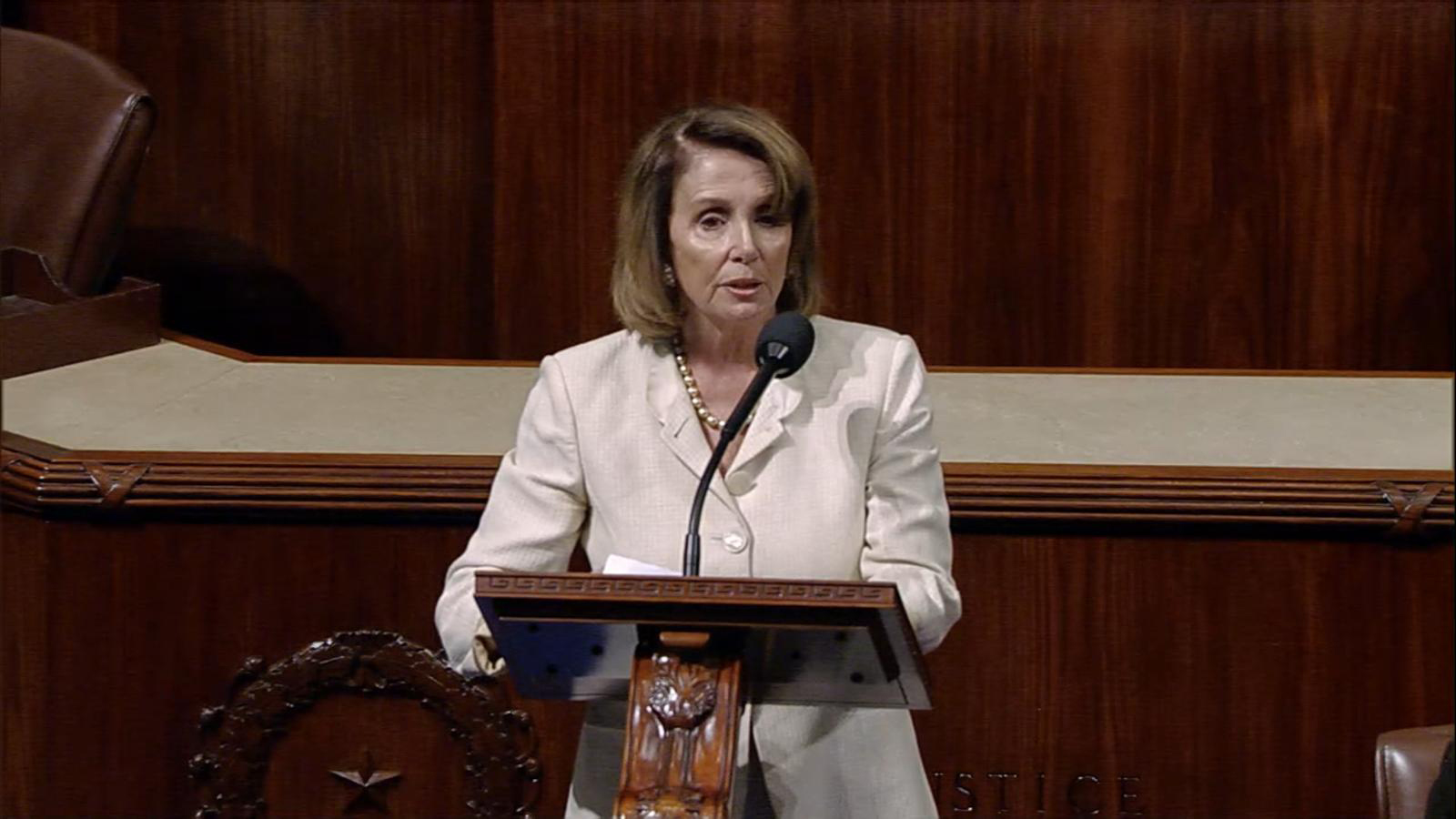
    Nancy Pelosi June 14th floor speech (abc news)
    To some Republicans the hatred and vindictiveness from Democrats, the press, and Executive Branch insiders are unremitting. That's why the remarks from former Speaker Nancy Pelosi following the shootings last Wednesday are a welcome relief. More importantly, they give everyone a glimmer of hope for our nation. [bold added]
    You may not know this, my colleagues, but every time I pray, which is very frequently, and certainly every Sunday, I pray for all of you. All of you, together.

    In the earlier years I used to pray for your happiness, for the fact that we would work together, heed the words of President Kennedy in the closing of his inaugural address, when he said, may God's work – ‘God's work must truly be our own.’ How do we view what god's will is for us? How do we come together to give confidence to the American people that, as our Founders intended, we would have our disagreements and we would debate them and we would have confidence in our beliefs and humility to listen to others?

    But in more recent years, I have been praying not only for that, but for our safety. As I above anyone in here, and I can say that quite clearly, have been probably the target of more – I’m a political target and therefore the target of more threats than anyone, other than the President of the United States, Barack Obama. And so I prayed for Barack Obama. Now I continue to pray for him. And pray for Donald Trump. That his presidency will be successful and that his family will be safe. Because it is about family.
    When conservatives think of San Francisco liberals, Nancy Pelosi, a Roman Catholic, is the first person who comes to mind. However, at heart she just may be a "Christian liberal," many of whom I encounter on a regular basis in the Episcopal Church.

    Christian liberals are just as outspoken about issues as their secular siblings, but they know when to set aside politics. As Louisiana Republican Steve Scalise lies in critical condition from gunshot wounds, Nancy Pelosi and other political leaders are praying for his recovery.
    While we look not at the things which are seen, but at the things which are not seen: for the things which are seen are temporal; but the things which are not seen are eternal. --2 Cor 4:18

    Wednesday, May 31, 2017

    Brawl by the Bay

    As of this writing (Wednesday, May 31st) the San Francisco Giants are 22-32, 10 games below .500 and 11½ behind the NL West-leading Dodgers. The Giants' best pitcher, Madison Bumgarner, is out for the first half of the season with a shoulder injury from a dirt-bike accident. It's only May, and the season may already be lost.

    The Giants are currently hosting the Washington Nationals, one of baseball's best teams, in a 3-game series. The contests normally wouldn't have gotten attention, but Monday's game captured sports headlines (while we're waiting for the NBA Finals to start Thursday) because of a beanball thrown by Hunter Strickland against Nationals superstar Bryce Harper, apparently because the latter had hit playoff home runs off the former three years ago.

    The batter took umbrage, fists landed, and the benches cleared. Several vignettes produced a multitude of memes.

    Sad, but true, it's the most interesting thing to happen to the Giants all year.

    Sunday, July 10, 2016

    Understanding or Anger?

    (YouTube image)
    The minister's grief was evident as he began his homily:
    This past week was a sad and terribly tragic week in which two black men, one in Baton Rouge, and another in St. Paul, Minnesota were shot and killed by police, only to be followed by the killing of five police officers and the wounding of another seven police officers and two civilians in Dallas....What do these events say about the United States of America as a nation? What are we to do?
    I know from past discussions that he, like many Episcopal clergy, subscribe to the social justice movement, which holds that most of our troubles are the result of "-isms", i.e., racism, sexism, capitalism, and the values traditionally associated with Middle America, such as the Protestant ethic and the right to bear arms.

    But today he took off his social-justice warrior hat and tried to bridge the gap in understanding [bold added]:
    The young people behind the Black Lives Matter movement intend to be provocative. But in being provocative and prophetic, they are not being correctly heard. The Black Lives Matter movement has been countered by an “All Lives Matter” movement, and a “Police Lives Matter” movement. Steve Hartman of CBS News said this weekend that a necessary word needed is the word “some.” Some police shoot and kill young black men, not all police. Some young black men are out of control and dangerous, not all. Some people are racist, not all. Imagine if the word “too” was added so it would say, “Black Lives Matter too.” Wouldn’t this get to the point that black lives, as any other life matters? Wouldn’t it still point to the ongoing national tragedy of the killing of young black men?
    "Black lives matter, too," has been suggested before. Whether one uses the phrase depends on whether one is trying to change the hearts of the indifferent and antagonistic or whether one is trying to silence them with one's righteous anger.

    Note: the minister's sermons may be downloaded here.

    Thursday, July 07, 2016

    Not 1968 Yet

    This week's fatal police shootings of Philando Castile in Minnesota and Alton Sterling in Louisiana brought the issue of "blue on black" violence to a boiling point, culminating in widespread demonstrations. Tonight's headline, Snipers open fire on officers during Dallas protest, killing 4, is shocking, but not surprising, given the inflamed emotions of the current day.

    [Update - 7/9: the final casualty count is 5 officers killed, 7 officers wounded, 2 civilians wounded, and 1 shooter killed.]

    The zeitgeist of the times has evoked memories of a Presidential election year a half-century ago, but we have a long way to go, thankfully, before 2016 will be as tumultuous as 1968, which had two assassinations and hundreds of American troops dying each month in a far-off war. True, there are protest movements that threaten to disrupt the major parties' conventions, there's a cloud of uncertainty over Europe as Russia and China are ascendant, and neither of the leading Presidential candidates excites the majority of the country, but 2016 is not 1968, and we'll pull through.

    In one respect the past was much better than today. Here are 1968's top 20 songs, many of which are still played. (50 years from now I doubt that we'll have more than a couple from 2016.)
    1. Hey Jude, The Beatles
    2. Love is Blue, Paul Mauriat
    3. Honey, Bobby Goldsboro
    4. (Sittin' On) The Dock of the Bay, Otis Redding
    5. People Got to Be Free, The Rascals
    6. Sunshine of Your Love, Cream
    7. This Guy's In Love With You, Herb Alpert & The Tijuana Brass
    8. The Good, The Bad and the Ugly, Hugo Montenegro
    9. Mrs. Robinson, Simon and Garfunkel
    10. Tighten Up, Pt. 1, Archie Bell and The Drells
    11. Harper Valley P.T.A., Jeannie C. Riley
    12. Little Green Apples, O.C. Smith
    13. Mony Mony, Tommy James and The Shondells
    14. Hello, I Love You, The Doors
    15. Young Girl, Gary Puckett and The Union Gap
    16. Cry Like a Baby, The Box Tops
    17. Stoned Soul Picnic, The Fifth Dimension
    18. Grazing In the Grass, Hugh Masekela
    19. Midnight Confessions, The Grass Roots
    20. Dance to the Music, Sly and The Family Stone

    Sunday, May 01, 2016

    Hawaii No Ka Oi

    (Honolulu Star Advertiser/AP photo)
    May Day on the Mainland:
    Seattle police used pepper spray this evening to disperse black-clad anti-capitalist protesters authorities say threw rocks, flares, bricks and Molotov cocktails at officers during a rowdy May Day gathering.


    (Honolulu Star Advertiser photo)
    May Day in Hawaii:
    Three-year-olds Keana Pegg, left, Elle Keifer, and Lily Kawashima dance hula at Holy Nativity School at the longest running May Day pageant in Hawaii. King Justin Hazel and Queen Taihere Thompson watch from behind.
    Frankly, if I may say so, I prefer Hawaii’s version of May Day to the other ones.

    Wednesday, December 02, 2015

    It's Not Hopeless

    Sadly, a relevant and informative article: What to Do in an Active Shooter Situation.

    The obvious strategies, in order of priority, are run, hide, and fight.

    To increase one's chances of surviving involves a little study, though. Stop invading my safe space while I'm checking my Twitter feed!

    Sunday, November 22, 2015

    The Best of Humanity

    The Rev. Daniel Simmons, Cynthia Graham Hurd, Ethel Lance, The Rev. Depayne Middleton-Doctor,
    Tywanza Sanders, Myra Thompson, The Rev. Sharonda Singleton, Susie Jackson
    and The Rev. Clementa Pinckney (Time photo)

    When I feel like patting myself on the back for some modest charitable endeavors, the world reminds me that there is a great distance between ordinary practitioners of faith and those who live and breathe the Word.

    On June 17th a declared white supremacist killed nine members of the Mother Emanuel African Methodist Episcopal Church at a Bible Study in Charleston, S.C. Nadine Collier, whose mother, Ethel Lance was one of the victims, said at the bond hearing:
    “I couldn’t remember his name,” she recalls of her one-way encounter with the alleged killer. But she remembers that she was “angry, mad” because her mother had “more living to do.” And the killer “took something away from me that was so precious.”

    At the same time, racing through her head were lessons she had learned long before: “You have to forgive people and move on,” she says. “When you keep that hatred, it hurts only you.”

    “I kept thinking he’s a young man, he’s never going to experience college, be a husband, be a daddy. You have ruined your life,” she recalls thinking.

    What she said at the podium, while choking back sobs, came out like this: “I forgive you. You took something very precious away from me. I will never get to talk to her ever again—but I forgive you, and have mercy on your soul … You hurt me. You hurt a lot of people. If God forgives you, I forgive you.”
    Forgiveness is more than just saying the words. True forgiveness can be a long and painful process.
    Anthony Thompson essentially agreed with Collier’s statement, as far as it went. It was important for him to forgive as quickly as possible so that he could continue to live as God intended. Forgiveness, as he later explains, is like a Band-Aid that holds the edges of an open wound together long enough for the wound to heal. Though he cannot heal what happened to his wife [Myra], nor whatever is wrong with the man who killed her, he must attend to the wound inside himself. “I don’t know what happened in his life, and frankly I don’t want to know,” he says.

    Thompson did not want to leave the impression that forgiveness is as simple as speaking three words. For Roof to be forgiven by God, the young man had an awful lot of work to do.

    Thompson put it this way, speaking quietly: “I would just like him to know that—to say the same thing that was just said—I forgive him, and my family forgives him. But we would like him to take this opportunity to repent. Repent,” he repeated. “Confess. Give your life to the one who matters most, Christ, so that he can change him. And change your ways, so no matter what happens to you, you’ll be O.K.”
    How easy it is for us to advise other people to forgive wrongs, yet how fiercely we hold on to our own memories--and anger--over slights that are but pinpricks in the great scheme.

    On this Thanksgiving week I am grateful to the members of the Mother Emanuel AME Church for showing us how to walk a very narrow and difficult path. In their response to the tragedy they have shown the best of humanity.

    Saturday, March 08, 2014

    A Nettlesome Problem

    For male prisoners with a history of violent behavior the catalyst frequently is perceived disrespect, which leads to shame, which in turn triggers violence. Writer Jonathan Asser "used to struggle with his extreme rage until he learned to master it – and discovered a skill for calming violent prisoners." [bold added]
    With the exception of psychotic prisoners being treated through the healthcare department, every violent incident I have ever come across in prison could be traced back to shame and the feeling of being disrespected. Conventional programmes working outside the heat of the moment studiously avoid the crucial shame trigger. I worked with it every day. I came up with the name Shame/Violence Intervention (SVI) to describe my approach.
    Many prisoners are able to give the "correct" answer when a staff psychologist poses a hypothetical question, such as "what if you see a man talking to your girlfriend?" In SVI therapy Jonathan Asser publicly embarrasses the prisoners and trains them how to recognize and control their responses.

    His approach is difficult, slow, expensive (in terms of trained therapists' time) and successful. Unfortunately, it's not easily scalable and demonstrates why breaking the cycle of violence is such a nettlesome problem.

    [Update - 3/9/14: Jonathan Asser's screenplay, Starred Up, was nominated for eight British Independent Film awards.]

    Saturday, January 08, 2011

    Tone It Down

    The shooting of Congresswoman Gabrielle Giffords (D-AZ) and 18 other people earlier today was an act of evil. As of this writing Congresswoman Giffords has survived, but six people, including Federal Judge John Roll and a nine-year-old girl, have died. The suspect, Jared Loughner, had shown signs of aberrant behavior:
    Lynda Sorenson said she took a math class with Loughner last summer at Pima Community College's Northwest campus and told the Arizona Daily Star he was "obviously very disturbed." "He disrupted class frequently with nonsensical outbursts," she said.
    Although little is known so far, commentators are already attempting to link Mr. Loughner with their political opponents. Here is liberal NYT columnist Paul Krugman attributing the incident to the GOP “climate of hate”:
    You know that Republicans will yell about the evils of partisanship whenever anyone tries to make a connection between the rhetoric of Beck, Limbaugh, etc. and the violence I fear we’re going to see in the months and years ahead. But violent acts are what happen when you create a climate of hate. And it’s long past time for the GOP’s leaders to take a stand against the hate-mongers.
    Conservative blogs like Gateway Pundit are also weighing in:
    [Loughner] was reportedly left-wing, quite liberal. His favorite books: Communist Manifesto, Mein Kampf.
    The evil act has rightly been condemned by everyone. But also deserving of condemnation is our rush to impugn entire groups of people because of the actions of a few. We don’t profile all Muslims at airports although some are terrorists, nor should we condemn the entire Tea Party if some of its supporters turn to violence (it’s far from clear whether Jared Loughner is a Tea-Party supporter).

    Let’s tone it down, people. When you say that this or that politician is ruining the world, our lives, and our future, it shouldn't be surprising how some disturbed people react. © 2011 Stephen Yuen