Monday, January 10, 2022

The Blue-Green Divide

I forwarded this WSJ article to
a thread with only iPhone users.
The political extremes live in red and blue echo-chambers, but to the under-30 crowd the more meaningful divide is blue vs green and has nothing to do with politics.
Apple got creative in its protection of iMessage’s exclusivity. It didn’t ban the exchange of traditional text messages with Android users but instead branded those messages with a different color; when an Android user is part of a group chat, the iPhone users see green bubbles rather than blue. It also withheld certain features.

There is no dot-dot-dot icon to demonstrate that a non-iPhone user is typing, for example, and an iMessage heart or thumbs-up annotation has long conveyed to Android users as text instead of images.

This pic of a Thanksgiving turkey went
to a mixed Android/iPhone group.
Apple later took other steps that enhanced the popularity of its messaging service with teens. It added popular features such as animated cartoon-like faces that create mirrors of a user’s face, to compete with messaging services from social media companies... customers were particularly fond of replacing words with emojis and screen effects such as animated balloons and confetti.

Avid teen users said in interviews with The Wall Street Journal that they also liked how they could create group chats with other Apple users that add and subtract participants without having to start a new chain.
Since your humble blogger very rarely uses emojis and never plays iMessage games, the blue-green divide seems like a contretemps in a teapot. The great MLK said something like you should never judge a man by the color of his bubble but by its content, and if not, he should have said it.

Sunday, January 09, 2022

Everything is Easier Today....Unless You Want to be a Saint

Baltimore Archbishop Lewandowski with pictures
of Black candidates for sainthood. (WSJ photo)
There has never been a Black Catholic saint from the United States: [bold added]
[In November] at a church in Baltimore, a group of Catholics launched a campaign calling on Pope Francis to name six men and women the first Black Catholic saints from the U.S...The Vatican spokesman, Matteo Bruni, responded that investigations are under way of all six proposed saints and in some cases their “heroic virtues” have been officially acknowledged. But the Vatican’s rules for canonization—the formal declaration by the pope that someone is a saint—ordinarily require at least one verified miracle attributed to the proposed saint’s intercession, something that has not yet occurred for any of the six Black Americans.
The intercession occurs after the candidate's death, i.e., supplicants pray to the proposed candidate for a miraculous healing:
theologians must decide whether the healing was due to the intercession of the candidate for canonization, which means that those who prayed for his or her help did so at the time of the healing and that they prayed only to the proposed saint and no one else. Additional prayers to the Virgin Mary, whom Catholics consider the pre-eminent intercessor, or Jesus himself aren’t considered disqualifying.
Comments:
1) Racism is not the reason that there are no Black Catholic American saints:
There are a number of canonized Black saints, most of them from Africa, but including the Peruvian St. Martin de Porres (1579-1639), who cared for orphans, the poor and the sick.
2) It will become tougher to qualify for sainthood as advancing technology will be identified as the cause of what used to be called medical miracles.

3) Technology will also produce much more documentation--text, video, audio, data from instruments--that will scrutinize "miracles" more closely and likely raise the bar higher.

4) Worshippers have to pray to the candidate after he or she dies, whereupon a subsequent miracle occurs that proves that the candidate, now in heaven, interceded with God. That's a tall order--it took Mother Teresa 19 years after death to be canonised in 2016.

5) This non-Catholic hopes that at least one American Black Catholic saint will be canonized. What counts for this humble blogger is not that miracles be documented but that he, she, or they help to model selflessness, faith, and service for Black Catholics--or all Christians for that matter.

Saturday, January 08, 2022

Education is Everywhere, If You Just Look For It

Many of the conveniences of middle-class life are taken for granted, like in-house washers and dryers.

After the old Kenmore dryer failed 10 days ago, I expected to pay $500 for a basic model at Home Depot, Costco, or Best Buy; $700+ would be the all-in replacement cost after delivery, installation, sales tax, and removal of the old dryer.

YouTube showed that repairs were easy--even allowing that it would take me ten times as long as the professionals in the videos--so it couldn't hurt to try to diagnose the problem and attempt a fix (the parts would probably cost less than $50).

I had to promise the household CEO that I wouldn't dither; going to the laundromat was not only inconvenient but in the coronavirus era could be hazardous to one's health because of proximity to others in a warm, humid environment. If the task could not be done in a week, we would buy a new dryer.

Lint obstructed air flow from the clothes drum
After opening the bottom panel and unscrewing the lint cover for the first and only time in 13 years, the likely source of the problem became apparent: lint was jamming the air flow throughout.

Wearing a dustmask, I scooped out handfuls of lint, then used a brush and vacuum cleaner. The dryer had been working harder for at least a year, and the longer drying time finally burnt out one of the circuits.

Pulling out the metal housing for the heating element, I checked for a break on the three devices ("test for continuity" is the technical term) that were most likely to fail: the fuse, thermostat, and heating element.
Testing for continuity


It was the heating element. Ordering a kit for all three parts for $34 from Amazon, I replaced the heating element and kept the thermostat and fuse if either of them blows.

I'll spare you the details of putting everything back together and cleaning out more lint, dear reader. Suffice it to say that the dryer is working again, more efficiently than it has in a long time, and should be good for 2-3 years.

Comments: I did derive satisfaction from:
1) not having to spend $500-$700 on a new dryer;
2) not having to send the old one to the landfill or recycling plant;
3) being able to fix it myself.
But the most satisfaction arose from learning how the dryer worked. It's both simple and ingenious. Discreet writers call it a negative pressure system, but your humble blogger prefers simpler language.

Heating element + small parts
The motor both tumbles the drum and sucks the hot moist air out of the drum and expels it through the exhaust. The drum in turn sucks in outside air that has passed over the heating element. The features (tumbling, drum, timer, moisture sensing, varying the heat, etc.) that we see in current dryers were all invented before 1960.

Frankly, I am in awe of the engineers and inventors that created wonders, both big and small, in 20th century America.

Friday, January 07, 2022

Around the Neighborhood

Walking around the neighborhood is not only good for my health, it also serves as a source of inspiration for landscaping, color schemes, and home improvements.

As we do with people we admire, we look for characteristics that we can adopt to improve ourselves and perhaps our social standing.

Sometimes we come across sights that make us grateful for what we have already...

Thursday, January 06, 2022

The Other Dismal Science

(Image from the balance)
I never gave a thought to actuarial science until I went to business school. One of the smartest guys in the class had been an actuary, which I came to understand was too tough a career choice if I had to be as smart as he was and pass difficult, technical exams. (BTW, he's now CFO of a well-known company.)

Digression: so I became a CPA, which meant sitting for two days of exams and working for two years in the audit department of a CPA firm. The latter path was easier, and besides, I've never had to pay anybody to do my taxes.

Apparently, becoming an actuary is even tougher these days: [bold added]
Among people taking at least one exam from the Society of Actuaries—the field’s biggest U.S. credentialing body—15% eventually pass the multiple tests required to become an Associate, one of two designations allowing them to practice. Just 10% pass those and additional tests to become a Fellow, the group’s higher designation, which affords bigger responsibilities and salaries.

It’s such an arduous process that the number of test-takers has been declining in recent years, and the society is making changes to keep candidates from dropping out of the gantlet. It is also adding new “predictive analytics” tests to adjust to the massive amounts of data insurers now have...

There is no limit to how many times a candidate can take the tests. It took one man 50 years to become a Fellow, says Stuart Klugman, an official at the society. The society says a candidate typically takes seven to 10 years to become a Fellow. They must pass 10 exams plus other coursework and requirements.
Every profession is being inundated with oceans of data, and being familiar with data science has become essential to being an actuary. Knowing how to filter, analyze, and model the data is crucial to success. (We noted the importance of predictive analytics three years ago.)

If one is not thorough, knowledgeable about statistics, and honest, one can easily promulgate misinformation by biasing the data sets, selecting or not selecting variables to be analyzed, finding causation in correlation, and not "showing the work" so that results can be replicated.

Why must an actuary be honest? Because as the analyses become more complex, and as the demand for risk assessment (not only for insurance purposes) explodes, there are fewer people who are available to check the work; actuaries must be trusted not to force through results that please the powers that be.

I was glad that I didn't try to become an actuary.

Just for fun: the article presents a sample question involving rudimentary statistics and algebra. Without using a calculator, I could still solve it. (My high school self could have figured it out much more speedily but would also have snickered throughout at the phrase "blue balls.")
“An urn contains 10 balls: 4 red and 6 blue. A second urn contains 16 red balls and an unknown number of blue balls. A single ball is drawn from each urn. The probability that both balls are the same color is 0.44. Calculate the number of blue balls in the second urn.”


Wednesday, January 05, 2022

Just Because You Can Do It Doesn't Mean You Have To

The WSJ takes a look at future tech on display at the Consumer Electronics Show.

Some I could see myself using, others appear derivative, and a few are cringe-inducing, a subjective feeling to be sure.

Case in point: the Amagami Ham Ham Finger-Nibbling Robot Toy:
“Most people like the nibbling sensation but know they need to teach their children or pets to stop it,” reads the press release. This robot “frees humankind from the conundrum of whether ‘to pursue or not to pursue’ the forbidden pleasure.” The robot uses an algorithm—a “HAMgorithm”—to cycle through two dozen “nibbling patterns” so you won’t get bored using it.
As a toddler I learned not to stick my finger in strange places, and I'm not about to start now.

Tuesday, January 04, 2022

Don't Ignore That Sinking Feeling

Ishmael had misgivings about Ahab before they met.
One reason it's difficult to "see something, say something."
when a man suspects any wrong, it sometimes happens that if he be already involved in the matter, he insensibly strives to cover up his suspicions even from himself. And much this way it was with me. I said nothing, and tried to think nothing.
             -------Moby Dick, Ch 20

The modern world distracts us from thinking about or doing what is right, which is usually quite difficult or it would have been done long ago.

Monday, January 03, 2022

Breaking the Law of Large Numbers

Six months after Steve Jobs' death in 2011 Apple stock had risen by 50%. The company was valued at $535 billion.

It was around that time that the law of large numbers became a popular term in the financial news. The "law" makes intuitive sense:
any company growing at 20% per year, or 4x-5x the overall U.S. economy, will someday see its growth slow—otherwise it would grow larger than world GDP...

This real world limit on the economy and revenue potential is called in mathematics the “law of large numbers”, and is best applied when projections of future compounding cannot be sustained because they are too high, too far out in the future, or some combination of both.
In 2012 Apple had reached a hard-to-justify valuation of $535 billion, and it was likely that slower future growth in earnings would result in slow appreciation of the stock price. Besides, look what happened to Microsoft. At the peak of the dot-com bubble ten years earlier it too reached $500 billion only to see its valuation cut in half shortly thereafter.

Today's WSJ headline: Apple Becomes First U.S. Company to Reach $3 Trillion Market Value
Apple shares crossed the milestone when they topped $182.856 Monday. The share price has more than tripled since the pandemic lows of March 2020, adding around $2 trillion in market capitalization.
The analysts can cite the reasons for Apple's growth since 2012: the iPhone remains popular; the growth in services is strong; there's the promise of augmented reality and an Apple car. Exactly how it all works out to a $3 trillion market capitalization is $2.999999 trillion above my paygrade.

The law of large numbers will eventually apply to AAPL, but it doesn't say when.

Sunday, January 02, 2022

Desmond Tutu (1931-2021)

Desmond Tutu and Nelson Mandela (Forbes)
Whether or not "systemic racism" exists in America today, it unquestionably existed in the deep South for the majority of the 20th century. But the racism in America paled before South Africa's apartheid, a society built entirely around racial distinctions:
The implementation of apartheid, often called “separate development” since the 1960s, was made possible through the Population Registration Act of 1950, which classified all South Africans as either Bantu (all Black Africans), Coloured (those of mixed race), or white. A fourth category—Asian (Indian and Pakistani)—was later added....In practice, this act and two others in 1954 and 1955, which became known collectively as the Land Acts, completed a process that had begun with similar Land Acts adopted in 1913 and 1936: the end result was to set aside more than 80 percent of South Africa’s land for the white minority. To help enforce the segregation of the races and prevent Blacks from encroaching on white areas, the government strengthened the existing “pass” laws, which required nonwhites to carry documents authorizing their presence in restricted areas.
The South African government ruthlessly suppressed any challenge to its authority by the blacks who comprised two-thirds of the population. Into this parlous atmosphere stepped Anglican Archbishop Desmond Tutu, who died on December 26th at the age of 90:
With his friend and fellow Nobel Peace Prize winner, Nelson Mandela, he is credited with leading the charge against a white-minority government that was guided by a policy of racial segregation, known as apartheid. Still, after the African National Congress came to power in the 1994 democratic elections, he criticized the party for graft and greed...

As a bishop in the apartheid era, with police brutality roiling the country, Mr. Tutu went from township funeral to township funeral preaching for peace. He served as general secretary of the South African Council of Churches from 1978 to 1985, and his status in the religious community offered him protection from the apartheid government.

Sometimes Mr. Tutu’s sermons left people laughing; other times in silence. Once, he dove into a frenzied mob to save a suspected police informer from being burned to death. The crowd had thrown a gasoline-soaked tire around the man’s neck and was about to throw him into a burning car before Mr. Tutu pushed through to stop the killing.
Preaching at Grace Cathedral in 2011 (SFGate)
Latter-day critics of Archbishop Tutu fault him for the corruption and disastrously managed economy that arose in South Africa after the black population took control in the 1990's. IMHO, he was too astute a student of history not to have recognized the danger of overthrowing an evil government (cf Saddam's Iraq), but the potential benefits outweighed the risk.

He did speak out against abuses by the African government post-apartheid, and did not seek money or power for himself once the revolutionaries won. He was a man who put his life on the line for his principles and never stopped doing so. R.I.P.

Saturday, January 01, 2022

Happy New Year of Self-Discovery and Self-Help

Well, we made it.

For the past two years we were on our own--no, not in the pure survivalist sense because we did need doctors, supermarkets, online retailers, vaccine makers, technology, and so on--because we were forced to make our own decisions to save our lives and livelihoods.

The experts and government leaders changed their mind every month or so. The catch-phrase "often wrong but never in doubt" had never been more true.

We found that we didn't need to work in offices, go out to eat, attend classes, travel, work out in gyms, or use mass transit as much as we thought we did, if at all. We didn't need to live in cities and left crowded conditions for the sake of the health of our families.

More of us discovered that we could live without the approval or disapproval of social media. We found that the only thing holding us back from making right-for-us but unpopular decisions was the fear of what other people might say.

Our physical selves are constrained, but our minds are freer than they were two years ago.

Happy New Year!

Friday, December 31, 2021

The Big Got Bigger

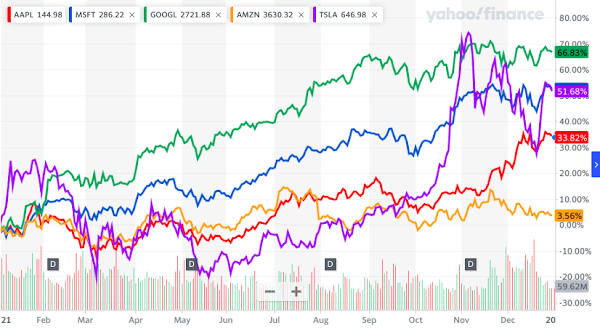
Except for Amazon, the "tera" cap stocks beat the indices
It was a very good year for stock market investors: [bold added]
the rollout of Covid-19 vaccines and low interest rates...helped the S&P 500 to close at a record 70 times this year, more than one-quarter of all trading days, according to Dow Jones Market Data, and pushed the index up 27% in 2021. The Dow and Nasdaq did well over the past 12 months too, rising 19% and 21%, respectively, handing all three benchmarks their best three-year performance since 1999.

Much of the broader market rally was also driven by a small group of massive stocks, such as Apple, Tesla and Microsoft. Microsoft and Tesla shares have each risen around 50% this year, while Apple has gained more than 30%.
Our stock holdings are weighted toward the so-called "megacap" tech stocks, so the portfolio has done well for the past decade. The 2021 performance of about 30% was way above expectations, since we did not expect the biggest of the big to go up that much. If we're up 10% in 2022, we'll be happy.

If you keep your expectations low, you aren't likely to be disappointed.

Thursday, December 30, 2021

A Lot of Trouble to Replace

Bent out of shape: I did that without help.
The best $150 I ever spent was in 2008.

Our 20-year-old dryer was irredeemably broken, and the new dryers at the time were too wide and cost at least $500, not including tax, installation, and hauling the old one out. On Craigslist the ideal replacement miraculously appeared. It was narrow enough, and the door hinge was at the bottom which was a "try-for" specification from the household CEO.

The seller, a lady in Palo Alto, had bought a new laundry pair and thought she could find a use for her old dryer but had given up trying. Her Kenmore had been sitting on the back patio for a year, covered with a tarpaulin. Before taking it, I asked her to plug it in to prove that it worked. It did.

The dryer easily fit in the 11-year-old Dodge Grand Caravan. (I always use an old car--for different reasons, of course--when I have to negotiate a purchase, do charity work, or go to crime-ridden areas like San Francisco.) The used dryer worked like a champ, and the garbage haulers took the old dryer on one of the two annual bulk-disposal days.

[Note: I forgot that I had blogged about the purchase in 2009. Most of the details are still clear in my memory. I'm not that far gone....yet.]

This week the dryer that had served us for 13 years finally failed. The drum turns but doesn't heat; the problem was likely due to one of three parts, said the Internet, each of which costs less than $50. But first the bottom cover plate has to be opened. It had never been removed by myself, nor likely the original owner, too, so I'm using brute strength and WD-40 against the rusty metal. So I can't even get to step 2: testing the continuity on the three parts to see which of them is busted. So I'll be spending a bit more time, probably through New Year's weekend, working the problem before giving up.

Fortunately for me the household CEO did not act disappointed though I bent the bottom plate out of shape. She knows that the hired help doesn't respond well to criticism and will be a lot of trouble to replace.

Wednesday, December 29, 2021

John Madden (1936-2021)

The 1970's was a miserable decade--runaway inflation, gas lines, Watergate, the fall of Saigon--but at least Bay Area sports fans could find solace in their Oakland teams.

Charles Finley moved the Athletics from Kansas City and won three straight World Series from 1972 to 1974. Both owner and players broke the mold with "Charley O the mule, orange baseballs, mustachioed players, the designated hitter and designated runners."

The Golden State Warriors, led by Hall of Famer Rick Barry, were the surprise winner of the 1975 NBA championship. They dominated the 1975-1976 season, only to fall in the Western Conference finals to the Phoenix Suns.

Both the A's and Warriors were fan favorites--let's not talk about the mediocre 49ers and Giants, who rarely made the playoffs--but by the beginning of the 1970's football was already the most popular sport in America, and the top echelon of the National Football League included the Oakland Raiders.

Celebrating the 1977 Super Bowl Win
Led by its brilliant owner Al Davis, the Raiders were a team of castoffs, misfits, and rejects. John Madden, who died yesterday, molded this unconventional roster into a championship contender and became the most successful coach in Raiders history.
Just 32 when he became the Raiders’ head coach, Madden, who quickly became known for his sideline outbursts and unruly hair, led his team to the playoffs eight times in 10 seasons and compiled a .759 winning percentage (103-32-7) that still ranks as the highest of any coach with at least 100 victories.
Every January, while it was cold and raining outside, we could count on Raider football to entertain us on weekends.

During the '70's the Raiders had to go up against a historically great dynasty, the 4-time-champion Pittsburgh Steelers, as well as the Miami Dolphins, who in 1972 became and still are the only undefeated team in NFL history. Given the competition, John Madden's record was remarkable.

Tom Landry
Prowling the sidelines with his portly frame and expansive gestures, John Madden was the opposite of Tom Landry, the buttoned-down coach of the "America's team" Cowboys.

Madden's game-planning and Hall-of-Fame players made Raiders-Steelers must-see TV. The playoff game between the teams in December, 1972, was decided by the Immaculate Reception, perhaps the most famous play in NFL history. I remember watching that game on a tiny low-res TV screen in Hawaii and thought that Terry Bradshaw's 4th-quarter 4th-down pass was knocked down and the Raiders had won. Then the fuzzy TV showed a Steeler (Franco Harris) racing toward the end zone for a Steeler touchdown and victory.

Huh? What just happened? Similar to the 1969 moon landing, you could hardly see it and you couldn't replay it.

We were sad to see John Madden retire from coaching in 1978, but even in those days it was understood that he was headed for a stress-induced heart attack if he continued.

Again, much to everyone's surprise, he became the most popular TV football analyst of all time and put his name on one of the most popular sports videogames of all time.

I don't know when it was that politicians sought to become a person "you would like to have a beer with," but they should just say "I want to be like John Madden." R.I.P., coach.

Tuesday, December 28, 2021

Promising Start

I-80 near Truckee is currently closed (Chron photo)
Snowfall over Christmas weekend broke a 51-year-old December record:
On Monday, the UC Berkeley Central Sierra Snow Lab, located northwest of Lake Tahoe at Donner Pass, recorded 38.9 inches of snowfall over the previous 24 hours — bringing the monthly total to 193.7 inches so far for December. The previous December record was in 1970, with 179 inches of snow.
All that snow isn't water until spring, so reservoirs haven't yet reached average levels:
As a rainy December comes to close, nearly all Northern California reservoirs were still drier than historic averages for this time of year, according to data from the California Department of Water Resources.

But the precipitation still gave several reservoirs a boost from the beginning of the month.

Of seven major reservoirs in Northern California, three currently have more water than they did a year ago: Lake Mendocino, up 7%; Lake Oroville, up 2%; and Hetch Hetchy, up 15%.
If we have just normal precipitation from January to March, there won't be a drought emergency next summer. It's a promising start to 2022.

Monday, December 27, 2021

Sugar Rush

At $38/dozen I was compelled to try Sibby's cupcakes.
The forecast from 2½ weeks ago has been fulfilled. Our house has been inundated with sweetmeats.

We've received over two dozen boxes of candy, cakes, and cookies. The fruitcake will go into the disaster-preparedness inventory, but the rest will have to be consumed in the next month or two. Some sharing outside the house is unavoidable.

Getting serious about a recent diabetes diagnosis, I bought a continuous glucose monitor. Let's not rush it: I will wait until after New Year's Day to put it on.