Monday, June 14, 2021

Flag Day, 2021

Happy Flag Day!

Old Glory has been revered through most of the nation's history, to such an extent that men have given their lives to see it raised on the battlefield. It's a symbol of America, tattered, resilient, and unique among nations. Everyone who is not descended from Native Americans or African slaves can trace their ancestry to someone who chose to be here.

On this day we celebrate choice, the freedom to choose what to do with our lives regardless of the circumstances of our birth, and to succeed or fail on our own merits. Of course, these are aspirations and frequently do not depict "reality." As the saying goes, unless we know where we are going, we will never get there.

Sunday, June 13, 2021

Life is But a Stream

The youth minister's office is also the streaming hub.
After "attending" church for over a year via YouTube, I must confess that I like watching services from home:
  • I don't have to get dressed up.
  • I can eat and drink. Sipping a cuppa joe while listening to the sermon is both stimulating and relaxing, if that makes any sense.
  • I don't have to worry about decorum and can go to the bathroom without "holding it", if you know what I mean.
  • I can stand, wave my arms, and do stretching and breathing exercises. You can't do that in an Episcopal church; we're not Pentecostals!
  • All that said, I've been going to in-person services since they resumed three weeks ago. It seems almost a novelty to be with people and take Communion, but the largest benefit to me has been the re-imposition of mindfulness. The cellphone is off, and I must focus on what is going on in the moment.

    Park Avenue Synagogue member Allan Ripp agrees:
    During remote services the distractions are constant, like working from home. Only instead of zoning out on a client while putting on my socks, I miss the benediction for the state of Israel. There’s also the temptation to multitask—is it a sin to empty the dishwasher while singing the Aleinu? Or to google the parents of the bat mitzvah girl? Most diverting are on-screen glimpses into congregants’ homes. I’m joining the nice couple chanting Bar’chu, while squinting at the furnishings in their elegant living room. Is that the Hamptons?
    Modern distractions are new, but the state of being distracted has been observed for centuries:
    The idea of lapsed or divided attention at prayer has long occupied Jewish scholars. Rabbi Ethan Witkovsky of Park Avenue Synagogue explains—over Zoom, of course—machshavot zarot, which a 13th-century sage described as “spurious thoughts” that creep into worshipers’ heads. “Back then, it might have been the health of your ox that intruded, whereas today it could be your bank balance or an episode of ‘Game of Thrones,’ ” he says.
    (I've never had to worry about the health of an ox, but the health of my car, that's another matter.)

    The coronavirus has irrevocably changed the world of work, and, likewise the world of worship. Having another option on Sunday morning is much better than having no option at all. As the Gershwins might have said, live-streaming is here to stay.

    Saturday, June 12, 2021

    Inflation: I Hope They Know What They're Doing

    March, 2021: Brisket $3.69/lb
    The headline story in Friday's WSJ comes as no surprise. On our weekly shopping trips we've been noticing substantial increases in the price of food, and it's a good thing that we don't drive much any more because Bay Area gas is almost $4 per gallon. As noted in an earlier post, we've been having flashbacks to the 1970's. [bold added]
    The Labor Department said last month’s increase in the consumer-price index was the largest since August 2008, when the reading rose 5.4%. The core-price index, which excludes the often-volatile categories of food and energy, jumped 3.8% in May from the year before—the largest increase for that reading since June 1992.
    May, 2021: Brisket $4.49/lb


    Consumers are seeing higher prices for many of their purchases, particularly big-ticket items such as vehicles. Prices for used cars and trucks leapt 7.3% from the previous month, driving one-third of the rise in the overall index. The indexes for furniture, airline fares and apparel also rose sharply in May.
    To be sure, a portion of these price hikes represents a springing back of demand from the lockdown economy of one year ago. A comparison with pre-COVID 2019 is less alarming:
    June, 2021: Brisket $5.49/lb
    The annual inflation measurements are being boosted by comparisons with figures from last year during pandemic-related lockdowns, when prices plummeted because of collapsing demand for many goods and services. This so-called base effect is expected to push up inflation readings significantly in May and June, dwindling into the fall.

    Compared with two years ago, overall prices rose a more muted 2.5% in May.
    Policy-makers are currently behaving as if the inflation spike is temporary.

    Despite his fears, your humble blogger hasn't seen convincing evidence that they're mistaken. Like last year, when our worries were about a different subject, we're forced to trust that the experts know what they're doing. And it worked so well the last time....

    Friday, June 11, 2021

    Episcopal Leadership: Political Partisans to the Core

    Bishop Budde: just another
    partisan political hack?
    (Note: although I did like some of his policies, I have never cast a vote for former President Trump in any election.)

    One year ago, I expressed my disappointment at another Episcopal church official using a sad incident to take a partisan shot at President Trump.

    Bishop Marianne Budde accused him of ordering "his officials" to use tear gas against protestors in Lafayette Park. Her outrage, even when transcribed on paper, is unmistakable: [bold added]
    "Consider the context," Budde said. "After making a highly charged, emotional speech to the nation where he threatened military force, his officials cleared peaceful protests with tear gas and horses and walked on to the courtyard of St. John's Church and held up a Bible as if it were a prop or an extension of his military and authoritarian position, and stood in front of our building as if it were a backdrop for his agenda. That was the offense that I was speaking to."
    It turns out that President Trump had nothing to do with clearing the park of protestors. Yes, he did use St. John's as a backdrop for a photo-op, but that was just a picture. He didn't set the Parish Hall on fire.

    Mark Lee Greenblatt
    Glenn Greenwald reports on the findings of Inspector General Mark Lee Greenblatt:
    “the evidence we reviewed showed that the USPP cleared the park to allow a contractor to safely install anti-scale fencing in response to destruction of Federal property and injury to officers that occurred on May 30 and May 31.” Crucially, “the evidence established that relevant USPP officials had made those decisions and had begun implementing the operational plan several hours before they knew of a potential Presidential visit to the park, which occurred later that day."
    Bishop Budde readily believed the false CNN, Washington Post, and NY Times reports that President Trump was responsible for tear-gassing (there was no tear gas, btw, but less harmful pepper spray) and made a partisan political speech.

    Even if the false reports were true, the Bishop could have reflected upon the evil that men do to each other, the sin that is ingrained in the rioters as well as President Trump, and prayed for healing and reconciliation. She could have called for the better angels of our nature.

    Instead she chose to cast all the blame upon the President, and she and St. John's rector dismissed the physical damage to the church in light of "the bigger concerns" of "systemic racism and police brutality."

    We have seen this gullibility in Episcopal leadership before:
    Episcopal leaders appear to be uncritical consumers of left-wing narratives. They are quick to issue proclamations without considering that there may be more to the story or even that the story is wrong. (Yes, your humble blogger is susceptible to confirmation bias, too, and makes a sincere effort to avoid snap judgments on fast-moving stories. I will wait to see if someone presents evidence to counter the Federalist counter-narrative.)

    I witnessed the enthusiastic reception accorded to the widespread Ferguson narrative at the 2014 Diocesan Convention in San Francisco. Priest after priest rose to speak about racism and police brutality visited upon black Americans; some had gone to Ferguson to stand with groups outraged by the shooting of the allegedly innocent Michael Brown in 2014. Mainstream media publications, long after the fact but to their credit, debunked the entire "hands-up-don't-shoot" story. Too late for the priests to take it back, however, whose righteousness had been on proud display.
    So quick to judge, so quick to agree with those who bear false witness.

    To my priests to whom I look for moral authority, how about being very slow to condemn, and, if you must, only after much prayerful consideration and after you are sure of the facts?

    Then, perhaps, when people see that you are able to place the eternal principles that you espouse above the evanescent issues of today, you will be trusted as a person of integrity, and your congregations may begin growing again.

    Thursday, June 10, 2021

    Tempest in a Chamber Pot

    The portable toilets have hand-washing stations (Chron)
    The cost of solving the homeless problem ($75,000? $336,000?) seems astronomical when it's analyzed on a per-person basis, especially compared to the living expenses of the average person.

    But it's not surprising when one considers the slow-as-molasses nature of government. Look at the dithering over portable toilets: [bold added]
    The fight over toilets gets at the bigger question of how the city with the most expensive housing in the country should respond to the issues of visible homelessness and soiled sidewalks. Some argue providing amenities like toilets encourages sleeping on the streets if and when other options are available, while others say a place to relieve oneself is a basic human dignity required to keep the streets clean when affordable housing isn’t yet accessible.
    The crux of the conflict: toilets encourage homeless camps, but they help keep streets less disgusting. Both arguments could be correct, so for heaven's sake, choose one or the other, envision the consequences and deal with those too. After all, you have $billions to, er, waste. (For the record, I'm in favor of keeping the toilets, even putting more out there.)

    About the cost:
    It costs from just over $100,000 to nearly $632,000 a year to staff and rent a toilet, depending on the kind of bathroom and how many hours it’s open a day.
    On a monthly basis San Francisco spends $8,300 to $53,000. Here are the rental rates posted by a port-a-potty company.
    VIP restroom for rent
  • $75-$100 per month for a Standard Portable Toilet with once a week service
  • $100-$125 per month for a Handicap Accessible Toilet
  • $50-$80 per weekend for a Special Event Unit
  • $700 - $1,800 per weekend for a VIP Luxury Trailer
  • Even allowing for continuous monitoring and cleaning, it's difficult to get to a toilet expense of $53,000 per month, but it's not surprising since the City is in charge.

    Flashback: the Navy spent $600 on toilet seats in 1985 in what became a mini-scandal. (They were engineered for P3 Orion planes.) Ah, the good old days.

    Wednesday, June 09, 2021

    Making Lists and Getting Serious

    I can point to a few recipes I've learned, some books I've read, and clutter I've cleared, but basically it's been an unproductive 15 months. During the pandemic it's easy to make excuses for not tackling projects that matter. Now's the time to make lists and get serious.

    Yes, it's time to get the ducks in a row.

    Tuesday, June 08, 2021

    Homelessness: We Lacked Imagination

    Under a San Francisco overhead freeway (UCSF)
    Two months ago we were taken aback by the cost of San Francisco's homeless programs of $75,000 per person per year (a rough estimate).

    Last week SF Mayor London Breed proposed spending $1 billion to solve homelessness and doubling outlays to about $150,000 per year. We only half jokingly remarked that failure will make her come back for another $1 billion in 2023.

    We lacked imagination. Headline: [bold added]

    Bay Area homelessness could be solved with $11.8 billion, says new report
    The Bay Area Council came to its estimate in a report released Thursday by calculating it would take $9.3 billion to create enough shelter and housing to put roofs over all 35,118 people now estimated to be homeless in the region’s nine counties — then $2.5 billion a year to maintain those roofs with services and staffing.
    So let's do the division: $11,800,000,000 ➗ 35,118 = $336,010.

    Given that level of expenditure, you could pick names out of the phone book who could come up with permanent solutions for much less, for instance, giving every homeless person a $10,000 cashier's check and a plane ticket anywhere at least a thousand miles from here. But that's not the point.

    After decades of working I still remember the year when my salary hit $60,000. It was indeed cause for celebration.

    Little did I know that all I had to do was pitch a tent on a Bay Area sidewalk, and I would be in line (ok, it hasn't been approved yet) to receive $336,000 in housing, goods, and services without being obliged to anyone.

    Is this a great country or what?

    Monday, June 07, 2021

    Before You Can Simulate the Universe, You Have to Map It

    Perlmutter is named after Berkeley Lab’s Nobel
    Prize-winning astrophysicist Saul Perlmutter.(WSJ)
    A powerful supercomputer will use artificial intelligence to map the universe in 3-D:
    The real power of Perlmutter, Dr. Bailey said, will come into play as the data starts to build up and researchers begin creating maps to judge their progress. Processing a year’s worth of the data, for example, would take weeks with an existing supercomputer, Dr. Bailey said.

    However, Perlmutter—which will be shared with other research teams working on other scientific projects—should be able to accomplish the task in a matter of days...

    HPE says the NERSC computer has a peak AI performance, or speed, of almost four “AI exaflops,” which the company said would make the machine the fastest AI supercomputer to date. An AI exaflop is roughly mathematically equivalent to performing 250 petaflops per second, it said. A petaflop is 1,000 trillion, or one quadrillion, operations per second.
    Today's smartphone is more powerful than all of NASA's computers used for the moon landing. Perlmutter will seem as primitive to data scientists 50 years from now as NASA's computers appear to us today.

    Given the speed that computing power is progressing, we may soon have the power to populate this 3-D map of the universe with beings who think they are "conscious." Of course, that doesn't have to mean anything about our world.

    Sunday, June 06, 2021

    Ordinary Time

    In the liturgical calendar this is the Second Sunday after Pentecost, which means it's the green season:
    the season after Pentecost can be considered ordinary time. It may be referred to as the "green season," because green is the usual liturgical color for this period of the church year.
    The color green represents the growth of the church after Pentecost. There won't be a major event on the liturgical calendar until Advent, November 28th.

    This period is also known as the season of Trinity, but I like another term, Ordinary Time. After an extra-ordinary year and a half, we deserve a breather.

    Saturday, June 05, 2021

    Oyster Farming: Turning the Corner

    In 2013, despite the entreaties of California Senators Feinstein and Boxer, the Obama Administration shut down the oyster farm in Drakes Bay (store pictured on right).

    The oyster farm had been operating safely since the mid-20th century, but the Interior Department declined to grant a lease renewal.

    One might well have thought that environmentalists would have wanted to showcase Drakes Bay Oyster Farm as an example of a "sustainable" enterprise that protects the environment while benefiting consumers, workers, and owners.

    But the mask slipped. IMHO, progressives use kind words if they do not hold the dominant hand. When they were in a position to dictate Obama environmental policies, compromise fell by the wayside.

    Perhaps they realized that overriding their political allies in Northern California was an over-reach, however, because there have been no signs that the oyster farms in Tomales Bay are on the chopping block.

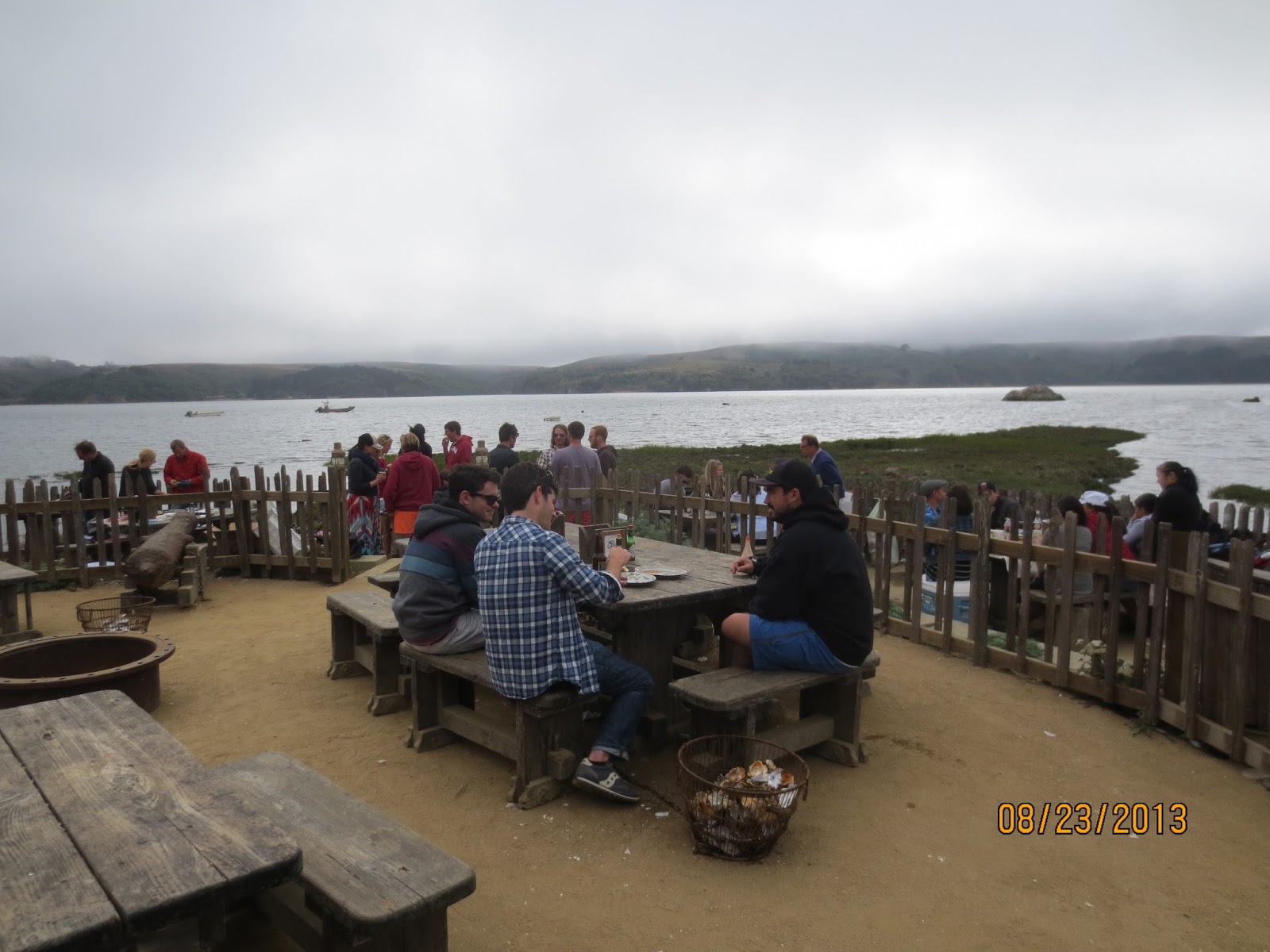
    2013: The Hog Island picnic area.
    To shore up oyster farming the Marin Agricultural Land Trust granted a long-term easement to the Hog Island Oyster Company. Hog Island will use the easement for its land-based activities such as oyster holding tanks:
    It’s the first easement involving aquaculture in the history of the land trust, which was established in 1980 and has set aside more than 54,000 acres of Marin County farmland from development...

    The MALT easement designates 8 acres for mariculture, or shellfish farming activities, and leaves some acres alone because they are in riparian areas.
    The Marin Agricultural Land Trust is a non-profit trust that
    has protected more than 54,000 acres of Marin farmland, forever. MALT’s model of using conservation easements to prevent development has been replicated to save family farms all over the country.
    MALT is opposed both to developers and environmentalists that seek to convert farmland to another purpose (or no purpose at all).

    Plaudits to MALT for its support of Hog Island Oyster Co.; if that business is not environmentally acceptable, then no business is.

    Friday, June 04, 2021

    I'll Go Back Inside


    After generations of protected status the ducks have lost all fear of humans. They sleep in large groups, not caring about our presence. In the photo above, the ducks wouldn't move when the two strollers approached on the path. Eventually the ladies walked around the dozing birds.

    The ducks waddle about, leaving their organic matter everywhere. Neighbors with decks fronting the lagoon have to hose them off weekly; the same goes for cars that are parked outside.

    Often we see plumps flying overhead...caution! I have learned from experience not to gaze upward with my mouth open. (Is that where the phrase "duck and cover" comes from?)

    Speaking of sharing space with creatures who have the right of way, the kids are back in class. Within a couple of blocks of a school, drivers really must slow down, breathe deeply and exercise patience.

    Making it worse, the new bike lanes have encouraged more children and adults to try bicycling. With some using the sidewalk, and with many riding the lanes both with and against traffic, drivers have to keep their head on a swivel.

    The coronavirus is nearly over. Nevertheless, I'll go back inside.

    Thursday, June 03, 2021

    Susie Q

    On a Wednesday morning that started with a sweater and ended with a T-shirt, it was a good time to pressure-wash the boat.

    The "Sue Sea Q" is a clever play on words by a boat-owner who may be a fan of a 1957 song, Susie Q, by Dale Hawkins or one of the numerous versions it inspired, such as those by the Stones, Creedence, and the Everly Brothers.

    In the 1930's Suzie Q was a dance step popularized by a song quite different from Dale Hawkins'. It lives on as a popular dance move in modern salsa.

    Finally Susie Q is the name of a 1996 G-rated ghost movie that ran on the Disney Channel. There doesn't seem to be a good reason for the title other than naming the lead character "Susan Quinn" and finding an excuse to refer to that old 30's or 50's number.

    According to Wikipedia the name originated when the "audience misheard 'Syracuse' as 'Susie-Q.'"

    Sometimes words and names, accidental or not, stick with you until you just have to write them on your boat.

    Wednesday, June 02, 2021

    San Gabriel Valley Warrior Woman

    A 17-year-old Southern California girl pushed a bear off a wall to protect her dogs. She reacted from instinct--no dog owner foresees this possibility.

    Someday the young lady will make a fierce mother who will protect her cubs (she said something similar to this in the interview)

    SF Homelessness: More of the Same with a Lot More Money

    (Examiner photo)
    Just two months ago we did a quick-and-dirty estimate of the direct cost of homelessness on San Francisco's budget:
    My calculator shows that $600,000,000 ➗ 8,000 = $75,000 per homeless person per year.
    That number needs to be nearly doubled. Headline: Mayor Breed wants to add more than $1 billion to fighting homelessness in San Francisco over next two years

    I won't bother quoting from the article. There's the usual blather about "investment" in this program or that, how San Francisco has messed up in the past but this time it really means to solve the problem, how the homeless will now be incentivized to behave, etc.

    Two years from now, after doing the same thing only with (a lot) more money, the homeless will still be with us.

    I'll see your $1 billion and raise you another.

    Tuesday, June 01, 2021

    The Gratitude is Overwhelming

    Accounting equity is well-defined.
    Woke "equity" is a muddled mess
    and will never be attained.
    In San Francisco a new guaranteed income program of $1,000 per month per person to help struggling artists has been beset by identity politics:[bold added]
    City leaders say YBCA [Yerba Buena Center for the Arts], was chosen because it was best equipped to take on the pilot program, which was funded with $877,000 from the city’s Arts Impact Endowment, money that comes from the hotel tax, along with $60,000 of YBCA’s budget...

    Curator, visual artist and organizer Rhiannon Evans MacFadyen...says an organization with expertise working with people of color should have been put in charge of the program, not YBCA.
    Below are representative criticisms from "marginalized" groups' spokespersons: [bold added]
    "I think it’s just the typical white savior cluelessness.”

    “There is a history of inequity in arts funding, where communities of color are not trusted with the funds to do the work we know how to do really well.”

    But because of historical and structural racism, she said, bigger but not necessarily better organizations are more trusted to administer programs dealing with racial equity.

    “It’s a case of might makes right,” she said. “A large, white-led organization that doesn’t understand and outsources equity is rewarded for their sheer lack of expertise in equity and then leverages it to benefit their organization.”
    The gratitude is overwhelming.

    One of the reasons I like private charity is that there's far less fighting over the expenditures. If donors to a private foundation want to educate kids of a certain ethnicity or support artists from another, they have the freedom to do so without controversy.

    But the art program in question is mostly funded from taxes, and as with any government program, there are complaints that
    1) It's not enough;
    2) The monies are benefiting the wrong people (the YBCA put in a "randomizer" element to avoid charges of favoritism, but they heard complaints about that, too);
    3) The wrong groups are in charge of the money;
    4) Only certain specialists can truly understand the plight of the intended recipients.
    For nearly 20 years I've participated in various food and shelter programs in the Bay Area. The beneficiaries know that the volunteers are giving their own money and time and have never expressed resentment about our efforts, modest though they often are.

    When government dispenses aid on a much grander scale, the result is often resentment and division, and yet there are calls for even more money to be spent in this manner. The voters keep electing people who say yes, so the voters must like the picture that has been painted.