NASDAQ is up 23% year-to-date, while AAPL has gained 8%. Still, it's 101 points higher than April.
As an Apple investor and fan of its products, I've been rushed (panicked?) into doing things too soon. Last April, worried about tariffs and a trade war with China, I mothballed my 6½-year-old XS Max and bought an iPhone 16 Pro Max. (Halfway through the product year I would have normally waited to order the new iPhone models in September.) Two months ago, pleased that the stock had recovered from the April tariff scare when it had hit a low of $169.21, I sold some AAPL at $241.50.
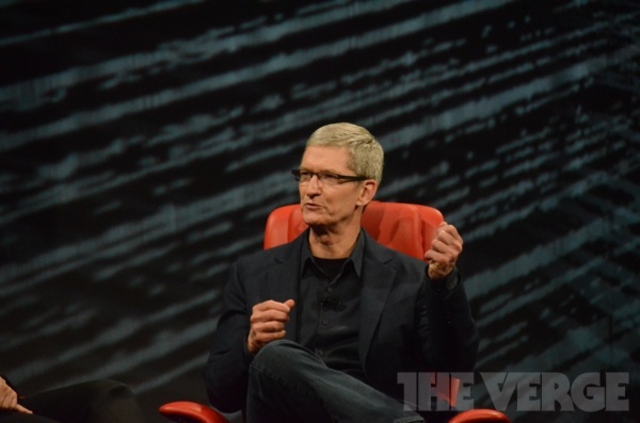
Tim Cook (Morris/Bloomberg/WSJ)
I should have had faith that the new iPhone 17 would be a hit, the problems with China would lessen, the stock would rise even more, and that CEO Tim Cook knew what he was doing.
It took two quarters for Tim Cook to save Apple from what was almost a disastrous year.
President Trump’s on-again, off-again tariffs risked massively increasing the company’s costs. A pending court ruling imperiled Apple’s lucrative Google contract. Plus, the company was seen as lagging on artificial intelligence.
Facing so much uncertainty, Apple tumbled to a market capitalization of $2.6 trillion in April and lost its title as the world’s most valuable company.
Six months later, Cook pushed Apple’s market value above $4 trillion for the first time. That’s more than 10 times what the company was worth when Cook took over as chief executive from Steve Jobs 14 years ago.
I am pleased with the iPhone 16 purchase and that I took some profits in the stock. However, if I had not let emotions cloud my judgment, it would have been even better.
Steve Jobs gets all the adulation, but Tim Cook deserves his own chapter in the history of American business. Steve Jobs rescued Apple from insolvency and transformed it into the world's most innovative consumer company; Tim Cook was handed the keys in 2011 and oversaw its growth into an international colossus that is worth ten times as much as it was when he took over. Perhaps we should focus less on what Apple products are in the pipeline than the man himself. The WSJ ran a profile over the weekend: [bold added]
There is one idea that encapsulates the approach to innovation that makes all of it possible—and it’s maybe the closest thing to a grand unified theory of Apple. It’s a philosophy of just four words that describe Apple’s past, present and definitely its future. Four words that help explain why this was the year the company plowed into spatial computing and artificial intelligence. During one of those epochal years when it feels like everything is about to change again, I heard them over and over, in conversation with Apple executives and Cook himself: Not first, but best.
...“We weren’t the first to do intelligence,” he says. “But we’ve done it in a way that we think is the best for the customer.”...He puts Apple Intelligence in the same pantheon of innovative breakthroughs as the iPod’s click wheel and the iPhone’s touch interface. “I think we’ll look back and it will be one of these air pockets that happened to get you on a different technology curve,” he says.
Tim Cook, 64, may not be as inventive as Steve Jobs, but he has arrived at the point where he trusts his ability to select that one "great" idea from the merely good ones that Apple considers every day. As a shareholder, I hope his tenure continues for a long, long time.
The Berkshire Hathaway shareholders' meeting in Omaha last Saturday.
Apple stock has been Berkshire Hathaway's largest and most successful investment in Warren Buffett's storied history. [bold added]
Apple is Warren Buffett’s greatest investment. It has also become one of his riskiest.
In 2016, Buffett made perhaps the most surprising bet of his career. That year, Berkshire Hathaway, the company he runs, began buying up shares of Apple—the exact kind of stock Buffett and his longtime partner, Charlie Munger, had long avoided...
Yet working with protégés, Buffett soon transformed into an Apple bull in a remarkable about-face. After an initial purchase of nearly 10 million shares worth about $1 billion in 2016, Berkshire added to its holdings later that year and then stepped up its buying in 2017 and 2018, spending about $36 billion on the stock over those years. Berkshire later trimmed some of those holdings.
By the end of the third quarter of 2018, Berkshire’s Apple stake represented about a quarter of its entire investment portfolio. In dollar terms, it was twice as large an investment as Buffett had previously made.
The move has paid off, in a very big way. Today, Berkshire’s 5.9% stake in Apple is worth about $157 billion, even though Apple has fallen lately. Berkshire is sitting on about $120 billion in paper gains, likely the most money ever made by an investor or a firm from a single stock. Nothing in Buffett’s long career comes close. Apple stock represented nearly 50% of Berkshire’s stock portfolio at year-end.
Warren Buffett has never followed hard-and-fast rules for portfolio diversification. Many portfolio managers would sell an individual stock if its value exceeded, say, 10% of their portfolio, but Warren Buffett rode a seven-year wave until Apple equalled nearly half of Berkshire's $370 billion stock holdings.
At that point no one would criticize Warren Buffett for trimming his position, which he did in the first quarter. He announced his action in last Saturday's Berkshire shareholders meeting, all the while continuing to praise Apple:
Warren Buffett is still a big fan of Apple.
The legendary investor praised the iPhone maker on Saturday from the stage of his annual meeting, even after revealing that Berkshire Hathaway had slashed its stake in the first quarter. He hinted that tax considerations may have played into the decision.
Buffett told an arena of Berkshire shareholders that Apple is “an even better business” than American Express and Coca-Cola, two other big positions in his company’s massive stock portfolio.
Berkshire sold about 13% of its mammoth stake in Apple in the first months of 2024, leaving it with $135.4 billion of the iPhone maker’s shares at the end of March, according to a regulatory filing released Saturday morning.
He really didn't have to justify the sale, but what was the reference to "tax considerations"? Was there some esoteric tax rule that applied to unbalanced insurance company investments?
No, Mr. Buffett was simply referring to the likelihood that the Federal government, facing unprecedented deficits and unwilling to cut spending, will soon raise the long-term capital gains rate from 21%. (He elaborates on YouTube.)
We don’t mind paying taxes at Berkshire , and we are paying a 21% federal rate on the gains we’re taking in Apple. That rate was 35% not that long ago and has been 52% in the past when I’ve been operating. The Federal government owns a part of the earnings of the business we make. They don’t own the assets but they own a percentage of the earnings. They can change that percentage in a year and the percentage is currently 21%, and I would say that with the present fiscal policies I think that something has to give and I think that higher taxes are quite likely, and if the government wants to take a greater share of your income or mine or Berkshire’s, they can do it.
They may decide that someday they don’t want the fiscal deficit to be this large because that has some important consequences and they may not want to decrease spending a lot and they may decide they’ll take a larger percentage of what we earn, and we’ll pay it. We always hope at Berkshire to pay substantial Federal income taxes. We think it’s appropriate that a country that has been as generous to our owners—Berkshire was lucky that it was here—and if we sent in a check like we did last year, we sent in over $5 billion to the US Federal government—and if 800 other companies had done the same thing no other person in the United States would’ve had to pay a dime of Federal taxes [applause], whether income taxes, no Social Security taxes, no estate taxes, all down the line. I hope things develop well enough with Berkshire—we say we’re in the 800 club [companies with a market capitalization of at least $800 billion]-- and maybe even move up a few notches. It doesn’t bother me in the least to write that check, and I would really hope with all that America has done for all of you, it shouldn’t bother you that we do it, and if I’m doing it at 21 percent this year and we’re doing it at a lot higher percentage later on, I don’t think you’ll actually mind the fact that we sold a little Apple this year.
Far be it for me to argue with Warren Buffett, but his statement that no one would pay any taxes if 800 companies paid $5 billion to the Treasury is technically true, but fantastical. Excluding banks, who need multi-$billions to conduct operations, there are fewer than 50 companies that have at least $10 billion on hand. (It's like saying that if everyone had an EV there would be no climate crisis.)
However, the Oracle of Omaha is very likely to be correct in his prediction that the government is unwilling to cut spending and will raise taxes in the near future. At 93, Warren Buffett talks about the way things are, not the way he wishes they could be.
Tim Apple wants to protect the walled garden (WSJ)
Think of all the words that are prefixed with "side"---sidewinder, sidesaddle, sideeye, sideswiped, sideways---many have a negative connotation. Added to the list is sideloading: [bold added]
Apple’s defense of its mobile operating system, or iOS, comes ahead of an expected debate Wednesday in the House Judiciary Committee on a package of bills aimed at reining in the nation’s largest tech companies.
Provisions in one of the bills, known as the American Innovation and Choice Online Act, could effectively give Apple’s customers broader control over which apps to download on their devices. It could prohibit Apple from continuing to block a practice known as sideloading, in which users install apps directly onto their iPhones without having to go through the company’s App Store. In Europe, the Digital Markets Act was introduced in December and is making its way through the legislative process. It too includes provisions to open the door to sideloading.
One of the reasons we are loyal Apple subscribers is because of the company's privacy protections. As is happening increasingly, we are loading apps from health-care providers onto the phones (with COVID testing and vaccinations we are almost forced to use them for travel and work). These apps contain personal information that could very easily be used for identity theft.
Anything that erodes these protections is anathema, and for Congress to force Apple or any company to do so for the sake of a game company's profits is crazy, stupid, reprehensible, outrageous, and...not surprising.
It's not the must-see event that it was when Steve was alive, but the company, which is six times as valuable as when he passed in 2011, isn't the same either.
I'm watching the livestream at 10 a.m. PDT though Tim Cook reportedly won't be talking about the iPhone.
My 2014 iPad Air has a cracked screen that kinda works, and I have a version 3 Apple Watch that doesn't have all the health bells and whistles. I'll be buying something Apple makes soon.
10:03 a.m. Tim Cook speaks from the Apple spaceship HQ. Camera angle shows vast expanse of the interior garden of the space ship.
10:05 Tim says they'll be covering only Apple Watch and iPad. Wonder if they'll be doing one more thing that Steve used to do?
10:08 Testimonies from Watch customers. I suppose they have to do marketing. Not everyone is an Apple technophile.
10:09 COO Jeff Williams introduces the Series 6 Watch. Blood Oxygen app measures blood oxygen in 15 seconds.
10:15 Touts Apple Silicon, display always on, continuous altimeter for hikers.
10:17 New Apple design faces. OK, but not world-beating.
10:19 New watch bands - solo loop with no clasps. It stretches! My Timex did that back in the 1970's.
10:20 Family Setup allows multiple watches to be paired with one iPhone. Many individualized programming options for each watch wearer; obviously valuable for young and old people who don't have iPhones.
10:23 Apple Watch SE is cheaper option ($279+) with most important features, except for blood oxygen measurement. Uses slower S5 chip. Apple Watch series 6 starts at $399.
10:28 New watches are available this Friday, September 18th.
10:39 Apple Fitness+ ($9.99 per month per family) has workout videos for many activities.
10:37 Apple One combines iCloud, Music, TV+, Arcade, News+, Fitness+. For $29.95 per month you get all services for the family, or you can get fewer apps at a lower price.
10:40 Tim's back to talk about the iPad.
10:42 Product Manager Ted Merendino on 8th generation iPad: begins with A12 chip. "2x faster than Windows laptop" Neural engine: 5 trillion operations per second. Keyboard options, Apple Pencil. iPad OS14 allows handwritten text into input boxes. iPad 8th Generation starts at $329.
10:48 Tim Cook introduces new iPad Air. Laura Legros, VP Engineering, starts with design and colors. 10.9" liquid retina display. Touch ID not on screen but on top button. Tim Millet on A14 Bionic chip: 5 nanometer technology--efficiency, speed. 40% performance improvement than previous iPad Air. 2x graphics improvement over comparable laptop.
10:56 Game, music, photo developers extol the new iPad Air.
10:57 Laura - USB-C performance improvement; 7 MP camera front, 12 MP camera back. Stereo audio speaker system.
11:00 iPad Air starts at $599, available "beginning next month" -- October [ ]?
11:02 Tim announces New OS for iPhone, iPad, Watch, and TV available tomorrow. That's it, no one more thing.
I'm guessing the announcements disappointed most people, but I'll be buying the iPad Air and the Watch. I'll also be a subscriber to Apple One. I probably won't be buying the new iPhone, whenever it is announced, because the 2018 iPhone XS Max is doing just fine.
Contra Isaac Newton, Apple defied the laws of gravity and floated above a Two Trillion Dollar ($2,000,000,000,000) valuation today.
When Steve Jobs died on October 5, 2011, everyone agreed that Apple's glory days were in the past. Tim Cook appeared to be a competent manager, but after a couple of years came the realization that there were no world-beating, industry-destroying products in the pipeline, nothing like the iPod, iPhone, and iPad.
There were no revolutionary devices---unless one counts the Apple Watch's niche in personal health---but it turns out they weren't necessary to power Apple in the coming decade. Selling services to over one billion Apple devices provided plenty of growth.
Apple's market capitalization when Tim Cook officially took over in October, 2011, was $344 billion. The company is valued six times as much today. As we've observed, naming Tim Cook as his successor was Steve Job's wisest decision.
Apple’s services and wearables business proved to be the difference maker for the company in the March period, underscoring the value of its strategic shift from selling more devices to selling more services and accessories across those devices. Those businesses, which include App Store sales and AirPods wireless earbuds, surged 18% to $19.63 billion. Meanwhile, sales of the company’s legacy products—the iPhone, iPad and Mac—fell nearly 7% to $38.68 billion.
The 2020 new-iPhone's delays could have been much worse, so today's announcement counted as good news:
Apple is pushing production of this year’s flagship iPhones back by a month, which could delay sales of those devices from September until October or later. It also is cutting production volume for the four new models by about 20% as the coronavirus weakens consumer demand.
Apple's China operations have recovered:
Mr. Cook said that Apple’s operations team and suppliers have returned to work and production reached traditional levels by the end of March.
The information coming from China's government has been untrustworthy, but we do trust Tim Apple.
China has been 2-3 months ahead of the U.S. in battling COVID-19 outbreaks. If the timeline is replicated, we should be underway to recovery in June.
Unlike other Silicon Valley tycoons opposed to Donald Trump--a redundant description now that the President's only major SV supporter moved to LA--Tim Cook has kept the lines of communications open:
(WSJ photo)
Mr. Cook is one of the few executives in a hyperpolarized political era who has managed to both support and challenge the president’s agenda in a way that has kept him in Mr. Trump’s good graces while avoiding any public backlash from either employees or customers.
The laudatory Journal article, IMHO, understates the business and political skill of Tim Cook. He can express disagreement with the President and his own virulently anti-Trump work force without being vilified by either. And he is able to maintain cordial relations with China though Apple is one of the most prominent symbols of America and a visible target for China's displeasure.
This month the Apple CEO was named the chairman of the advisory board for Tsinghua University's economics and management school, aka the "Harvard Business School" of China. The appointment was lambasted by some American hard-liners, but declining the position would not only have hurt Apple but also the U.S.-China trade negotiations. The result is that Tim Cook has the ear of everyone and is respected by everyone.
Most of us didn't see it clearly in 2011, but naming Tim Cook his successor was Steve Jobs' wisest decision.
AAPL has outperformed the FANG (Facebook, Amazon, Neflix, Google) stocks in 2019.
I went to the nearby Apple Store to buy a set of AirPods, Apple's wireless earbuds. At $159--the wireless-charger version is $199--they're an indulgence, especially since the new hearing aids perform a similar function.
I mentioned to the Apple salesperson that I was keenly interested in using the Apple Card, the new credit card that Tim Cook announced 11 days ago, to buy Apple products.
Unfortunately--and I hope this isn't a trend---we'll have to wait at least 3 months to get it. (We're used to the new stuff being available within a month after an Apple announcement.)
While the Apple Card will allow users to make purchases anywhere MasterCard is accepted, it’s also quite unlike many other cards available today.
Apple Card doesn’t have late fees, annual fees, international fees, or over-limit fees. And although users will be encouraged to pay their monthly statements, technically, if you want to skip a month, you can. Just be ready to pay extra interest.
I like the price--no annual fees--and better security--no credit card number or CVV imprinted on the surface.
I also like it as an Apple shareholder. [bold added]
[Wedbush analyst Dan] Ives went on to say that Apple’s clear opportunity is “tapping into its 1.4 billion active iOS devices and monetizing the financial vertical.”
BTW, I miss working full-time in the financial world; impressing people with phrases like "monetizing the financial vertical" is what made my day.
A Duke University doctor working with Microsoft researchers sifted through data on the physical movements of computer users that came from millions of internet searches. Their study found links between some behaviors—such as tremors when using a mouse, repeat queries and average scrolling velocity—and Parkinson’s disease. They used artificial intelligence, or a computer analysis, to identify which of the metrics separated a control group from those searching for Parkinson’s disease symptoms.
It used to be that family members were the first to notice that something is amiss. The machines that we touch every day--cars, phones, computers--are now more accurate, quicker, and smarter diagnosticians than loved ones. But what about individual privacy?
I HOPE that Apple lives up to its standards.
For those who are too cautious to buy a TV that can watch them, or a smart speaker that monitors what they're saying, the promise of real-time health monitoring may the lure that allows the Internet of Things(IoT) into personal space.
As for me, it's too late. My Apple Watch, which has been tracking me for 1½ years, knows more about me than my doctor.
In Tim Cook I trust (because I don't have any choice).
This is CNN: Executive editor for Politics Mark Preston, chief political analyst Gloria Borger, Political Director David Chalian, and Chief Political Correspondent Dana Bash.
AAPL: a spike at 10 a.m. Pacific/1 p.m. Eastern, then excitement lapsed.
Next month will mark the 4th anniversary of Steve Jobs' death. A sign that he's missed: Apple continues to dominate its markets, but the buzz at the product announcement show has faded.
(2014's Apple Watch was the first new hardware since Steve's death, and sales failed to catch fire.)
In fact expectations had been ratcheted so low that many tech journalists fell over themselves praising this year's announcements. Example - the Mercury News (bold added):
In a two-hour extravaganza, Apple on Wednesday unveiled a veritable bounty of new and at times mind-boggling products, including two new iPhones and a new larger iPad Pro, that should keep every fanboy busy for months.
As a long-time Apple shareholder, I do think that the changes to the iPhone, iPad, and Apple TV will deliver solid profits, but there's no shiny new bauble to excite the casual Apple fan.
It’s a $99 stylus for the tablet that allows users to draw pictures and interact with apps. When it was announced on stage the audience, who had applauded everything up to that point, laughed.
Pleasant surprise: AAPL appreciated 62% over 12 months
As a holder of Apple stock, we haven't posted about our investment since June. (For the past couple of years there was not much to write about.)
After Steve Jobs' death in 2011 the stock price first rose in anticipation because of the "amazing" future products rumoured in his biography, then dropped as the pipeline birthed mice.
Though our own investment profile had shifted to moderate-growth-with-income stocks such as Apple had become, we had grown disenchanted by Tim Cook's leadership and his long-running promises. Though we weren't going to liquidate the majority of our holding, expectations were low.
Much to analysts' surprise, the company has appeared to regain its mojo:
Apple sold 74.5 million iPhones in three months, more than most expected, and a profound amount of product to move. Even more amazing: According to data from Strategy Analytics, Apple regained lost market share, with the iPhone rising to nearly 20% of all smartphone shipments, the highest level since the end of 2012. Retaking lost market share is almost never accomplished in the fast-moving world of tech.
Apple shares did the reverse of Microsoft and jumped 6% the next day, ending the week at $117.16, after hitting a high of $120 on Friday.
The stock now sports a price-earnings ratio of about 15, in line with the S&P 500 market multiple. However, its dividend yield of 1.6% ($1.88 per share) is not appealing to income investors. On the plus side the iPhone is viewed as a luxury brand in fast-growing Asian markets, its Apple Pay and thumbprint identification technology provide a solution to both credit-card and mobile hacking, and the Apple Watch's prospects are not thought to be great, but could be.
But really, how fast can a company valued at $700 billion grow?
There is much to like about Tim Cook. As the WSJ essay points out, he has admirable personal characteristics. He's frugal, hard-working, smart, an excellent manager, and doesn't hesitate to dig deep:
Apple under Jobs was a roller coaster, but Cook's operations fief was orderly and disciplined. Cook knew every detail in every step of the operations processes. Weekly operations meetings could last five to six hours as he ground through every single item. [snip]
Cook's quarterly reviews were especially torturous because Cook would grind through the minutiae as he categorized what worked and what didn't, using yellow Post-its. His managers crossed their fingers in the hopes of emerging unscathed.
Though Apple is still the most valuable company in the world, it's no longer considered to be among the top innovators like Google, Facebook, Twitter, Tesla, Netflix, and Yelp (and those are just the Bay Area companies on the list). Since Steve Job's death on October 5, 2011, Apple's stock has underperformed the NASDAQ and been soundly outpaced by Google, Apple's largest rival.
After Steve Jobs: Apple +39%, NASDAQ +75%, Google +141%
Apple has remained a leader in its markets, and today's Macs, iPads, and iPhones are thinner, lighter, and faster than they were in Steve's time, but incremental improvements to existing products are not enough to keep Apple on top.
We arrived for the 9 AM Apple shareholders' meeting at 8:45, but already we were too late to get into the main auditorium. The young guides with Apple badges herded us over to Building 4, where two large videofeeds had been set up. Before entering, we had to check in all iPhones, iPads, Macs, and any other electronic equipment. (It took 20 minutes to retrieve our items after the meeting, so for future reference it's recommended that attendees leave their gear in the car.)
Now that Steve Jobs is gone, there's little point in attending Apple shareholders' meetings. Today there were no product, dividend, strategy, or personnel announcements. The business session went smoothly--the controversy over Proposal 2, regarding shareholder approval of new preferred stock issues--had dissipated because Apple withdrew the proposal. The rest of the Board's recommendations passed overwhelmingly (for more detail see Barron's live blog). CEO Tim Cook fielded questions for half an hour and several times repeated that Apple wants to make the best products, not necessarily the most or the biggest.
Other comments:
1) the breakfast spread was generous and well laid out; shareholders could bring food and drink into the meeting area, unlike in previous years.
2) at the beginning it was announced that the meeting would be over by 10 AM, so it was obvious that there weren't going to be any big revelations today. At least with Steve Jobs there wasn't the feeling that he couldn't wait for the meeting to end; he would field questions until the audience was reasonably satisfied.
"During a period of exciting discovery or progress there is no time to plan the perfect headquarters," he wrote. "The time for that comes later, when all the important work has been done. Perfection, we know, is finality; and finality is death."
Apple CEO Tim Cook speaks to Brian Williams
About television: "It's a market that we see that has been left behind.....It's an area of intense interest. I can't say more than that."
About Apple's mission: "Our whole role in life is to give you something you didn't know you wanted. And then once you get it, you can't imagine your life without it."
Okay, so the company isn't the same without the guiding hand of its founder. Yet, who other than Tim Cook should be at the helm?
Bill Gates, whose once-dominant enterprise has been struggling just to hold onto second place, Google's Page and/or Brin who are brilliant but maybe a tad unfocused, Mark Zuckerberg, whose company has yet to fulfill the extraordinary promise of its IPO multiple, or John Chambers or Larry Ellison, both of whom are experts at marketing to businesses, not so much to consumers?
Billionaire CEOs or former CEOs all, their companies' shares have not appreciated as much as Apple's since Steve Jobs died fourteen months ago.
Apple's product announcements attract widespread news coverage, and the iPhone 5 launch on September 12th was its biggest ever.
It has become impossible recently for Apple to keep key details under wraps. Because every move by the company, its largest suppliers, and partners is being scrutinized, tech observers have been able to make educated guesses about features and components of the iPhone 5 long before the official announcement. In fact many were let down, in part because their clever detective work removed the element of surprise.
But I'm not disappointed. The i5 is bigger, faster, and lighter than the 4S, without apparent diminution of battery life. The i5 is not revolutionary in the sense that a car that cruises easily at 200 MPH and gets 30 MPG is only an "evolutionary" improvement over a 100 MPH / 30 MPG vehicle. (IMHO, the "R" designation should be used sparingly anyway---for the first iPhone, iPad, and iPod.) So I'm going to get an iPhone 5.
Apparently, investors weren't disappointed either. Apple's share price declined for days leading up to September 12th--even through the first hour of the announcement--but then picked up when it dawned on everyone that the iPhone 5 would begin shipping on September 21st. The quarter will be better than analysts had previously forecasted because of the earlier-than-expected shipment of millions of new iPhones. Apple hasn't entirely lost its capacity to surprise.
The quacking gets my attention in the morning. The dover eye me warily.
I, er, duck behind the car so as not to scare them off. I wish the iPhone 4 had higher resolution for this snapshot. The two-year contract has already expired; hurry up with the iPhone 5, Tim, lest you lose a customer to Android (yeah, right).
The ducks don't care about pixels. They're waiting for me to toss them a piece of my breakfast muffin, but the City says not to feed them.
The ducks lose interest. They turn their tails, quack, then waddle away. Yes, go to the neighbors and be-fowl their yard. Wildlife is beautiful, but only at a distance.
He dribbled out a few nuggets about Apple's manufacturing and intellectual-property philosophy but didn't give the audience what it most wanted to hear: information about an iPhone 5 or an Apple television. He even declined to give specific answers about lesser (for Apple) endeavors, such as improvements to Siri or the Facebook interface.
Since Steve Jobs' death on October 5th, Apple has: introduced a new iPad to great acclaim, announced its first dividend in 17 years, and beat the analysts' estimates by more than 20% for each of the last two quarters, the last being all the more remarkable during a period in which other tech giants have faltered.
Apple's stock has risen by over 50% since October 5th. In less than eight months the company has increased its value by $180 billion (to $535 billion)---the increase alone is worth about three entire Facebooks at today's close. With that kind of performance Tim Cook can say as much or as little as he wants to.
AAPL has outstripped the indices since since Steve Jobs' passing.
FASB and the International Accounting Standards Board (IASB) expect to issue final, joint standards in their major convergence projects by mid-2013, according to a report to the Financial Stability Board (FSB) Plenary on Accounting Convergence posted Monday on the IASB website.....delays are unfortunate but necessary to ensure that the changes bring about improvementto financial reporting.
Analyst: How do you think about the markets for tablets and PCs going forward? Why don't you believe the ultrabook and the tablet market won't converge? Isn't realistic [sic] we'll have a device under two pounds with great battery life that can fold up?
[Apple CEO Tim] Cook: Anything can be forced to converged, but the problem is that products are about tradeoffs. You begin to make tradeoffs that you make at end of the day that don't please anyone. You can converge a refrigerator and a toaster but that probably won't be be [sic] pleasing to the end user.
If you're the best, converging with your competitors helps neither you nor your customers. On the other hand, if you're not the best, then convergence may make you better.